


6G news and analysis for the week ending Friday, 18th September, 2026.
Hello and welcome to another edition of the 6G Futures newsletter. It’s been a busy week... First, a note on 3GPP. The TSG #113 plenaries convened in Madrid this week for RAN, SA and CT, with SA only wrapping up today. I will publish detailed write-ups of each meeting in the coming days, once I have time to analyse the many, many reports. Until then this edition sticks to the news.
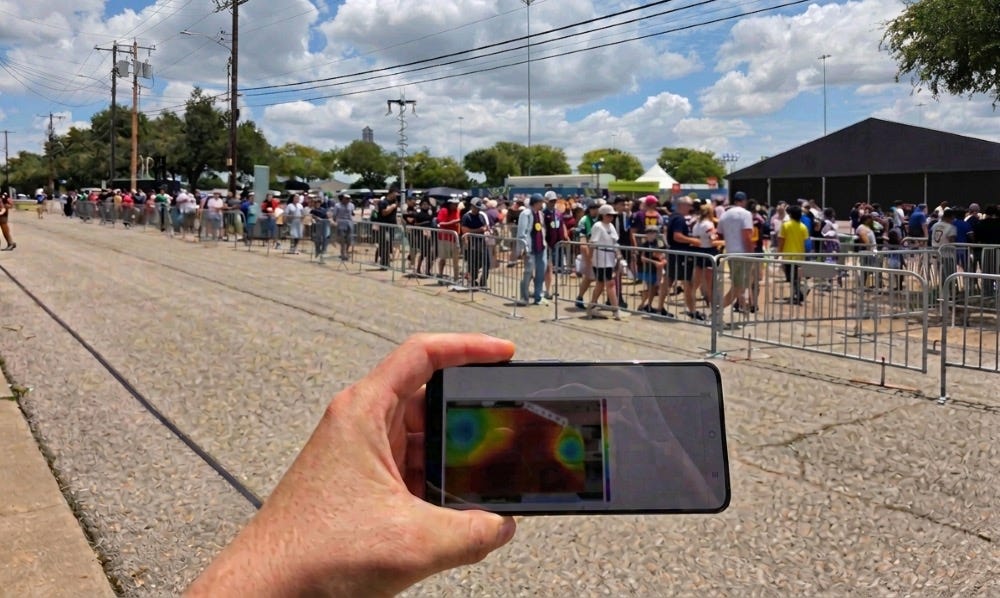
And the news this week really belongs to Verizon. A year after it launched the 6G Innovation Forum with five radio and device companies, it has added nine more, including AWS, Cisco, Intel, NVIDIA and three test vendors. Alongside the roster it showed two integrated sensing trials, the better documented one being a crowd-density heatmap built with Samsung on a virtualised 5G network at “a major international soccer fan event” in Dallas (i.e. the World Cup). It is a good demonstration and is honest about its limits.
Over in Washington, the Office of Management and Budget has amended a 2016 rule that forced federal band studies and FCC auction preparation to run one after the other. They can now run in parallel and the NTIA is talking about five auctions by the end of 2028. In the same week, the CTIA and Valo Analytica published opposing cases for the 4.4 GHz band: one for clearing and licensing, one for sharing. Verizon, meanwhile, filed for an experimental licence to test sensing in that very band around its Los Angeles lab. The clear-or-share argument is 3.5 GHz all over again, and I suspect it will be settled by WRC-27 politics rather than engineering.
In Korea, SK Telecom, KT and LG Uplus used a conference to ask for net neutrality, rate regulation and MVNO policy to be rewritten before 6G. The figure that will probably get the headline is a 7.1 per cent operating margin against Verizon’s five-year average of 22 per cent. The telcos want quality-guaranteed services and pricing freedom, whilst the ministry wants social consensus.
In other news, Nokia has named eight more operators trialling its AI-RAN platform, five of them in the Gulf. Speaking of which, the UAE’s du has claimed a world first for six-carrier aggregation on 5G-Advanced, which is a real engineering result with a 6G label attached to add a bit of spice. Finally, we have our usual selection of four research papers and the one I would point you to first quantifies the beam management cost of the FR3 “golden band”. It is a useful antidote to this week’s spectrum advocacy.
Verizon widens its 6G forum and takes ISAC into the field
Verizon has added nine members to its 6G Innovation Forum (6GIF), the consortium it launched a year ago with Ericsson, Nokia, Samsung, Qualcomm and Meta. The new arrivals are Amazon Web Services, Cisco, Intel, Keysight Technologies, MediaTek, NVIDIA, Palo Alto Networks, Rohde & Schwarz and VIAVI Solutions. Verizon says they bring cloud services, silicon and accelerated computing, automated test emulation, network security and device graphics simulation to the group. Alongside the expansion, the operator highlighted two integrated sensing and communication (ISAC) field trials with founding members: crowd-density detection with Samsung and drone and vehicle tracking with Qualcomm. Yago Tenorio, Chief Technology Officer at Verizon, said:
“With 6G, our collaborative objective is fundamentally bottom-up and use-case driven. We are designing the next generation of connectivity with a specific target already in mind: enabling and scaling AI workloads and the massive AI ecosystem, particularly the emerging class of AI-enabled wearables like untethered smart glasses, as well as pioneering ISAC technologies.”
The Samsung trial is the better documented of the two. At a World Cup event in Dallas, a CBRS radio unit using 40 MHz of 3.5 GHz spectrum, mounted on a Verizon cell-on-wheels, acted as a sensing receiver. It captured channel variations in transmissions from a commercial 5G handset. Samsung’s Network in a Server platform, running its commercial vRAN and vCore alongside an ISAC application, turned that data into a near-real-time crowd density heatmap. Verizon also showed a prototype AI sports companion running on Meta glasses. A small language model on an NVIDIA DGX Spark at the edge answered spoken questions about live play. The forum now points at the 2028 Los Angeles Olympics as its “interim proving ground”, with Verizon’s 6G Lab already in the city. My colleague Ray Le Maistre has written up the announcement for TelecomTV, and I should again declare that TelecomTV is my day job!
What’s new: The founding five were radio, chipset and device companies. The nine additions fill in the cloud, security and test layers, and they bring NVIDIA and Intel into the same group as Samsung and Ericsson. The ISAC trials add a first Verizon dataset to the sensing evidence base, though the Samsung demonstration ran on a 5G device with 40 MHz of CBRS spectrum. That makes it a 5G-Advanced proof of concept using existing infrastructure, which is exactly what Samsung claims for its vRAN, rather than a 6G radio result.
Why this matters: Verizon has been the most consistent operator voice for a use-case-first approach to 6G. This week it put a roster and a deadline behind that position. Tenorio told the TelecomTV report we covered a fortnight ago that around 400 MHz of mid-band per operator is the non-negotiable floor for workable sensing. Dallas was done with 40 MHz. That gap between the demonstration and the stated requirement shows how far ISAC has to develop. The 2028 Olympics target is a showcase date set by political and commercial calendars, not by 3GPP, whose Release 21 specifications are not expected before late 2029. Sensing on a virtualised network at a sports venue is a credible use case for crowd safety but the Europol report we covered last week is a reminder that regulators will read “crowd management” quite differently from operators. The Samsung work also follows the ISAC research agreement it signed with LG Uplus in May, so the vendor is now running sensing trials with operators in two markets.
What this means for the vendor race: 6GIF is becoming a map of Verizon’s preferred supply chain and is now large enough to matter. Both Samsung and Ericsson supply Verizon’s RAN and both appear in its 6G test plans (see the 4 GHz licence application below). NVIDIA joining puts its Aerial platform inside a Samsung-vRAN operator, while Intel joins to defend the general-purpose silicon that Verizon’s vRAN has run on to date.
View source material to read more - Verizon
View source material to read more - Samsung
View source material to read more - TelecomTV
White House clears parallel auction prep for five sales by 2028
The US Office of Management and Budget has amended a 2016 memorandum that governed how federal spectrum is repurposed and the NTIA says the change clears the way for as many as five auctions by the end of 2028. Under the previous guidance, any early auction preparation by the FCC automatically halted the Spectrum Relocation Fund payments that federal agencies rely on to study and plan their move. The NTIA called this the “Spectrum Relocation Fund gap”, and it meant band studies and auction preparation had to run in sequence. The new memorandum, M-26-19, allows them to run in parallel. The NTIA is currently running four simultaneous repurposing studies across the 1.6 GHz, 2.7 GHz, 4.4 GHz and 7 GHz federal bands. Arielle Roth, NTIA Administrator, said:
“Now the Trump Administration is taking a decisive step to secure 6G leadership by significantly closing that gap and allowing band studies and FCC auction preparations to proceed simultaneously.”
What’s new: We have followed the pipeline from the December 2025 “Winning the 6G Race” memorandum through the 2.7 GHz relocation plans in April. By August, all four federal bands had entered study together. Until now, nobody in Washington had put a number on how many auctions that pipeline would produce or when. Five by the end of 2028 is a target, not a schedule, and no band has yet been assigned a date.
Why this matters: The gap being closed was a real one and was a consequence of a 2016 budgeting rule rather than an engineering constraint. The mandate behind it is the congressional requirement to identify 800 MHz for commercial mobile use, with 500 MHz of it between 1.3 and 10.5 GHz. That said, the difficult work is unchanged. Federal incumbents still have to be relocated or protected, and the multi-year measurements we covered in March showed usable 2.7 GHz bandwidth varying sharply from one year to the next. The 6G framing also remains political. These are general-purpose mobile bands, and only the 7 GHz study overlaps with the upper mid-band that the rest of the world associates with 6G.
What this means for operators: Five auctions in roughly two years, on top of the Upper C-Band sale the FCC plans for 2027, is a financial planning problem as much as an opportunity. US carriers would be bidding for 2.7 GHz, 4.4 GHz and 7 GHz spectrum while 6G radio specifications are being frozen, and before any 6G device exists. The upside is timing. Licences won in 2028 would be in hand for a 2030 first-wave launch, the date Verizon and the Next G Alliance have both been using. The operators that argued last year that they could not afford another 5G-scale spectrum bill will now find out whether they meant it.
View source material to read more - Broadband Communities
View source material to read more - NTIA
Clear it or share it? The 4 GHz argument begins
Two reports published within a day of each other set out opposing models for the US 4.4 GHz federal band (4400 to 4940 MHz), which the NTIA placed under study in August. The CTIA, the US wireless industry association, argues for full-power licensed use and wants the band study launched within 60 days. Its report says the band can deliver 400 MHz of contiguous mid-band spectrum. It cites an ecosystem of some 1,500 compatible devices and support in more than 50 countries. It also presents 4 GHz as the US answer to China’s push for licensed 6 GHz at WRC-27. The US has assigned the whole of 6 GHz to unlicensed use. Ajit Pai, President and CEO of CTIA, said:
“Beginning work this fall is our best chance at freeing up the spectrum needed to meet surging AI demand, fuel innovation, expand access to affordable broadband, and reassert America’s global wireless leadership.”
Valo Analytica, a spectrum consultancy, takes the other view. Its report argues that clearing federal incumbents, including aeronautical telemetry and Navy ship-to-shore links, could take a decade and cost billions. It proposes a hybrid framework combining Automated Frequency Coordination and Dynamic Protection Areas, the tools already used for 6 GHz and CBRS. Commercial use could then begin as soon as the coordination system is live. Its target market is dense private networks for manufacturing, logistics and robotics rather than macro mobile.
Meanwhile, Verizon has applied to the FCC for a one-year experimental licence to use 4.8 to 4.9 GHz around its 6G Lab in Los Angeles. The filing, spotted by consulting engineer Steve Crowley and reported by Light Reading, describes a private outdoor network of Ericsson radios within a five-kilometre radius, with Samsung equipment also listed. The stated purpose is to demonstrate “5G advanced technology use cases such as object sensing as a precursor to 6G integrated sensing and communication”. Samsung Research America has filed separately for 4720 to 4820 MHz in Plano, Texas.
What’s new: The Verizon application is the first request to test in 4.4 GHz explicitly for 6G-related work, according to Crowley. It is also the first time the carrier has sought a licence in any of the four federal bands under study. The two reports are the first public statement of the clear-versus-share argument for this band. Note that both are advocacy documents.
Why this matters: This argument will be familiar to anyone who followed 3.5 GHz. The CTIA’s case rests on a demand projection it attributes to analysts and to Accenture, which puts $1.4 trillion of economic growth at risk without 820 MHz of additional mid-band. Readers of the Plum study we covered last month will know that demand forecasts of this kind are contested. The sharing case rests on the claim that relocating military telemetry is slower and costlier than a coordination system, which is plausible. But the CBRS experience shows shared bands attract less investment and lower power. The Next G Alliance paper we covered last week named 4.4 GHz and the C-band extension as the bands most compatible with existing infrastructure. That is why the carriers want it cleared. Verizon’s filing shows what they think the band is for: sensing, at power levels a shared regime might not permit. The FR3 beam management paper in this week’s research section is a useful counterpoint, since it quantifies why the 7 GHz alternative is harder to deploy than its bandwidth suggests.
What this means for policymakers: A cleared, full-power band is the only outcome that produces auction revenue and satisfies the congressional mandate on the timeline the White House set this week. A shared band produces private-network activity sooner and protects federal missions without relocation, but it does not count in the same way. The WRC-27 dimension raises the stakes. If the US wants 4 GHz as its international counter to Chinese 6 GHz, it needs the band in a form other administrations can harmonise with, and that means licensed.
View source material to read more - CTIA
View source material to read more - Valo Analytica
View source material to read more - Light Reading
Korea’s carriers want net neutrality rewritten before 6G
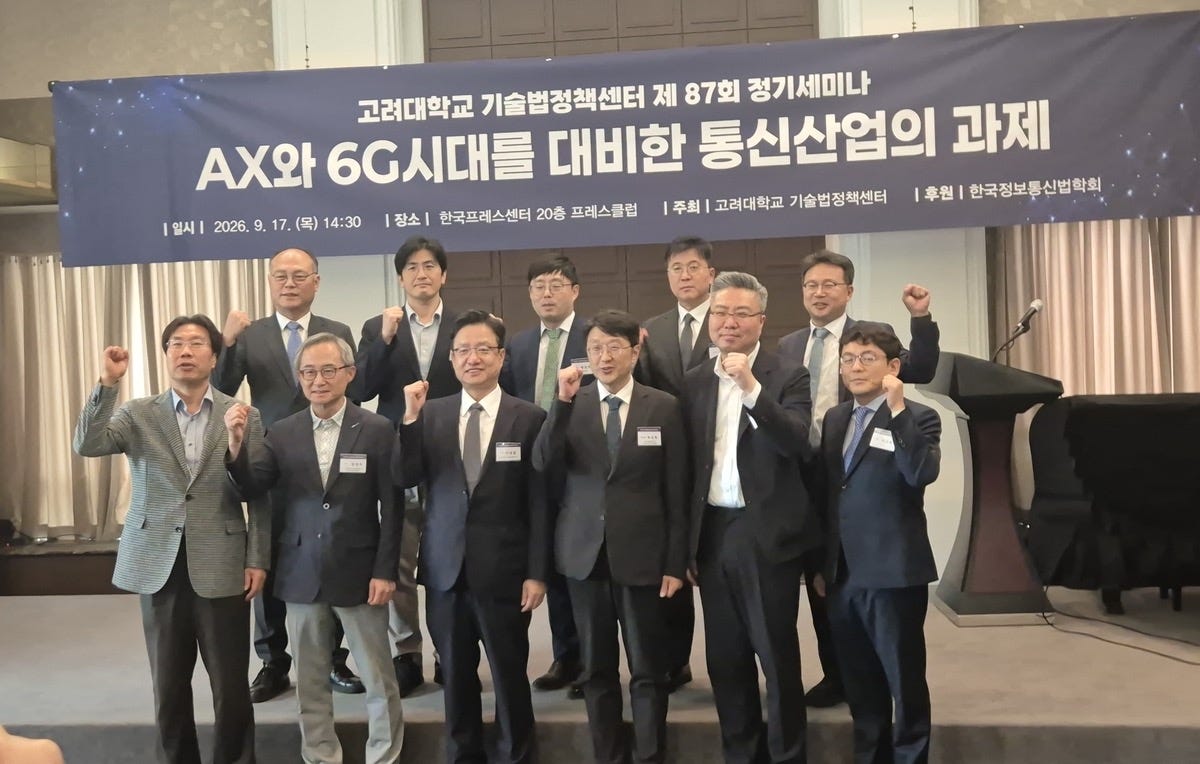
Executives from SK Telecom, KT and LG Uplus used a seminar at the Korea Press Center this week to call for an overhaul of the country’s net neutrality principle, rate regulation and MVNO policy ahead of what they called the AX and 6G era. Their shared argument is decoupling: traffic keeps rising and carrier revenue does not. A rule that treats all traffic equally, they say, prevents them selling quality-guaranteed services to autonomous driving, robotics and industrial AI customers. Lee Gyu-hwa, Managing Director at LG Uplus, said that combined revenue for the three carriers grew from around 13 trillion won in 2001 to around 60 trillion won last year. Operating profit only rose from 3.3 trillion to around 4 trillion won. He added:
“Verizon’s operating margin over the past five years is 22%, and Japan’s KDDI is around 18%, but South Korea remains at 7.1%, leaving insufficient investment capacity.”
Shin Sang-min, Vice President at SK Telecom, asked for “autonomy in developing specialized services such as network slicing and QoS guarantees” alongside pricing flexibility. Seo Eun-il of KT proposed a “launch-first, verify-later” regime for differentiated services, spectrum fees redesigned as investment incentives, and bringing the government’s 2035 LEO satellite target forward to 2031.
What’s new: The three telcos speaking with one voice on net neutrality, in public, with a 6G justification attached is a new development and is a shift from the investment hesitancy we reported in May, when domestic experts were asking whether the telcos would build 5G Standalone at all. The explicit references to the EU’s Digital Networks Act, with its unlimited-duration spectrum rights and legal basis for specialised services, show the Korean industry looking to Brussels for a template. The ministry’s spectrum fee review launched in August now looks like the first instalment of a wider regulatory renegotiation.
Why this matters: Korea launched 5G first and handed back its 28 GHz licences on profitability grounds. It has since been candid that its operators will not fund a generation without a revenue model. The decoupling problem is real and it is global, as the panel noted, but the proposed remedies deserve some scrutiny. Net neutrality exceptions for slicing and QoS have been legally possible in Europe since 2015 and have produced very little revenue. The KAIST suggestion that AI agents become paying network customers is the more interesting idea, and it lines up with the agentic traffic assumptions running through 3GPP’s 6G requirements work. However, it is also entirely unproven.
What this means for investors: Korean telco equity has been priced as a regulated utility with a shrinking ARPU. This week’s message is that the telcos want that bargain renegotiated before they commit to 6G capex. If the ministry moves towards launch-first specialised services and investment-linked spectrum fees, it would be one of the first regimes designed to raise operator returns ahead of a generation change. The government’s caution suggests a multi-year process.
View source material to read more - BigGo Finance
View source material to read more - Seoul Economic Daily
Nokia names eight more operators for AI-RAN trials
Nokia has announced that A1 Group, Chunghwa Telecom, du, e&, Mobily, stc, TPG Telecom and Zain Saudi are running AI-RAN proofs of concept or live trials on its anyRAN software with the NVIDIA Aerial RAN Computer. Trials with NTT DOCOMO and the previously announced evaluations with T-Mobile US, SoftBank and Indosat Ooredoo Hutchison continue. Nokia repeats that its platform has delivered more than 20 per cent improvement in spectral efficiency and that further software-driven gains are on the roadmap for 2027 and 2028. Emma Falck, President of Mobile Infrastructure at Nokia, said the engagement “shows that AI-RAN is moving quickly from vision to commercial reality and becoming a foundational technology for the AI-native 6G era.”
What’s new: The operator names are the new element here. The 20 per cent figure, the 2027 and 2028 roadmap and the software-upgrade path to 6G were all in the commercial platform launch we covered on 17 July. No trial results, deployment scale or timelines are disclosed for any of the eight. The geographic pattern is the one useful signal: five of the eight are Gulf operators. du and e& appear here a month after du’s own 6G blueprint argued for starting the autonomy journey during 5G-Advanced.
Why this matters: The purpose of this press release is to show that the NVIDIA partnership of October 2025 has customers beyond the launch trio, and it does that. What it does not do is tell us whether any operator has moved from evaluation to a purchase decision. Pilots were promised for the end of this year and commercial availability for 2027, and those dates are unchanged. The Gulf concentration is consistent with the region’s willingness to fund early technology. Yet it is also where operators have the least spectrum pressure, which is the problem AI-RAN claims to solve.
What this means for the vendor race: Nokia is building a customer list for GPU-based RAN faster than its rivals. Ericsson has positioned AI-RAN as an architecture rather than an accelerator, and Samsung’s vRAN just carried Verizon’s ISAC trial without any dedicated RAN accelerator. The contest is over whether operators buy accelerated compute as part of the radio refresh or keep RAN on general-purpose silicon and add AI elsewhere.
View source material to read more
du aggregates six carriers and calls it 6G readiness
UAE operator du says it has deployed six-component-carrier aggregation on its commercial 5G-Advanced Standalone network, combining 420 MHz of bandwidth across FDD and TDD spectrum in the 3.6 GHz, 2.6 GHz, 2.1 GHz, 1.8 GHz and 600 MHz bands. Nokia supplied its Habrok massive MIMO radios, and the capability was validated on the latest generation of devices under field conditions. du describes this as a world first and links it to the UAE’s national 6G roadmap under the TDRA. Saleem AlBlooshi, Chief Technology Officer at du, said the milestone “represents an important step in advancing our 5G+ network while building the foundations for the journey towards 6G.”
What’s new: Six carriers spanning five bands from 600 MHz to 3.6 GHz on a live SA network is a demanding scheduling and device exercise. 420 MHz is a large aggregate for sub-4 GHz holdings. The “world’s first” claim needs qualification. T-Mobile US told Mobile World Live last November that it had already deployed six-carrier aggregation on its SA network, as we reported at the time. du’s first is presumably specific to the band mix or to 5G-Advanced features. The release does not say which.
Why this matters: Carrier aggregation across fragmented holdings is the capability operators will need when 6G arrives in existing bands under Multi-RAT Spectrum Sharing (MRSS). But this is a 5G-Advanced deployment, the customer-facing deliverable is a 5G+ icon on new handsets, and nothing here touches 6G radio design. du has been the most active Gulf operator in upper 6 GHz field work and in publishing 6G vision material. This announcement belongs in the same pattern of claiming leadership at each step of 5G evolution.
What this means for operators: The practical lesson is about spectrum accounting. 420 MHz aggregated across six sub-4 GHz carriers is more contiguous-equivalent bandwidth than most European operators can assemble in any band and it is achieved without new spectrum. That reinforces the argument, made by Nokia for AI-RAN and by the NGMN for MRSS, that the early 6G capacity story is about extracting more from holdings already in hand. It also sets a bar for device capability that 6G migration will have to meet before it can add anything.
View source material to read more
Selected research papers published this week
Cell-free ISAC without a central brain
Mehdi Zafari, Björn Ottersten and A. Lee Swindlehurst tackle a scaling problem in multi-static sensing. Most ISAC resource allocation schemes assume a central controller with full knowledge of every access point’s channel, which does not survive contact with a distributed cell-free network. Their CORDIS framework offers two options. CORDIS-Split pairs fixed local beamformers with centralised power allocation for minimal overhead, while CORDIS-ADMM jointly optimises beamforming and power through consensus ADMM.
Why this matters: Every sensing trial we cover, including Verizon’s this week, uses a single sensing receiver. Networked sensing across many access points is where the 6G ISAC promise actually lives, and it will be built on distributed architectures with imperfect channel knowledge. A method whose signalling cost does not grow with the network is a prerequisite for that, and the robustness to poor CSI is the result operators should note.
View source material to read more
Intent-based networking opens an attack surface
Nilesh Chakraborty, Petar Djukic and Burak Kantarci examine what happens when the natural-language layer that AI-native networks use to translate goals into configuration becomes the way in. They define a threat model for adversarial intent injection, where malicious policies are hidden inside benign-looking intent flows. They test four injection strategies, including a stealth mode that spaces attacks to avoid detection. Their dual-path detector combines a CNN on TF-IDF features for supervised detection with an autoencoder trained only on benign intents for one-class anomaly detection.
Why this matters: Intent-based management is the assumed control model for 6G, and it appears in most of the AI-native architecture proposals we have covered. This paper treats the intent interface the way security researchers treat any input parser, and the finding that stealthy, low-frequency injection is markedly harder to catch is the practical warning.
View source material to read more
The golden band still needs beam management
Clémence Altmeyerhenzien, Ljiljana Simić and Marina Petrova ask how much beam management effort FR3 (7.125 to 24.25 GHz) really requires. The band is promoted as having friendlier propagation than mmWave with far more bandwidth than sub-6 GHz. But reusing FR1 sites at FR3 means base stations need antenna arrays and beam tracking, which proved difficult at FR2. Using an urban network model, the authors characterise beam alignment sensitivity, the number of usable directional link opportunities, handover and beam switch rates, and beam steering distance across FR3 sub-bands.
Why this matters: This is the most useful corrective to “golden band” language we have seen in some time. The industry case for 7 GHz rests on coverage parity from existing sites, which the Optus, KDDI and Telefónica trials support. What those trials do not show is the control-plane cost of keeping a mobile user on a narrow beam. It also strengthens the CTIA’s argument, covered above, that sub-5 GHz spectrum deploys more easily, whatever one thinks of the demand figures attached to it.
View source material to read more
An O-RAN xApp that spots jamming and rides it out
Marcin Hoffmann, Lukasz Kulacz, Osama Baldo, Marcin Pakula and Balaji Raghothaman present a jamming detection xApp for the O-RAN architecture. It monitors the moving-average block error rate over the E2 interface. On detecting an attack, it overrides normal link adaptation by capping the modulation and coding scheme to stabilise latency for URLLC traffic. The team then ported the approach from a RIC xApp to OCUDU, an open-source CU/DU implementation, to sidestep O-RAN platform adoption hurdles.
Why this matters: Jamming is a mundane threat compared with the AI-native attack surfaces in the paper above, but it is the one that actually happens. Mission-critical 6G use cases cannot tolerate the latency spikes it causes. The interesting decision is the migration from xApp to an open CU/DU. The authors say, in effect, that the RIC route is harder to deploy than the community would like, which is a candid data point on O-RAN adoption.
The Dallas trial leaves me wanting two plots side by side: crowd-density estimation error against ground truth, and user throughput/latency with sensing enabled versus disabled under comparable load. Then repeat as traffic increases. That would make the operational trade-off much easier to judge. Did Samsung or Verizon publish those measurements anywhere? I couldn’t find them in the Samsung announcement.