


6G news and analysis for the week ending Friday 27th February, 2026.

With Mobile World Congress 2026 opening in Barcelona next week, this edition documents some of the more important pre-show announcements that collectively reveal where the industry’s 6G investments are concentrating. Depending on what we see from MWC on Monday, it is likely that I will publish a mid-week update.
The standout development this week is SK Telecom’s third annual 6G white paper, ATHENA, which goes significantly further than the operator’s previous papers by presenting a domain-by-domain network architecture spanning AI-native RAN, an evolved core, converged transport and a new network data monetisation platform called DIVE. It is one of the most implementation-focused operator 6G papers published to date, with concrete R&D results including GPU-based L1 processing and commercial AI parameter optimisation.
Nokia made a significant move with its RAN Digital Twin, built on the NVIDIA Aerial Omniverse Digital Twin platform, which uses physics-based ray tracing to simulate radio propagation with unprecedented precision. As the industry hurtles toward AI-native 6G, the ability to design, train and optimise networks in simulation before a single base station is deployed becomes increasingly important.
The perennial monetisation question was addressed head-on by TM Forum and a coalition including Jio Platforms, Singtel, SoftBank and T-Mobile USA, with a white paper arguing that 6G must be designed for commercialisation from the outset. You would think that would be obvious, but the authors argue that the industry cannot afford to repeat the 5G-era pattern of building advanced networks without clear revenue models.
Also this week, InterDigital and Türk Telekom demonstrated collaborative cellular and Wi-Fi sensing, and research into semantic communication and goal-oriented networking continues to accelerate ahead of MWC.
Key announcements this week:
SKT publishes ATHENA 6G architecture framework
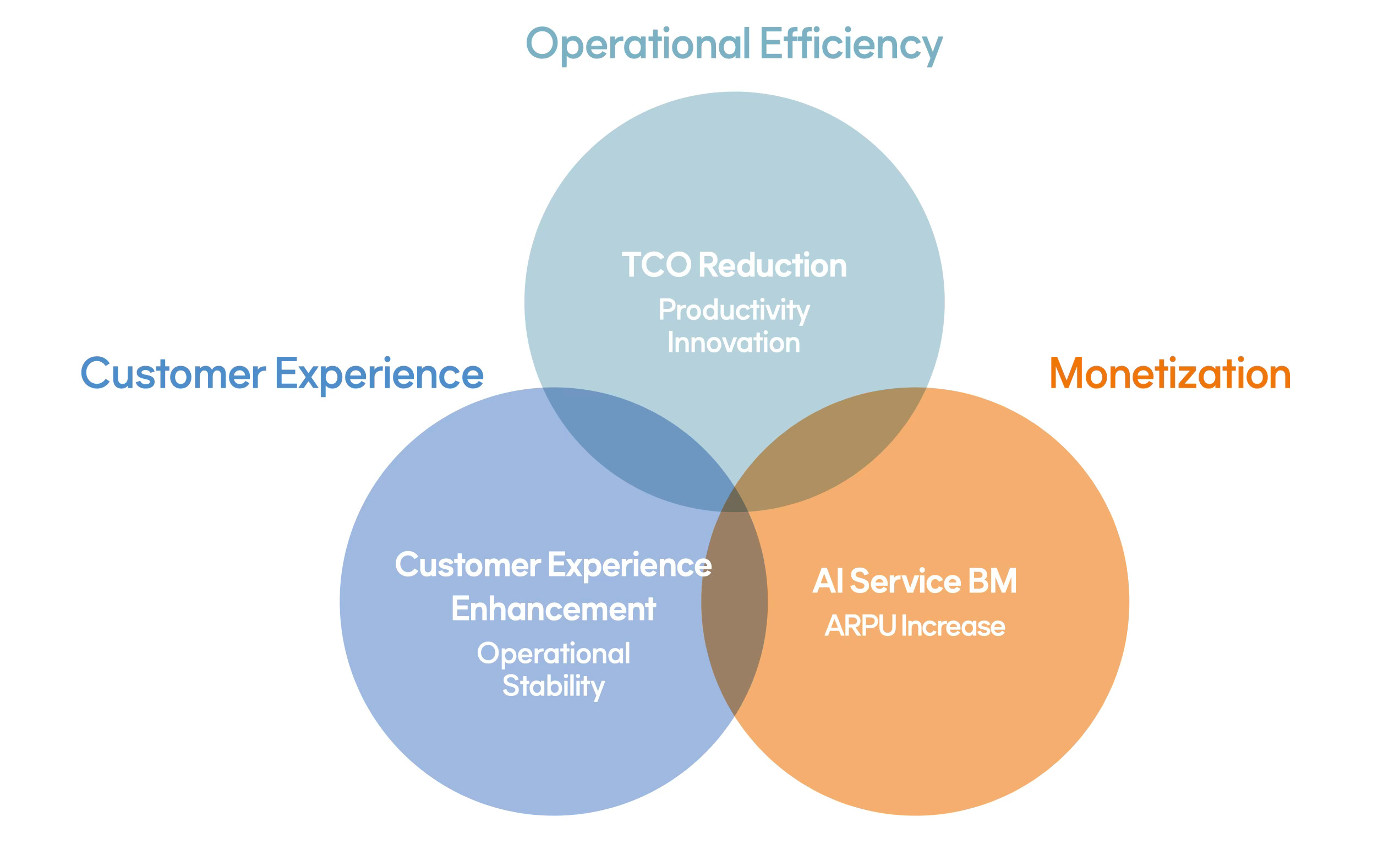
SK Telecom has published its third annual 6G white paper, introducing the ATHENA architecture framework, which stands for AI, Trust, Hyper-connectivity, Experience, opeN, Agility. This builds substantially on the operator’s previous papers (the 2023 one that looked at requirements and the 2024 paper on AI telco infrastructure) by presenting a detailed, domain-by-domain network architecture for the mid-to-long-term future.
The white paper defines six network visions: AI-native, Cloud-native, Ubiquitous, Open, Zero-Trust, and Customer-centric. Additionally, the architecture spans four domains: AI-native RAN, xCore (evolved core network), ACTN (AI-native Converged Transport Network), and DIVE (network Data Insight & Value Engine), which treats network data as a monetisable platform asset.
The AI-native RAN is built on xPU-equipped COTS servers running both communication and AI workloads simultaneously. SKT’s “Generation Mix” strategy supports 4G/5G/6G coexistence with flexible resource pooling. Agentic AI agents are deployed across all domains, moving toward Level-4 autonomous network operation. Zero Trust Architecture is embedded as foundational, including quantum cryptographic communication combined with post-quantum cryptography.
Yu Takki, Head of Network Technology Office at SK Telecom, said:
“Despite uncertainties in the 6G era, we will continue to create new growth opportunities by leading the evolution of future communication infrastructure over the next decade.”
What’s new: The ATHENA framework, the DIVE data monetisation platform, the detailed xCore evolution path toward an “Agentic Core,” and Cross-DC xPU Clustering for distributed AI training and inference. The paper discloses specific R&D milestones including approximately 10% throughput improvement from AI link adaptation, commercial deployment of AI-based parameter optimisation and sub-10-metre indoor positioning. Of note, SKT was recently elected to the board of the AI-RAN Alliance.
Why this matters: This is notably more implementation-focused than many operator 6G white papers that we have seen. Last year, SKT demonstrated GPU-based L1 processing and simultaneous RAN plus AI service delivery at MWC 2025, and the ATHENA paper builds on those results with a detailed architectural roadmap. The DIVE platform is particularly distinctive, providing a framework for operators to monetise network data through AI-powered pipelines and an AIOps Copilot. The positions are consistent with SKT’s 2025 3GPP 6G Workshop submission, where it advocated for pragmatic 5G core evolution and argued that “anything new should be justified with huge performance gain and cost efficiency.” The Generation Mix strategy directly addresses the migration challenge that operators have collectively identified as one of the biggest risks for 6G.
Implications for 6G standards: SKT is actively participating in 3GPP, ITU and O-RAN Alliance standardisation. At 3GPP RAN #110, SKT joined the operator bloc supporting realistic peak data rate targets. The ATHENA architecture’s emphasis on evolved 5G core, AI-native RAN with open interfaces, and generation-agnostic infrastructure aligns with the emerging consensus in 3GPP’s Release 20 study phase.
View source material to read more
Download the full ATHENA white paper: https://bit.ly/3OsdyGq
Nokia launches RAN Digital Twin with NVIDIA
Nokia announced a significant advancement in wireless network simulation with the launch of its Nokia RAN Digital Twin, built on the NVIDIA Aerial Omniverse Digital Twin (AODT) platform. The system uses AI and advanced ray tracing to provide physically accurate radio propagation environments for designing and optimising next-generation networks. The announcement was made at NVIDIA GTC. Soma Velayutham, Vice President of AI & Telecoms at NVIDIA, said:
“AI-Native 6G will be born in simulation, and digital twins will be essential to the train-simulate-deploy-optimise lifecycle.”
Bindhya Tiwari, VP of RAN Architecture & Systems Engineering at Nokia, added:
“We are drastically reducing the ‘concept-to-live’ cycle.”
What’s new: Unlike traditional simulators that rely on statistical approximations, Nokia’s solution ingests high-resolution 3D maps and material data to calculate radio signal interactions with physical objects. It includes product-level modelling for both base stations and user equipment through collaborations with terminal manufacturers. Use cases include beamforming optimisation in dense urban areas, high-speed mobility testing at 300 km/h, and end-to-end analysis of how specific beamforming algorithms interact with specific handset antenna designs.
Why this matters: As 6G pushes into higher frequency bands, the complexity of radio propagation demands simulation tools that go beyond statistical averages. Multiple 3GPP 6G Workshop submissions, including one from NVIDIA itself, identified network digital twins as foundational to 6G operations. Nokia’s RAN Digital Twin addresses the chicken-and-egg problem of AI-native networks: they need vast training data, but that data cannot be gathered from networks that do not yet exist. The partnership combines Nokia’s radio expertise with NVIDIA’s GPU-accelerated computing, potentially saving operators millions in infrastructure costs by optimising deployment before physical rollout.
Implications for 6G standards: Digital twins featured as one of the top ten requests from the 3GPP 6G Workshop, with calls for real-time monitoring, performance optimisation through simulation, and multi-domain interaction modelling. Physics-based simulation of the kind Nokia and NVIDIA are delivering look like being essential for validating 6G performance claims and training the AI models that will underpin AI-native network operations.
View source material to read more
TM Forum demands monetisation-first 6G design
TM Forum and a collaboration of global operators, including Jio Platforms, Singtel, SoftBank and T-Mobile USA, have published a white paper titled “Shaping a Monetization-Driven 6G Vision” with a clear message: monetisation must be a core design principle for 6G, not an afterthought. George Glass, CTO at TM Forum, said:
“6G is not a science project, it is a business platform. If monetization is not considered from the outset, the industry risks repeating the same value leakage challenges seen with 5G.”
Ankur Kapoor, EVP & Chief Network Officer at T-Mobile USA, added:
“This is our opportunity to architect networks with intelligence at their core: programmable by design, AI-native from inception.”
What’s new: The paper defines three monetisation models: differentiated experiences with SLA-backed connectivity; on-demand, moment-based services where performance and pricing adapt in real time; and enablement beyond connectivity, exposing network intelligence as platforms. The paper challenges the industry to avoid 5G-era pitfalls of fragmented architectures, operational complexity and slow automation. It positions 6G as a programmable platform for on-demand, outcome-based services spanning connectivity, sensing, AI and compute.
Why this matters: The monetisation challenge is arguably the telecoms industry’s most pressing strategic concern. The 5G era has demonstrated that technical capability alone does not translate into revenue growth. The collective diagnosis from this group of TM Forum members is consistent: 6G must span the entire service lifecycle from creation through to billing, and must be operationally manageable at scale. The emphasis on TM Forum’s role as a bridge between technical capabilities and commercial value reflects a recognition that standards bodies like 3GPP define what networks can do, but the operational and commercial frameworks determine whether those capabilities generate returns.
Implications for 6G standards: The white paper reinforces the monetisation and commercial viability themes that surfaced repeatedly in 2025’s influential 6G Workshop, where operators including InterDigital stressed that “6G must translate in a cost-effective system towards real market demand offering new monetisation paths.” The three monetisation models outlined could influence how network capability exposure, sensing-as-a-service and compute-as-a-service are specified in 3GPP Releases 20 and 21.
View source material to read more
TCS positions semantic communication for 6G edge monetisation
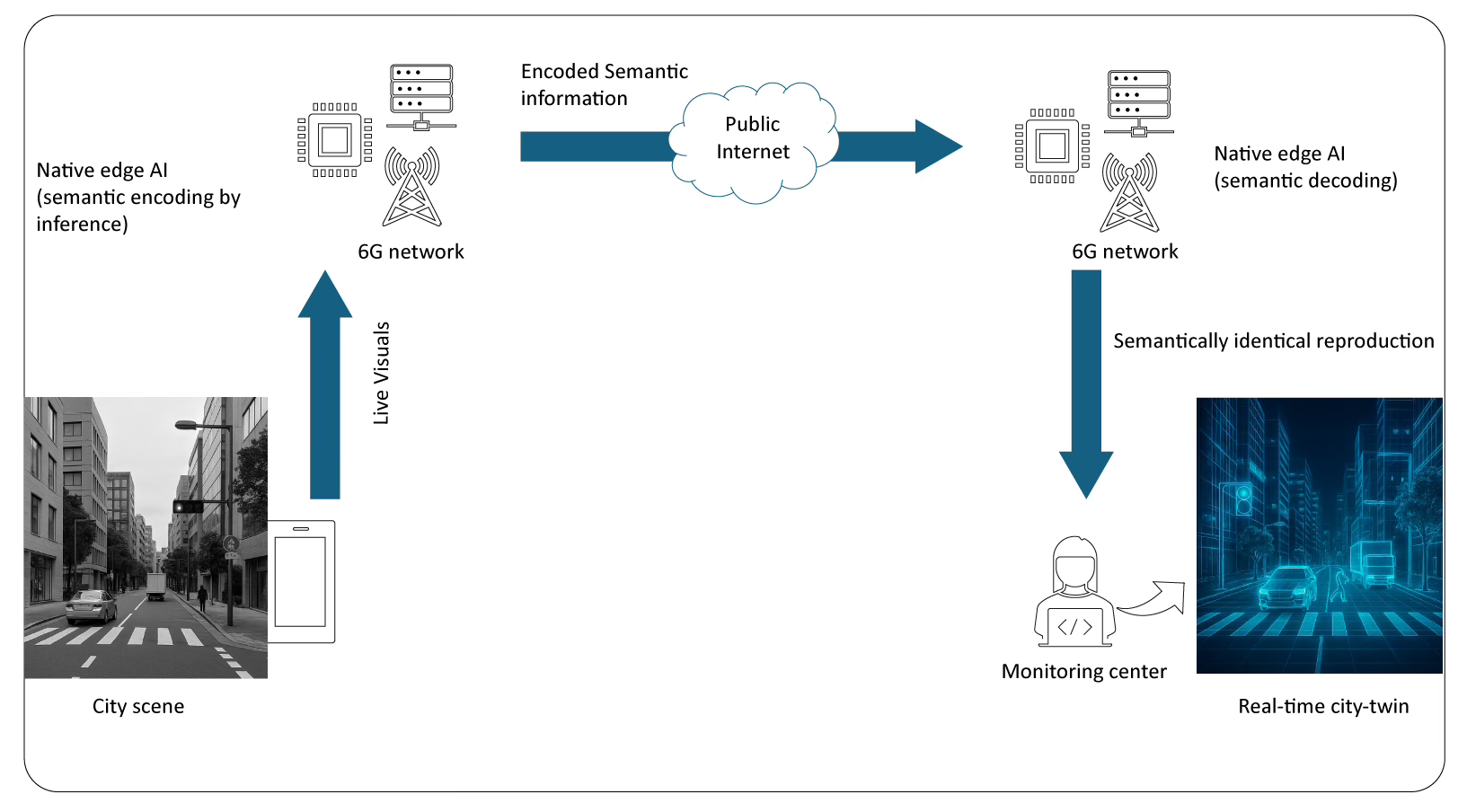
Tata Consultancy Services has published a white paper arguing that semantic communication could be the catalyst for monetising AI-native edge computing in 6G networks. The paper examines how transmitting distilled meaning rather than raw data could transform edge infrastructure from a cost centre into a revenue generator. TCS uses an analogy of a newspaper reporter (remember those?) who interprets a scene and conveys a structured narrative rather than raw visuals. Semantic communication works similarly, sending only the essential meaning of information while relying on AI at the receiver to reconstruct context. The white paper positions system integrators as key orchestrators of semantic-enabled services across multi-vendor environments.
What’s new: The white paper identifies semantic communication as the bridge between the two dimensions of AI-native networks: “AI for network” (intelligence embedded for performance optimisation) and “network for AI” (distributed computing resources enabling AI services). TCS proposes new monetisation models including pay-per-insight and semantic subscription tiers, moving beyond raw bandwidth pricing. The paper outlines specific research and standardisation gaps including the absence of semantic metrics, interoperability frameworks and security standards.
Why this matters: Edge computing monetisation has been a persistent challenge for operators. TCS argues that semantic communication reduces data transfer costs enough to make edge AI economically viable, while creating compelling use cases that drive adoption. The identification of standardisation gaps is useful, highlighting that semantic accuracy, reliability and cross-vendor orchestration all lack agreed benchmarks.
Implications for 6G standards: The paper calls for engagement with TSDSI, ITU-T and 3GPP to accelerate standardisation of semantic communication. While semantic communication remains primarily a research topic within 3GPP, the growing volume of industry white papers and EU-funded projects on the subject suggests it will be actively debated as 6G specifications develop (see also this week’s news from the University of Tokyo, below).
View source material to read more
Japanese trio demonstrates real-time AR on 6G/IOWN platform
The University of Tokyo, NTT and NEC have integrated three newly proposed technologies on a 6G/IOWN (Innovative Optical and Wireless Network) platform to support AI agents for safety and security applications. The collaboration targets a specific bottleneck: the massive data volumes generated by continuously operating AI agents overwhelm existing ICT infrastructure, making real-time response impractical. A trial using augmented reality safety monitoring verified that the combined technologies maintained constant end-to-end latency with no loss of AI inference accuracy.
What’s new: The three technologies are: streaming semantic communication that transmits only semantic differences when context changes, reducing wireless bandwidth dramatically; AI-oriented media control that selectively feeds only critical sensor data to AI agents, reducing computational load; and In-Network Computing (INC) architecture that distributes small, specialised AI models across the network rather than relying on a single massive model. A trial using 60 seconds of video (1,800 frames) in an AR safety monitoring scenario confirmed that end-to-end latency remained constant throughout the stream, with no degradation in AI inference accuracy.
Why this matters: The trial directly addresses a number of fundamental barriers to deploying always-on AI agents: insufficient wireless bandwidth, excessive computational load from continuous AI processing, and the power demands of large-scale AI models. The streaming semantic communication approach aligns with the growing body of research positioning semantic communication as a candidate 6G technology. The practical demonstration of constant latency under continuous video processing is a significant result for real-time AR applications that demand predictable performance.
Implications for 6G standards: The combination of semantic communication, AI-aware data filtering and distributed in-network computing reflects architectural concepts being discussed in multiple 3GPP study items. The trial provides much-needed quantitative evidence that these techniques can work together on a real platform, which is valuable input for the ongoing debate about how AI-native capabilities should be integrated into 6G specifications.
View source material to read more
InterDigital and Türk Telekom achieve cellular-Wi-Fi sensing first
InterDigital and Türk Telekom have announced the world’s first implementation of collaborative cellular and Wi-Fi sensing using a preliminary 6G architecture. The milestone will be showcased at MWC 2026. Türk Telekom CNO Zafer Orhan said the collaboration “highlights how 6G can unlock entirely new capabilities by blending communication and sensing.” InterDigital CTO Rajesh Pankaj added:
“One of the biggest challenges in delivering ISAC is maintaining reliable sensing performance in the face of coverage gaps and resource constraints.”
What’s new: The demonstration, conducted at Türk Telekom’s Innovation and Test Center in Ankara, showed how fusing sensing data from both cellular and Wi-Fi radio systems achieved improved accuracy, enhanced sensing service continuity and reduced blind spots, particularly indoors. At its core is Integrated Sensing and Communication (ISAC), underpinned by baseline architectural concepts from the first release of the ETSI ISAC Industry Specification Group, which InterDigital’s Alain Mourad chairs.
Why this matters: ISAC is one of the defining new capabilities for 6G, embedded in the ITU-R IMT-2030 framework and featured in virtually every major 3GPP 6G Workshop submission. This demonstration addresses a practical gap: single-network sensing struggles with coverage and resource limitations, particularly indoors. By combining cellular and Wi-Fi sensing data, the partners show a path to more robust, continuous sensing services. The involvement of the Wireless Broadband Alliance, whose CEO endorsed the work, underscores the growing convergence between cellular and Wi-Fi ecosystems.
Implications for 6G standards: The demonstration validates collaborative multi-RAT sensing as a viable architectural approach. As ISAC study items progress through 3GPP, the question of how sensing data from different radio technologies can be fused will become increasingly important. The ETSI ISAC ISG’s architectural work provides a pre-standards foundation that could feed directly into 3GPP specifications.
View source material to read more
Next G Alliance publishes 6G KPI databases
The Next G Alliance has made two complementary KPI databases openly available to the 6G ecosystem: the 6G Applications KPI Database and the 6G Sustainability KPI Database. The Applications database captures performance metrics tied to next-generation use cases while the Sustainability database catalogues metrics for energy efficiency and environmental issues. Together they reflect a critical shift in the industry’s approach to 6G: moving from envisioned capabilities and aspirational visions to measurable, accountable outcomes.
What’s new: The Applications KPI Database captures performance metrics associated with next-generation use cases, translating application requirements into measurable characteristics. The Sustainability KPI Database catalogues metrics for energy efficiency, environmental impact and lifecycle considerations. Both are designed as shared resources for researchers, operators, vendors, standards bodies and policymakers.
Why this matters: The industry has been long on 6G vision statements and short on agreed measurement frameworks. By hosting these databases openly, the Next G Alliance provides some practical reference points that can hopefully inform design choices and research priorities without constraining innovation. The sustainability database is particularly timely as sustainability KPIs are becoming central to 6G design discussions in both 3GPP and ITU, and the EU’s reporting obligations are driving operators to quantify environmental impact.
Implications for 6G standards: As 3GPP Release 20 study items progress and formal 6G service definitions develop, databases like these can serve as evidence-based inputs for defining performance targets and sustainability requirements in the specifications.
View source material to read more
€3 million funds goal-oriented semantic networking for 6G
Professor Yansha Deng of King’s College London has been awarded €3 million by Horizon Europe to build GoAgentNet, a goal-oriented multi-agent semantic networking architecture for 6G. The consortium includes Nokia Bell Labs and the University of Padova. Professor Deng said:
“By combining a goal-oriented approach with edge computing, this network architecture could just as easily connect a smart city in Milton Keynes as run a production line of internet-enabled robotic pickers in the rainforests of Brazil.”
What’s new: GoAgentNet introduces two virtual layers between the application and network layers: a Knowledge Layer that collects task information for goal understanding, and an Agent Layer that coordinates goal-oriented behaviour. Rather than transmitting raw sensor data, the system uses AI agents and knowledge graphs to communicate only essential goal-oriented information, dramatically reducing bandwidth requirements. For example, remote-controlling warehouse robots would require transmitting only a goal (”Move package A to pallet B, as fast as possible”) rather than massive volumes of video and sensor data.
Why this matters: Current wireless networks act as opaque data pipes with no understanding of application goals. GoAgentNet represents a step toward the intent-driven, AI-native networks that the 6G vision promises. The approach combines semantic communication, edge computing and multi-agent AI – three research threads that are converging rapidly. The project builds on work demonstrated at MWC 2025 with Nokia and VIAVI Marconi Lab.
Implications for 6G standards: Goal-oriented and semantic communication concepts appeared in multiple Workshop submissions, including from China’s Pengcheng Laboratory and several academic institutions. The translation of these concepts from research prototypes to standardisable architectures remains a significant challenge, but funded programmes with industry partners like Nokia help bridge the gap.
View source material to read more
Ho Chi Minh City plans 6G technology pilot
Ho Chi Minh City has announced plans to research, develop and pilot 6G technology in several areas within its jurisdiction during 2026, as part of a broader plan implementing Vietnam’s Resolution 57 on digital transformation. The city is also targeting 95% population coverage for 5G and 100% in major urban areas.
What’s new: The 6G pilot sits within a comprehensive digital infrastructure plan that includes establishing a venture capital fund, creating sandbox mechanisms for testing new technologies, and implementing preferential policies to attract high-tech businesses and foreign investment. The city’s Steering Committee has issued a formal implementation plan.
Why this matters: Vietnam has been moving aggressively on 5G deployment with strict rollout obligations tied to spectrum licences. A municipal-level 6G pilot from Southeast Asia’s largest city signals that emerging market economies are not waiting for standards completion before building research capacity. However, “piloting 6G technology” in 2026 should be understood in context: with 3GPP Release 20 still in its study phase, any 6G pilot at this stage would involve pre-standard experimental technology rather than standards-compliant systems.
Implications for 6G standards: The broader pattern of Southeast Asian and emerging market engagement with 6G reinforces the need for standards that accommodate diverse deployment scenarios and economic conditions. Vietnam’s approach, combining regulatory incentives with technology sandboxes, could provide useful data on how 6G technologies perform in tropical, high-density urban environments.
View source material to read more
Selected research papers published this week
Reasoning-native communication proposed for 6G agents
Hyowoon Seo and colleagues introduce “reasoning-native agentic communication,” a paradigm where communication is designed to address belief divergence between autonomous agents rather than merely transmitting data or preserving semantic meaning. The framework activates communication based on predicted misalignment in agents’ internal belief states, augmenting the conventional communication stack with a coordination plane grounded in shared knowledge and bounded belief modelling.
Why this matters: As 6G networks are expected to interconnect autonomous machines that continuously sense, reason and act, maintaining coherent behaviour across heterogeneous systems becomes a fundamental challenge. This paper reframes communication as a regulator of distributed reasoning, moving beyond both traditional bit-level and semantic communication paradigms to address a deeper coordination problem.
View source material to read more
AI conflict management framework for Open RAN
Abdul Wadud and colleagues propose an AI-powered framework for detecting, classifying and mitigating conflicts between xApps and rApps in Open RAN. The pipeline uses graph neural networks and Bi-LSTM models, with the SMOTE-enhanced GNN achieving 3.2x faster classification than rule-based approaches. Validation was conducted with both synthetic datasets and realistic ns3-oran simulations using Dublin cell topology data.
Why this matters: As Open RAN scales with increasing numbers of AI-driven applications, the potential for conflicting optimisation decisions grows. This paper addresses a practical challenge that will intensify as 6G moves toward AI-native RAN architectures with autonomous, multi-agent control systems.
View source material to read more
GNN framework improves mmWave path loss prediction
Mengyuan Lu and colleagues propose MM-ResGNN, a multi-modal sensing graph neural network for millimetre-wave path loss prediction in vehicular communications. The framework integrates topology-aware graph representations with visual semantics through a gated fusion mechanism, achieving a mean absolute error of 5.8 dB. A few-shot fine-tuning strategy enables cross-scenario generalisation with limited labelled data.
Why this matters: Accurate path loss prediction is critical for 6G network planning, particularly as higher frequency bands are deployed for vehicular and transportation scenarios. The multi-modal approach, combining radio propagation data with camera imagery and semantic scene understanding, reflects the sensor fusion concepts central to 6G’s integrated sensing and communication vision.
View source material to read more
Metasurface neural networks enable lightweight edge inference
Kyriakos Stylianopoulos and colleagues introduce Metasurfaces-Integrated Neural Networks (MINNs), a physical-layer deep learning framework that uses programmable multi-layer metasurface structures and MIMO channels to perform computation in the wave propagation domain. The system achieves performance comparable to fully digital deep neural networks while significantly reducing power consumption.
Why this matters: Edge inference for IoT applications is a core 6G use case, but traditional digital hardware for machine learning is power-intensive. MINNs offer an alternative computation paradigm where the wireless channel itself actively performs computational tasks, which could enable sustainable, ultra-low-latency inference at the network edge.