


6G news and analysis for the week ending Friday, 30th January, 2026.
The 5G patent wars are far from over, and this week’s updated rankings from LexisNexis reveal just how much is at stake as the industry pivots toward 6G. Huawei retains its lead in total 5G patent declarations and 3GPP technical contributions, but Qualcomm tops the value-weighted Patent Asset Index, earning nearly nine times more from licensing than its Chinese rival. With 5G licensing now a $15 billion annual market and 6G increasingly described as an evolution of OFDM-based technologies, the companies that dominate 5G intellectual property are well positioned to carry that influence forward. The geopolitical dimension is at play here, as Release 18 patent rankings show a notable shift toward South Korean and Chinese companies, with European and US players slipping.
Meanwhile, Dell’Oro Group confirmed what many operators already sense: the RAN market has stabilised after losing nearly $10 billion globally over the past two years, but growth catalysts remain elusive until 6G capex begins ramping toward the end of the decade. The forecast of just 1% CAGR over five years underlines the investment trough the industry must navigate before the next upgrade cycle.
On the technical front, ETSI published an important study comparing candidate multiple access techniques for 6G, including RSMA, power-domain NOMA and Cache-Aided MU-MIMO. These represent the building blocks of the 6G radio interface that 3GPP is now actively studying in Release 20. And from our friends at the University of Oulu, an award-winning demonstration of simultaneous D-band communication and sensing reinforces the practical viability of ISAC at sub-terahertz frequencies.
Key announcements this week
5G patent battle intensifies ahead of 6G
A new report from LexisNexis has updated the global rankings of 5G standard-essential patent holders, confirming Huawei in first place for total active and granted patent families and 3GPP technical contributions. However, Qualcomm leads on the value-weighted Patent Asset Index, reflecting the depth of its foundational 4G/5G IP including OFDM technology acquired through its $805 million purchase of Flarion in 2006. The 5G licensing market is now worth approximately $15 billion annually. Light Reading provided detailed analysis of the findings. Tim Pohlmann, Director of SEP Analytics at LexisNexis, said:
“As 5G licensing moves deeper into industrial, automotive, and infrastructure markets, the financial stakes tied to patent data accuracy continue to rise.”
The licensing revenue gap is striking. Qualcomm’s QTL division generated $5.6 billion in fiscal 2024, while Huawei made $630 million. Ericsson earned $1.57 billion and Nokia approximately $2.3 billion from patent licensing.
What’s new: The report introduces a breakdown by 3GPP release. For Release 15 (foundational 5G), the top six are Huawei, Qualcomm, Samsung, Ericsson, ZTE and Nokia. But for Release 18 (5G Advanced), the leaders shift to LG Electronics, ETRI Korea, Samsung, Oppo, Foxconn and Huawei. The highest-ranked European or US company for Release 18 is Nokia in eighth place.
Why this matters: Patent portfolios are not merely defensive assets; they represent bargaining leverage in the 3GPP standards process and generate substantial licensing revenue. The LexisNexis “Cellular Verified” methodology attempts to resolve long-standing inconsistencies between rival patent rankings from PA Consulting, Bird & Bird and the now-acquired IPLytics. The Release 18 shift toward Asian companies signals where R&D investment in 5G Advanced has been most concentrated. With 6G described as an evolution of 5G using OFDM-based technologies in higher spectrum bands, the companies dominating 5G IP are likely to carry that influence into 6G standardisation.
Implications for 6G standards: As Iain Morris at Light Reading notes, the industry can expect Huawei and Qualcomm to carry their 5G influence into 6G. The 3GPP consensus to evolve from 5G rather than start from scratch means existing patent holders retain structural advantage. The Release 18 rankings suggest that the IP landscape for later 6G releases may look quite different from the 5G baseline.
View source material to read more
RAN market stabilises but growth awaits 6G
Dell’Oro Group published its Mobile RAN 5-Year Forecast for January 2026, confirming that the global RAN market has stabilised following steep declines in 2023 and 2024 that wiped nearly $10 billion in revenue. Worldwide RAN revenues are projected to grow at just 1% CAGR over the next five years, as declining LTE revenues offset continued 5G investment and initial 6G spending. Stefan Pongratz, VP of RAN market research at Dell’Oro Group, said:
“The improved sentiment around 6G can be interpreted as a positive, bolstering this assumption that there could be material 6G revenue by 2030.”
What’s new: The forecast reaffirms that RAN is not a growth market over the long term, posting 0% CAGR between 2000 and 2025. Capital intensity ratios are expected to improve further before 6G investments commence toward the end of the forecast period. RAN as a share of wireless capex is expected to average 20-25% over the forecast window.
Why this matters: The flat outlook reflects a market caught between investment cycles. Operators have largely completed their initial 5G deployments and see no compelling reason to invest heavily until 6G brings new spectrum, new capabilities and new revenue opportunities. The “risks tilted to the downside” assessment, driven by slowing data traffic growth, suggests that the mid-decade period will test operator patience. The forecast also implies that 6G vendors need to offer clear ROI arguments well before commercial deployment to trigger the next capex cycle.
Implications for 6G standards: The timing pressure is real. If material 6G revenue is expected by 2030, as Dell’Oro suggests, then 3GPP Release 21 normative specifications need to be sufficiently advanced by 2028 to give equipment vendors time to develop and test commercial products. This aligns with the current 3GPP timeline but leaves little margin for delay.
View source material to read more
ETSI benchmarks multiple access candidates for 6G
ETSI’s Industry Specification Group on Multiple Access Techniques (ISG MAT) has released ETSI GR MAT 001, a comprehensive study comparing current downlink multiple access techniques used in 3GPP’s radio interface with three new candidates being considered for 6G: Rate-Splitting Multiple Access (RSMA), power-domain Non-Orthogonal Multiple Access (NOMA) and Cache-Aided Multi-User MIMO (MU-MIMO).
What’s new: The report evaluates each candidate against established 3GPP methods including Orthogonal Multiple Access (OMA), MU-MIMO and Multi-User Superposition Transmission (MUST). RSMA shows strong gains in scenarios with highly correlated user channels or power imbalance. Power-domain NOMA benefits users with significantly different channel strengths. Cache-Aided MU-MIMO introduces a novel approach where receivers use cached data to cancel interference, potentially useful for content delivery such as video-on-demand.
Why this matters: Multiple access techniques are fundamental to how 6G will share spectrum among users and achieve the efficiency targets set out in the IMT-2030 framework. This ETSI report provides an independent technical benchmark at a critical time, as 3GPP begins Release 20 study items on the 6G radio interface. RSMA in particular has been highlighted by several 3GPP 6G Workshop contributors, including the BBC’s R&D team, as a promising technique for improving spectral efficiency and fairness in dense deployments. The study also identifies limitations in current evaluation methods, flagging areas where further link-level simulations are needed.
Implications for 6G standards: This report feeds directly into the early technical discussions shaping the 6G air interface. The three candidate techniques represent different trade-offs between complexity and performance, and 3GPP working groups will need to assess which, if any, merit inclusion in Release 20 or 21 specifications alongside evolved versions of existing methods.
View source material to read more
6G Flagship wins IEEE award for D-band ISAC demo
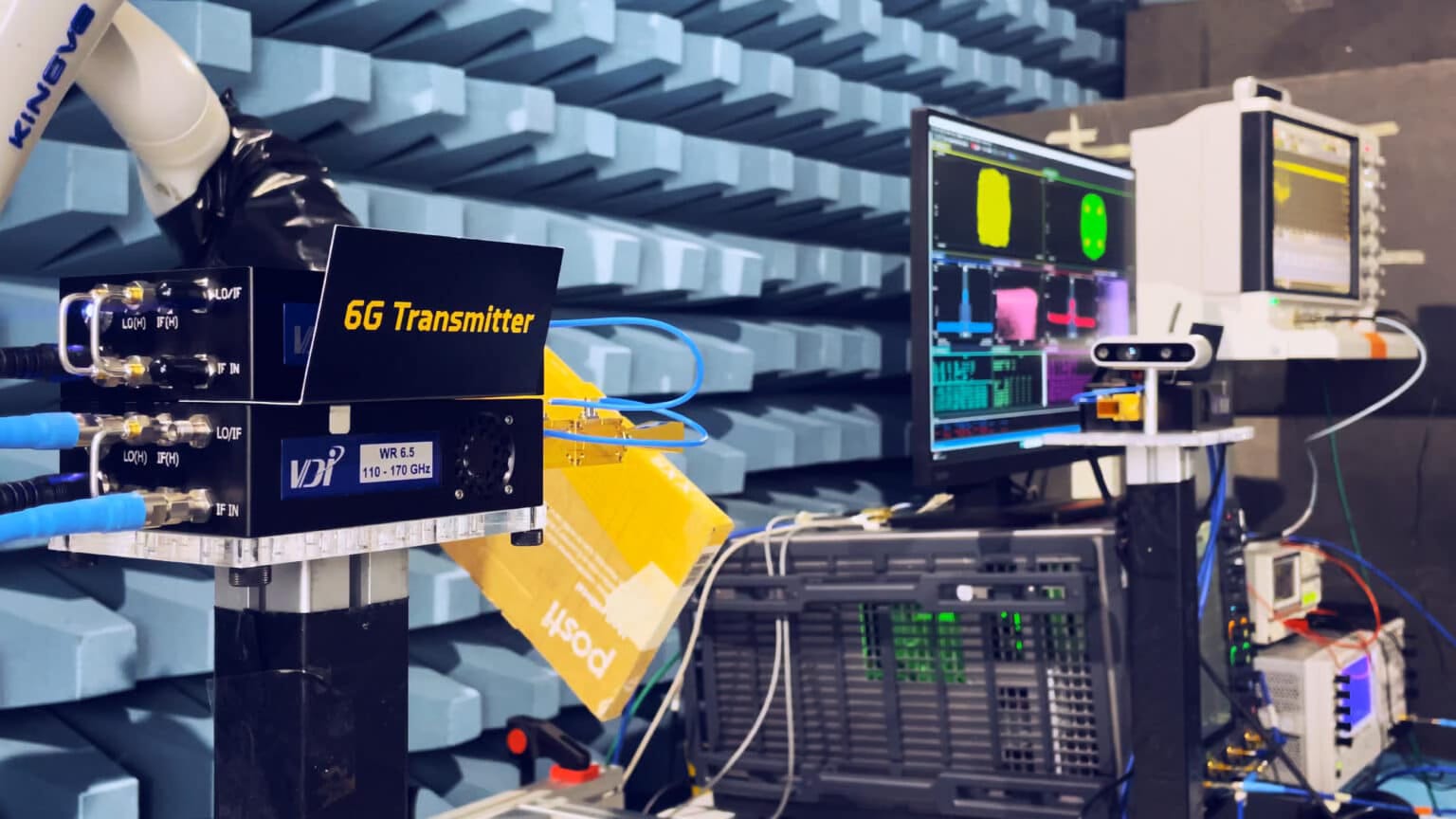
A research demonstration from the University of Oulu’s 6G Flagship programme has received the Joint Best Demo Paper Award at the 6th IEEE International Symposium on Joint Communications & Sensing (JC&S 2026) in Italy. The demo presented an integrated sensing and communication (ISAC) system operating in the D-band, combining high-frequency data transmission with radio tomography imaging using a single continuous radio link. Dr Praneeth Susarla, a member of the research team, said:
“The significance of the demo lies in demonstrating a single sub-THz radio link that enables data communication and environmental sensing simultaneously, without active scanning.”
What’s new: The system achieves simultaneous communication and radio tomography imaging using a fixed line-of-sight link, avoiding the active high-accuracy electrical or mechanical scanning typically associated with sub-THz sensing. The demonstration was operated remotely in real time from Oulu throughout the conference, which the jury cited as evidence of the system’s technical maturity.
Why this matters: ISAC is one of the defining new capabilities proposed for 6G, and demonstrations at sub-THz frequencies are essential to prove the concept works in practice. The D-band (110-170 GHz) offers enormous bandwidth but presents severe propagation challenges. Showing that a single radio link can simultaneously carry data and perform environmental sensing, without dedicated scanning hardware, addresses a key practical concern about the complexity and cost of ISAC deployment.
Implications for 6G standards: Sub-THz ISAC is an active area of study within 3GPP Release 20 work items. Real-world demonstrations like this one provide the evidence base that standards bodies need to assess the feasibility and performance bounds of integrated sensing at higher frequencies.
View source material to read more
Digital twins positioned as 6G enabler
RCR Wireless News published an analysis of three ways digital twins can enhance 6G networks: enabling risk-free “what-if” scenario testing, providing training data for AI-native network operations, and optimising power consumption. The piece draws on commentary from Siemens CTO Peter Koerte and Blue Planet’s VP Kailem Anderson.
What’s new: The article frames digital twins as a bridge between the AI-native ambitions of 6G and the practical challenge of training and validating AI/ML algorithms before deployment. Network digital twins can mirror the full 6G ecosystem from physical infrastructure through to the software plane, generating synthetic data to fill gaps and simulate failure scenarios that would be impossible to test on production networks.
Why this matters: Digital twins have emerged as a core architectural concept in 6G planning. Multiple 3GPP 6G Workshop submissions, including those from 5G-ACIA, Bosch and NVIDIA, identified network digital twins as foundational to 6G operations. The technology addresses a genuine chicken-and-egg problem: AI-native networks need vast amounts of training data, but that data cannot be gathered from networks that do not yet exist. Digital twins also offer a path to the energy optimisation that operators are demanding, by enabling dynamic resource management based on real-time traffic modelling.
Implications for 6G standards: Network digital twins featured as one of the top ten requests from the 3GPP 6G Workshop, with calls for real-time monitoring, performance optimisation through simulation, and multi-domain interaction modelling. The challenge for standardisation will be defining interoperable interfaces and data models that allow digital twins from different vendors to work together.
View source material to read more
Adelaide University advances terahertz fabrication
Adelaide University announced that its Terahertz Engineering Laboratory (TEL), working with the Australian National Fabrication Facility (ANFF-SA), is developing terahertz devices intended to support future 6G wireless communications. The devices use terahertz waves, sitting between microwaves and infrared light, which have only recently become accessible due to advances in nanofabrication. Professor Withawat Withayachumnankul, TEL Group Leader, said:
“We’re exploring devices that could enable wireless data rates above one terabit per second across several kilometres.”
Emphasis here on “could”, as this target remains commercially aspirational, but it is certainly valid as a research goal.
What’s new: The partnership is producing highly specialised terahertz antennas and silicon components using photolithography and deep reactive ion etching, achieving micron-scale precision including through-silicon vias (TSVs). The work is described as foundational technology for 6G networks, “which will be the first generation of wireless communication to fully integrate terahertz frequencies.”
Why this matters: Terahertz technology is central to the extreme data rate scenarios envisioned for 6G, but the gap between laboratory demonstrations and manufacturable devices remains significant. The Adelaide-ANFF collaboration focuses specifically on the fabrication challenge: translating designs into reliably manufactured components with the precision required for sub-THz operation. This work complements the component design research happening in parallel at institutions in South Korea, Japan, Finland and elsewhere.
Implications for 6G standards: While terahertz integration in 6G standards is likely to be addressed in later 3GPP releases rather than Release 20 or 21, the fabrication capabilities being developed now will determine whether commercial terahertz devices are feasible within the 6G deployment timeframe. Several 3GPP Workshop contributors noted that spectrum above 100 GHz should be considered for later releases once efficient implementations exist.
View source material to read more
Selected research papers published this week
Open RAN platforms bridge digital and physical testing
Davide Villa’s dissertation presents an end-to-end methodology for designing and evaluating next-generation cellular networks through complementary experimental platforms. The work centres on Colosseum, described as the world’s largest Open RAN digital twin, and X5G, an open, programmable, multi-vendor private 5G O-RAN testbed with NVIDIA Aerial GPU-accelerated PHY processing integrated with OpenAirInterface higher layers. Key contributions include a GPU-accelerated dApp framework enabling sub-millisecond control loops for AI-native applications including ISAC.
Why this matters: The dissertation addresses one of the most practical challenges in 6G development: how to test AI-native RAN applications at scale before commercial infrastructure exists. The sub-millisecond control loop capability is directly relevant to the real-time inference requirements of 6G ISAC and spectrum sharing applications.
View source material to read more
Graphene THz MIMO antenna designed for 6G
Researchers have designed a compact graphene-based MIMO antenna for 6G terahertz communications, operating across seven resonant frequencies between 3.7 and 6.5 THz. The antenna, implemented on a polyimide substrate measuring just 405 × 164 μm², achieves 13.4 dB peak gain and 96% efficiency. Machine learning regression using Random Forest was applied to predict antenna performance, achieving 94% accuracy. Published in Nature Scientific Reports.
Why this matters: Graphene-based antennas offer a potential path to practical terahertz MIMO devices, which will be required if 6G is to exploit THz spectrum for high-data-rate applications. The integration of ML-based performance prediction could accelerate the antenna design cycle.
View source material to read more
Energy-efficient massive MIMO through dynamic adaptation
Researchers propose a dynamic scheme for joint antenna and power adaptation in massive MIMO downlink, targeting the energy efficiency demands of 6G. The approach uses the multiple CSI-RS framework for antenna adaptation and the POLITE transmit power-aware link adaptation technique. Simulation results show consistent balance between network energy savings (NES) and user throughput, with significant improvements under low and light load conditions.
Why this matters: Network energy savings is a top priority for 6G, with the RAN accounting for roughly 80% of network energy consumption. This work addresses the practical challenge of reducing energy draw without degrading user experience, particularly during low-traffic periods when massive MIMO systems are typically over-provisioned.
View source material to read more
LLM agents orchestrated across 6G edge networks
The CORE framework proposes distributing multiple large language model (LLM) agents across mobile devices and tiered edge servers in 6G networks. Each agent is assigned a distinct functional role, with three optimisation modules handling real-time perception, dynamic role orchestration and pipeline-parallel execution. A novel role affinity scheduling algorithm dynamically matches computational demands with available dispersed resources. Case studies across 6G application scenarios demonstrated improvements in system efficiency and task completion rates.
Why this matters: As 6G is increasingly described as enabling “ubiquitous intelligence,” the practical question of how to distribute AI workloads across heterogeneous edge infrastructure becomes critical. This framework addresses the gap between centralised LLM deployment and the distributed computing reality of mobile networks.