

Operators warn against 6G repeating 5G mistakes
NGMN urges standards simplification, China expands its programme, and Oulu turns 6G theory into evidence.

6G news and analysis for the week ending Friday 5th June, 2026.
Who said there’s nothing happening with 6G yet? This week the EuCNC & 6G Summit brought Europe’s research community together in Málaga under the slogan “6G Connecting Intelligence”, while over in Singapore the industry prepares for next week’s 3GPP plenary meetings.
The lead story comes from the NGMN Alliance, which released two operator-view publications timed for the Singapore plenary. Both carry a single message: Learn from the 5G migration and prioritise simplicity over a proliferation of options. With Release 21 set to be the first 6G specification, this is operators trying to shape the foundations before it’s too late to change them.
China provided the second major development of the week. The Ministry of Industry and Information Technology launched a ministry-provincial collaborative pilot programme, with a stated target of forming independently developed 6G technical solutions by 2029. It is a national coordination move as much as a technical one.
The third highlight is empirical. Researchers from the University of Oulu put a reconfigurable intelligent surface (RIS) inside an operating mine and measured what it actually did. After years of RIS hype, the result is the kind of hard evidence we require.
Also this week: a multi-vehicle millimetre-wave demonstration from NTT DOCOMO, Spain’s prominent role at EuCNC, a medical-network study from Munich, and four selected research papers.
NGMN urges 6G to learn from 5G

The NGMN Alliance has published two operator-view reports arguing that 6G needs a different standardisation approach to avoid the complexity and market confusion that dogged 5G. “6G Architecture and Migration Options” assesses RAN and core migration choices, while “6G Deployment Timeframe Considerations” sets out operator views on timing. Both were released in conjunction with the 3GPP plenary in Singapore. The reports position Multi-RAT Spectrum Sharing (MRSS), where 5G and 6G share the same frequencies, as the baseline migration path. Guangyi Liu, Chief Expert of China Mobile and an NGMN Board Director, said “migration options need to be limited if we are to learn the lessons” of 5G.
What’s new: NGMN urges the industry to converge early on a single primary migration approach to limit fragmentation across devices, RAN and core. It states plainly that MRSS performance must be improved beyond the 4G-5G Dynamic Spectrum Sharing it succeeds, including support for both FDD and TDD spectrum.
Why this matters: This is the operator community speaking with one voice at the precise moment 3GPP is deciding the migration architecture. It’s a very strong message to 3GPP. The reports echo the standalone-first, simplicity-first themes that dominated the 3GPP 6G Workshop and the RAN #111 debate over migration options. NGMN also insists that high-quality specifications be completed before any commercial 6G launch, and confirms operator expectations of a commercial introduction in the early 2030s (no talk of 2029 here!). The emphasis on hardware reuse and multi-vendor, cloud-based deployments reflects a hard-nosed view of 6G economics. In short, operators want the business case to work before the marketing begins.
Implications for 6G standards: This lands directly on the RAN migration-options decision due by September 2026, where the choice between a 6G-anchored approach and a dual-stack approach remains open. NGMN’s framing of MRSS as the baseline, with dual connectivity reserved for gaps MRSS cannot fill, aligns with the direction RAN working groups are already taking. We shall report on its reception by 3GPP members in next week’s newsletter.
NGMN Alliance CEO Anita Döhler (pictured above) spoke at our DSP Leaders World Forum event last month. You can watch her panel, along with the special Extra Shot programme that examines the current state of 6G standardisation and its relationship with AI development, here on the TelecomTV website.
View source material to read more
China launches ministry-provincial 6G pilot

China’s Ministry of Industry and Information Technology (MIIT) has launched a joint ministry-provincial collaborative pilot programme for 6G innovation and development. The plan targets the formation of independently developed 6G technical solutions by 2029, alongside new application scenarios and terminal products to support eventual commercial deployment. Priorities include integrating communications with AI, satellite internet and wireless sensing, plus R&D on base stations, core networks, chips and operating systems. Pilot regions will pursue use cases such as immersive communications, the low-altitude economy, embodied intelligence and smart maritime operations. Pan Helin, a member of MIIT’s Information and Communication Economy Expert Committee, cautioned that “6G technology is still in a technology storage period.”
What’s new: The collaborative pilot mechanism is the new element, structured to let provinces and the ministry pool strengths and approve locally compiled work plans that fit the national layout. MIIT will run technology trials through the IMT-2030 (6G) Promotion Group and prioritise hosting major 6G conferences in pilot regions.
Why this matters: This builds on the 6 GHz trial spectrum permit we covered in our 8 May edition and the Nanjing Pre-6G network reported in our 24 April edition. The most striking note is Pan Helin’s candour: he argues that without rich application scenarios there is no case for a new round of infrastructure investment, and that applications must precede rollout. That is a markedly more disciplined view than the “10 to 100 times 5G” performance claims that accompany the Xinhua state-media framing - which is totally wrong (likely more a misreading than a deliberate falsehood). China’s phased programme remains unusually well coordinated with its standards strategy, feeding field data to its 3GPP contributors. The pilot also formalises regional clusters in Beijing, Shanghai and Zhejiang.
Implications for 6G standards: System-level results from pilot regions will inform Chinese contributions to 3GPP Release 20 study items and Release 21 normative work, particularly on AI-communication convergence, ISAC and NTN. The 2029 target for “independently developed” solutions also signals continued attention to technological self-sufficiency.
View source material to read more — Xinhua
View source material to read more — Global Times
Oulu puts RIS theory underground
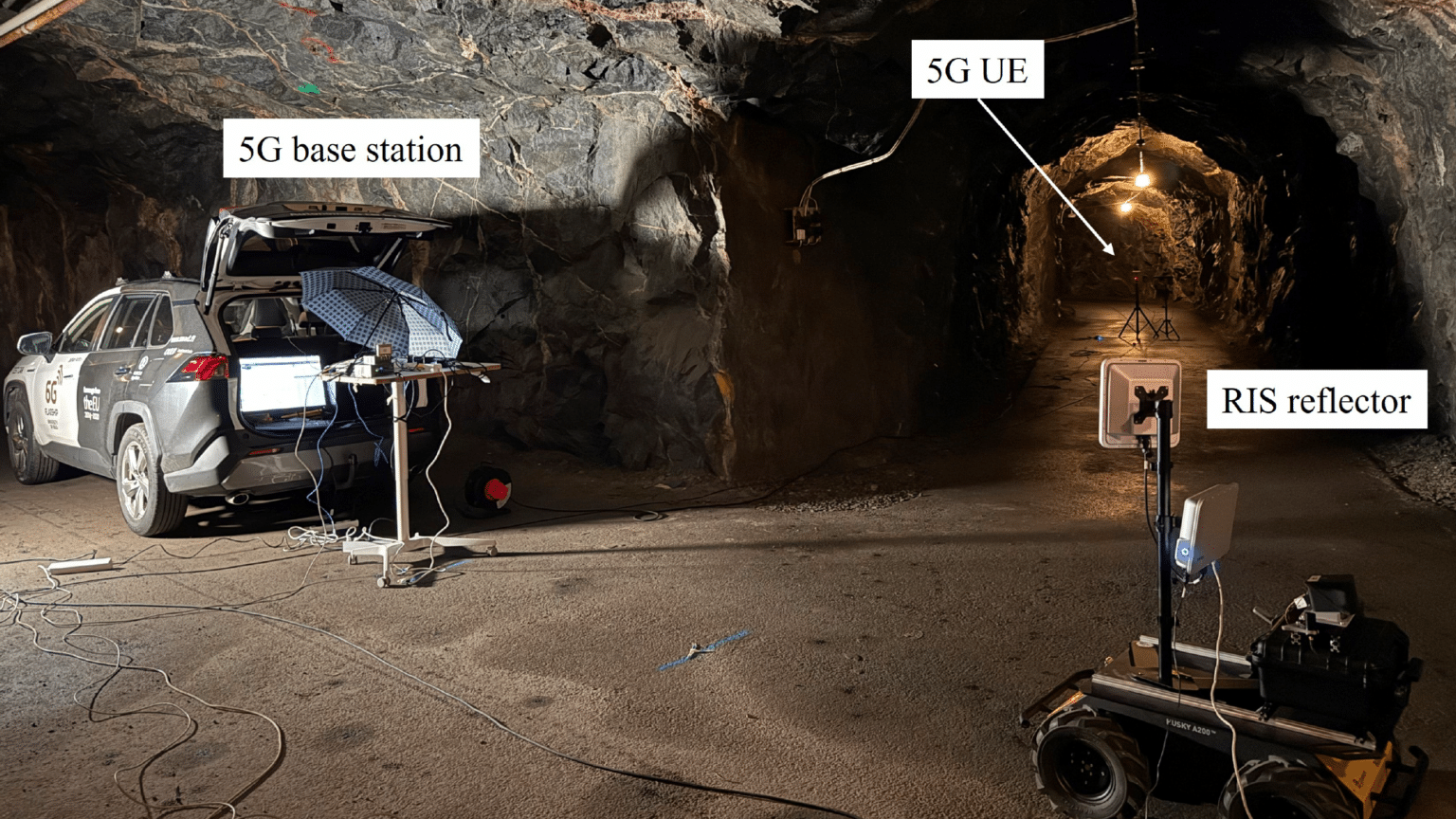
Researchers from the University of Oulu’s 6G Flagship programme and Luleå University of Technology installed a standalone 5G millimetre-wave network inside an operating mine in northern Sweden, added a reconfigurable intelligent surface (RIS) at a tunnel intersection, and measured the result. A RIS is a panel of programmable elements that reshapes radio waves in the air. Without it, the 28 GHz signal died roughly four metres around the corner. With the RIS reflecting the signal at the correct angle, usable coverage in the side tunnel extended to at least twenty-two metres. A theoretical prediction based on radar cross-section analysis matched the measurements to within an average of one decibel. The team believes this was the first such deployment of a 28 GHz standalone network with a RIS inside a working mine.
What’s new: This is empirical deployment evidence in a genuinely difficult environment, rather than a simulation. Tunnel geometry is among the harshest tests for millimetre-wave, where signals attenuate sharply around corners, and the close agreement between prediction and measurement is the notable result.
Why this matters: RIS has been one of the most-hyped 6G enablers for years, long on elegant mathematics and short on field proof. This work, presented at EuCNC in Málaga this week, is part of a trio of Oulu papers offering empirical, algorithmic and structural evidence. A companion paper tackles the harder problem of one RIS serving many users at once with different data needs, using dedicated sub-units rather than a single beamforming configuration. A third maps enabling technologies, including RIS, sub-networks, AI-RAN and post-quantum cryptography, onto business-model archetypes, arguing that technology choices quietly commit operators to particular commercial structures. The physics generalises beyond mining to factories, dense urban canyons and any setting where signals must bend around obstacles.
Implications for 6G standards: RIS featured in multiple 3GPP 6G Workshop submissions, but interface and control standardisation remains at an early stage. Hard measurement data of this kind, with a validated link between model and reality, is precisely what working groups need to move RIS from research curiosity toward a specifiable capability.
A side note here on the 3GPP 6G Workshop references that I like to include. I was told recently that the workshop, which was held in March 2025, was “a lifetime ago” and that so much has changed since then that makes it irrelevant. I disagree. The Workshop should stand as a checkpoint against which the actual progress of 6G should be judged. It remains incredibly useful to see how the 6G aspirations of the hundred-plus stakeholders who submitted presentations compare to the reality of 6G standards. Here’s the collection of reports I wrote for TelecomTV.
View source material to read more
NTT Docomo stabilises mmWave for moving vehicles
NTT DOCOMO, NEC and NTT have demonstrated a technique that keeps high-capacity millimetre-wave communications stable for multiple vehicles travelling at speed, using the 40 GHz band expected to feature in the 6G era. The method combines distributed MIMO, where antennas are spread across an area, with pre-compensation of transmit frequency and timing for each vehicle before the signals are combined. In a March 2026 trial at a full-scale tunnel test facility, two vehicles travelling in opposite lanes at 60 km/h achieved roughly a 1.3x improvement in average throughput over the conventional method. Combined average throughput rose to 560 Mbps, and the fifth-percentile value improved from 270 to 480 Mbps, an approximate 1.8x gain.
What’s new: This extends a March 2025 single-vehicle demonstration to the harder multi-vehicle case, where simultaneous antenna switching for several moving terminals causes abrupt shifts in Doppler frequency and propagation delay. Per-vehicle pre-compensation on the base-station side, before multiplexing, is the distinguishing technique.
Why this matters: High-frequency bands offer capacity but struggle with mobility, and frequent base-station switching degrades quality just when vehicles need it most. This trial provides concrete evidence that millimetre-wave can serve moving vehicles reliably, supporting use cases such as in-vehicle XR, real-time translation and sensor-data sharing for cooperative autonomous driving. It complements DOCOMO’s outdoor AI-driven wireless trial from our 28 November edition, which used a different technique to similar mobility ends. The tunnel setting is a deliberate stress test, with frequent reflections and switching. As ever, a controlled trial is not a deployment, and real arterial roads and railways remain to be proven.
Implications for 6G standards: DOCOMO is a leading 3GPP RAN contributor and the holder of a 40 GHz power-class work item agreed at RAN #110. Field data on distributed MIMO and pre-compensation for high-mobility millimetre-wave strengthens the evidence base for how these bands are specified for 6G.
View source material to read more
Spain takes a lead role at EuCNC
Two Spanish stories from Europe’s research week at the EuCNC & 6G Summit 2026 in Málaga. Telefónica, a co-organiser of the event, positioned itself as the operator with the largest share in the Smart Networks and Services Joint Undertaking (SNS JU), citing more than 35 projects on 6G technologies spanning AI-native networks, cloud-edge integration and future architectures. The company argued that 6G should be a gradual, service-centric evolution of existing infrastructure with clear monetisation pathways, not a disruptive leap. Antonio Guzmán, Director of Innovation at Telefónica’s CDO unit, said “the key to the evolution to 6G will lie in flexibility.”
Separately, the Madrid research institute IMDEA Networks announced it had secured funding for four SNS JU projects under Horizon Europe: PROSPERO, PAISES-6G, IoT-ZERO and PRIME-6G, covering sustainability, security, industrial 6G and simplified network architectures.
What’s new: IMDEA’s four grants are the results of prior collaborations such as DAEMON and ORIGAMI with partners including Telefónica and NEC. The projects target AI-driven energy reduction, quantum-ready encryption, near-zero-energy IoT and a close-to-market industrial 6G platform blueprint validated in real factory environments.
Why this matters: Together the two stories illustrate the depth of Europe’s institutional 6G effort and its consistent themes: sustainability, security, simplification and strategic autonomy. They sit within a broader €630 million round of public 6G funding. The announcements also match the operator-led message from NGMN this week, that 6G must build on existing assets and deliver viable economics. Europe’s challenge remains turning a strong research base and a crowded project portfolio into market capability, against the backdrop of the investment shortfall the GSMA has flagged.
Implications for 6G standards: SNS JU projects feed concepts into the 3GPP and ETSI processes, and IMDEA’s testbeds produce the real-world performance data that standards contributions rely on. The PROSPERO goal of a unified, simplified architecture echoes the simplification agenda now prominent across both operator and research camps.
View source material to read more — Telefónica
View source material to read more — IMDEA Networks
TUM shows 6G can lift medical network capacity
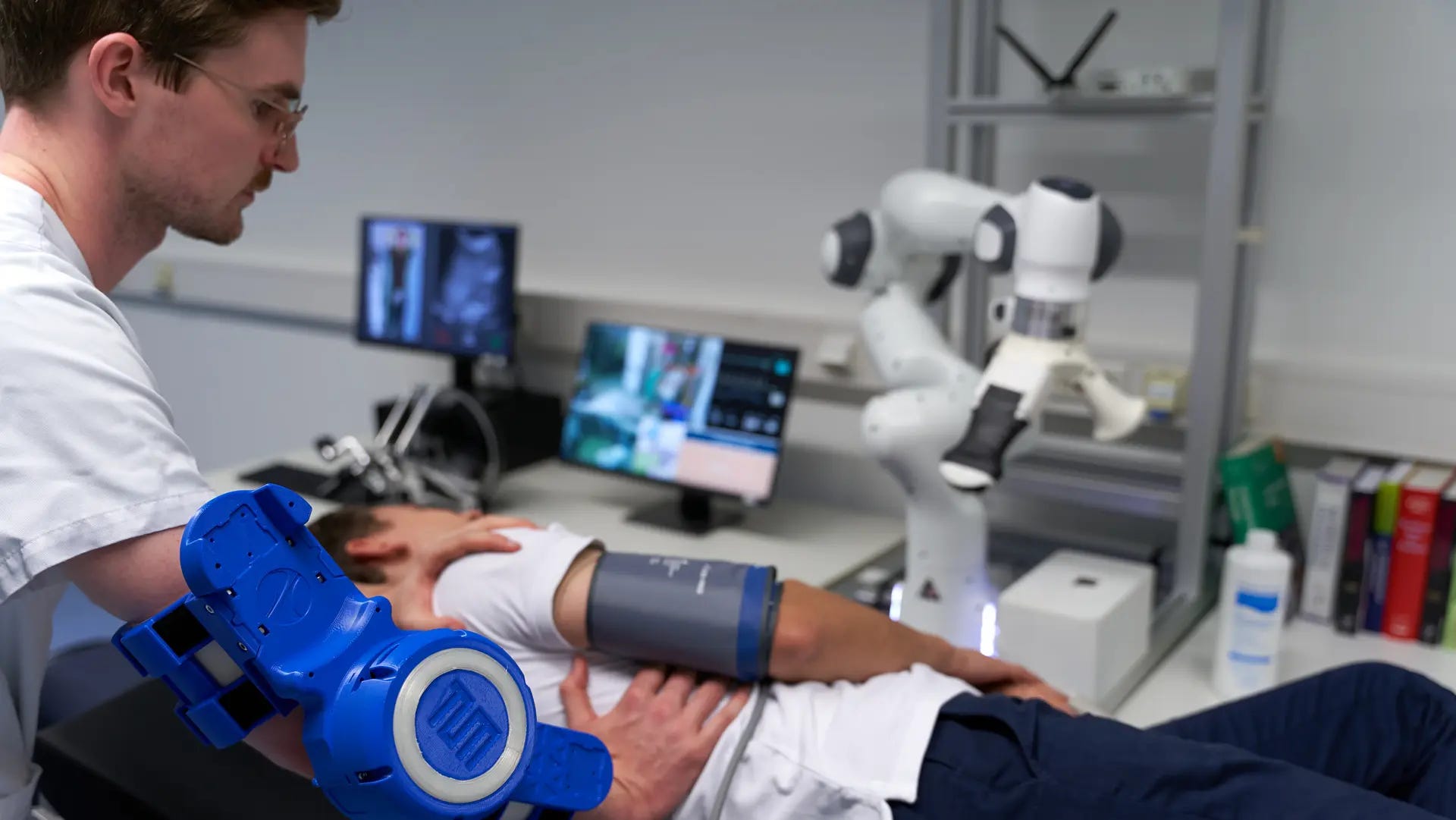
Researchers at the Technical University of Munich (TUM) and TUM University Hospital have studied how future 6G networks could manage computing and data transmission so that more medical applications run simultaneously. Their approach decides dynamically where each application is best executed: close to the patient, within the hospital, at a nearby network node or in a remote data centre. The work is framed as an optimisation problem that weighs active applications, their requirements, and available network and computing resources. Simulations indicate up to 40 per cent more medical applications can run at once, even under constrained capacity. Professor Wolfgang Kellerer said “it’s not enough to simply transfer data from A to B” for medical use.
What’s new: The contribution is in-network processing with application migration, deciding not just how fast to move data but where computation should happen, and shifting it as conditions change. The work is published in the IFIP Networking 2026 proceedings under the BMFTR-funded 6G-life project.
Why this matters: Telemedicine, continuous monitoring and remote procedures demand reliable, low-latency connectivity. Also, processing too close to the patient overloads the network while processing too far away adds delay. This study quantifies the gain from treating compute placement as a first-class network function, a concept that recurs across 3GPP 6G Workshop submissions under headings such as computing-as-a-service and function offloading. It is a simulation rather than a deployment, so the 40 per cent figure is an upper bound under modelled conditions. Healthcare is nonetheless a credible anchor use case for the compute-network convergence that defines AI-native 6G.
Implications for 6G standards: The in-network compute placement studied here aligns with the distributed computing and data-handling themes under active study in 3GPP. Use-case evidence of this kind helps ground the service requirements feeding into Release 20 and 21.
View source material to read more
Selected research papers published this week
Splitting both unicast and multicast in RIS networks
Hui Chen and colleagues propose a rate-splitting framework for RIS-assisted millimetre-wave networks that splits both unicast and multicast messages, rather than unicast alone. Two schemes are offered, optimised for energy efficiency under perfect and imperfect channel knowledge, with one favouring larger groups and the other smaller ones.
Why this Matters: Rate-splitting multiple access (RSMA) is a leading candidate for 6G spectral efficiency, and combining it with RIS targets two enabling technologies at once. Extending the splitting to multicast adds a degree of freedom for interference management that prior schemes left on the table, which matters for mixed broadcast-and-personalised services.
View source material to read more
A benchmark dataset for spectrum anomaly detection
A team including Gerhard Fettweis presents an open simulation framework and benchmark dataset for detecting spectrum anomalies in OFDMA systems, the access method underpinning 5G and 6G. It covers five jammer types, from simple noise to pilot-aware attacks, generated across a distributed sensing network in a simulated factory.
Why this Matters: Resilience against interference and jamming is a growing requirement for industrial and mission-critical connectivity, yet open datasets have been scarce. By publishing reproducible data and tooling, with applications extending to network digital twins, the work lets researchers compare detection methods on common ground, a precondition for trustworthy security claims.
View source material to read more
Taming rare latency spikes in cell-free networks
Yu Zhang and colleagues address ultra-reliable low-latency communication (uRLLC) in cell-free RAN, where rare but severe latency events matter more than averages. Using extreme value theory to quantify the probability of latency violations, they design a tail-risk-aware clustering scheme that adapts in real time to suppress extreme delays.
Why this Matters: uRLLC reliability is defined by its worst cases, not its mean, yet most clustering designs optimise averages. Applying extreme value theory to the problem is a more honest match to the requirement, and the energy-efficiency framing keeps the result grounded in the sustainability constraints that shape real deployments.
View source material to read more
Switching antennas off to save power
Zhe Wang, Shuaifei Chen and Emil Björnson study sparse antenna activation in cell-free massive MIMO, motivated by the goal of sustainable 6G. They develop a weighting framework that shapes each antenna’s contribution and four activation schemes that switch off elements selectively, achieving substantial energy savings with controllable loss of spectral efficiency.
Why this Matters: Cell-free massive MIMO promises strong performance but at a heavy energy cost from large numbers of active antennas. Demonstrating that careful, structured deactivation can cut power with a predictable performance trade-off speaks directly to the energy-efficiency priority that operators and vendors alike place at the centre of 6G design.
Agree on the arbitrary metrics, Dean. From the field side, the 1Gbps versus 700Mbps debate exposes a deeper issue: peak headline rates are the easiest number to quote and the least representative of what a user actually experiences at a given spot and time.
A lot of what gets framed as an investment gap is really a measurement gap. Operators can show coverage maps and peak-rate dashboards, but the experience that matters happens at a specific location and moment, and that is rarely the number being funded against.
The NGMN simplicity call resonates deeply from a field engineering perspective.
The 4G-to-5G migration created a diagnostic complexity explosion: NSA vs SA, EN-DC band combinations, different Layer 3 procedures on MCG vs SCG. Field teams carry toolchains designed for single-RAT environments while the network runs multi-RAT signaling.
If MRSS follows the same fragmentation path as DSS, proving network quality at a specific location and moment will become even harder for field engineers.
The Oulu RIS study is exactly the right approach: measured in a real operating environment, not simulated. That is what 6G validation needs more of. Evidence from the field, not from the lab.