


6G news and analysis for the week ending Friday, 21st August, 2026.
Welcome to another week of 6G readiness news. We start with confirmation that Nokia is winding down its research and development presence in mainland China. The Hangzhou radio R&D site will close by the end of 2026, eliminating around 1,600 jobs. Reporting from the South China Morning Post goes further, citing sources who say most sites will close in stages by year end, leaving only after-sales support. Nokia has neither confirmed nor denied that wider claim. What is not in dispute is the overall trend: Chinese revenues have more than halved since 2018 and combined Nokia and Ericsson RAN share in China now sits below a paltry 3 per cent. It looks like the prospect of 6G won’t change the picture.
Against that backdrop, SoftBank and Ericsson have validated the Swedish vendor’s AI-native scheduler for link adaptation on a live 5G commercial network in Japan. The reported gains are substantial, though they are vendor-measured. It’s another data point in the argument that AI-RAN will arrive before 6G.
In Finland, the Ministry of Defence has awarded €4.8 million to a consortium led by the University of Oulu to build Arctic testing capability for resilient 5G and 6G systems. Over in the UK, Loughborough university physicists have published a microcomb result with millimetre-wave implications. In other nerws, Turkcell has joined six European R&D projects and China’s state media published a 6G progress summary, but don;t get too excited.
Four research papers close this week’s edition. Happy reading.
Nokia retreats from China as supply chains split
Nokia has confirmed it will close its Hangzhou radio R&D site by the end of 2026, cutting approximately 1,600 jobs. The South China Morning Post subsequently reported, citing sources familiar with the situation, that the company plans to cut most of its mainland China workforce and close sites in stages by year end, retaining only after-sales services. Nokia did not directly confirm or deny that broader account. In a statement issued to Light Reading and repeated to other outlets, a company spokesperson said: “Nokia’s business in China has steadily declined over the last several years. Thus, we are adjusting our operational footprint in China to address this reality.” The company had roughly 7,200 staff across mainland China, Hong Kong and Taiwan at the end of 2025, with sites in Beijing, Shanghai, Hangzhou, Chengdu and Qingdao.
What’s new: The scale is the new factor here. Previous reporting covered the Hangzhou closure alone, but the SCMP account describes a near-total exit after more than four decades in the market (which it says was communicated internally by video conference from Helsinki). Nokia’s China revenue fell from €1.84 billion in 2019 to €913 million in 2025, with the region’s share of group revenue dropping from 7.9 per cent to 4.6 per cent.
Why this matters: The financial loss, whilst obviously a factor, is only a small part of this decision. Radio access development requires data feedback and China supplies the densest deployment data on earth, with roughly 4.84 million 5G base stations and 5G-Advanced coverage in more than 330 cities. With access to this amount of data, technology companies can work on beamforming, interference management and massive MIMO optimisation in ways smaller deployments cannot replicate. AI-RAN is another beneficiary. Nokia says that global R&D spending is rising, reaching roughly €2.3 billion in the first half of 2026, and that investment is being relocated rather than cut, which doesn’t address the data question.
Implications for 6G standards: Standards influence follows deployment evidence. Chinese contributors at 3GPP working groups are armed with field data from a network the scale of which no other market can match, particularly on ISAC and dense-deployment performance.
View source material to read more — South China Morning Post
View source material to read more — SDxCentral
SoftBank and Ericsson validate AI scheduler in Japan
SoftBank and Ericsson have conducted what they describe as Japan’s first validation of an AI-native scheduler for link adaptation on a commercial 5G network. The feature is part of Ericsson’s ‘AI in RAN’ software and runs on baseband hardware, making real-time inference decisions rather than applying static, offline-tuned parameters. The two companies evaluated spectral efficiency, user throughput, robustness and stability. They report gains of up to approximately 25 per cent in spectral efficiency and up to approximately 50 per cent in downlink user throughput against conventional methods. Averaged across all evaluated locations, both metrics improved by approximately 10 per cent. Teruyuki Oya, Senior Vice President and CNO of SoftBank, said the work “marks an important milestone in advancing the RAN through AI and represents a major step toward realising networks that will support the future AI era.”
What’s new: Link adaptation has historically relied on rule-based algorithms and static configuration. Running the decision as real-time AI inference on Ericsson silicon, inside the installed base, is the distinguishing element. Ericsson trained the model on actual network data and tuned it to predict channel capacity and select downlink transmission rates. The targeted gains sit at cell edges and in high-interference areas, which is where rule-based adaptation performs worst.
Why this matters: The averaged figure of approximately 10 per cent is consistent with the AI link adaptation gains SK Telecom disclosed in its ATHENA white paper in February. This is also the second consecutive week in which AI-RAN evidence has come from live commercial networks rather than laboratories, following the pattern set by Samsung with KT, Nokia with T-Mobile US and Indosat, and NTT DOCOMO’s outdoor trials. It should be noted that all these results are vendor-measured and vendor-published, with no independent verification. Dell’Oro has separately cautioned that AI-RAN enhances the RAN without expanding the RAN market.
Implications for 6G standards: Real-time AI inference inside the scheduler is a capability that Release 20 study items on AI and machine learning for the air interface are examining. Commercial field data of this kind carries weight in those discussions, because it demonstrates that the required inference latency is achievable on deployed baseband rather than only in simulation.
View source material to read more
Finland funds Arctic 6G testing for defence
Finland’s Ministry of Defence has awarded a government grant of €4.8 million to a consortium led by the University of Oulu to develop 5G and 6G network technology supporting homeland defence. The money funds the Arctic 6G Systems Testing and Development Programme, part of the government’s wider Programme for Northern Finland. The consortium comprises the University of Oulu, VTT, Nokia Defense and Telia, with the Finnish Defence Forces contributing test scenarios and operational use cases through its Innovation Unit and Artificial Intelligence Centre of Excellence. The work builds on the University of Oulu’s 6G Test Centre, which is a designated NATO DIANA facility. Minister of Defence Antti Häkkänen said the project “will intensify cooperation between actors in the research and development community.”
What’s new: The programme is structured as a three-pillar validation chain. The first pillar combines a controlled laboratory and spectrum-simulation environment with a carrier-grade, AI-enabled 5G and 6G campus network, covering Open RAN architectures, edge AI and hybrid terrestrial-satellite systems under simulated interference. The second extends into the OuluZone test area for deployable networks and connected uncrewed systems. The third moves outdoors into Arctic conditions and contested spectrum, aligned with NATO Innovation Range activities. VTT contributes interference and spectrum-resilience testing, Nokia Defense brings deployable and mission-critical network architectures and Telia provides the operator environment.
Why this matters: We flagged this funding in our 1 May edition, when the 6G Test Centre described a five-million-euro Northern Programme investment supporting an October 2026 NATO Innovation Range demonstration. This is the formal award, with the consortium and structure now named. The significant point is the shift from resilience as a research topic to resilience as a validated engineering property. Designing a system to withstand deliberate jamming from the outset is a different problem from hardening a network already in service and the dual-use argument holds: Graceful degradation and infrastructure-independent operation matter to emergency services and energy grids as much as to armed forces.
Implications for 6G standards: 3GPP does not standardise defence applications. However, interference resilience, spectrum robustness and hybrid terrestrial-satellite operation all feed civilian work in RAN and SA3, and into ITU-R IMT-2030 evaluation. Measured Arctic and contested-spectrum data is the kind of evidence that anchors requirements debates.
View source material to read more — Ministry of Defence
View source material to read more — 6G Flagship
Microcomb chip generates multiple millimetre waves
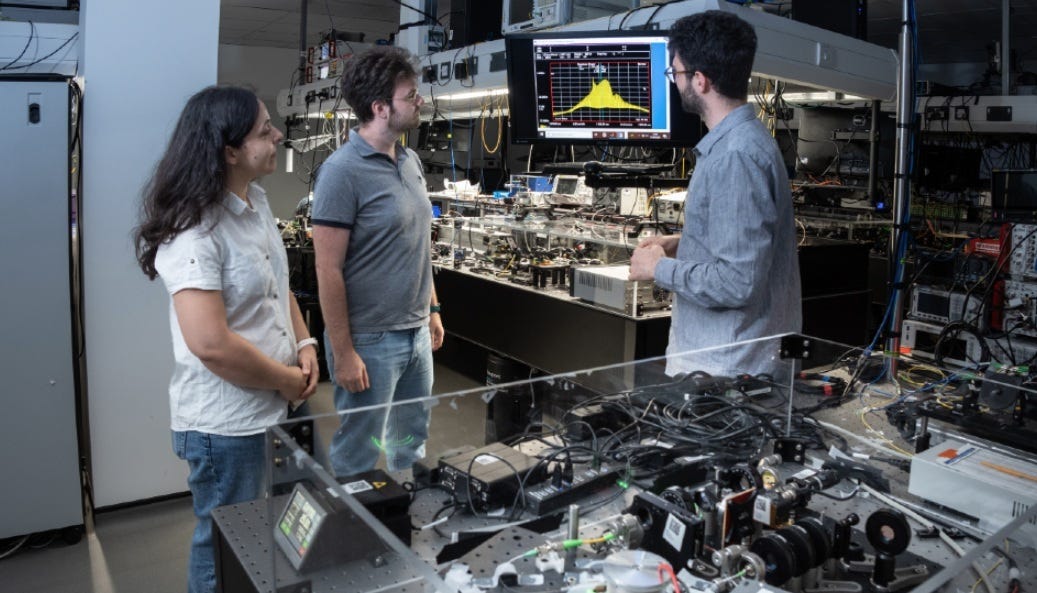
Physicists at Loughborough University in the UK, working with an international team, have demonstrated a microchip that produces a stable optical frequency comb which can be converted into multiple precisely spaced millimetre-wave signals at once. A microcomb is a spectrum of evenly spaced light frequencies generated in a microresonator and specialised antennas convert those optical frequencies into millimetre waves. Previous work produced a single millimetre-wave frequency. The Loughborough design combines the chip-based microresonator with a larger loop of optical fibre, so laser light circulates continuously through both. The result is published in Nature Communications. Dr Luke Peters of the university’s Emergent Photonics Research Centre said the frequencies “could ultimately contribute to faster, higher capacity 6G networks, but the potential goes far beyond communications.”
What’s new: The team showed it could shape the comb, strengthening or weakening individual frequencies, which allows the output to be tailored to different applications. It also showed that the precision and stability of the optical comb carries through to the millimetre-wave signals themselves. Generating many channels simultaneously, rather than one, is what makes the approach relevant to multi-channel data transmission.
Why this matters: Stable, low-noise signal generation is one of the harder engineering problems as radio moves into millimetre-wave and eventually sub-terahertz bands, where phase noise rises and electronic sources lose output power. This extends a body of microcomb work we have tracked, including KAIST’s results at 22, 44 and 66 GHz in May and Tokushima University’s 560 GHz transmission link. The researchers are appropriately cautious about their own work, noting that applications remain some way off. This is a signal source advance with communications among several possible uses, rather than a specific 6G breakthrough.
Implications for 6G standards: Frequencies above 100 GHz are expected in later releases rather than Release 20 or 21, but 3GPP workshop contributors argued that such spectrum should be considered once efficient implementations exist. Compact, stable signal sources strengthen the evidence base for that longer-term work, and the precision timing angle is relevant to positioning requirements.
View source material to read more
Turkcell joins six European R&D projects
Turkcell has secured places in six international research and development projects supported under European research programmes, three of which target 6G. MAGIC-6G, funded under Horizon Europe, aims to use artificial intelligence to make networks more autonomous and sustainable, with nine partners across Türkiye, Germany, Sweden, Greece, the United Kingdom, Spain and Finland. 3D-NET, approved under the CELTIC-Next cluster within the EUREKA framework and supported by TÜBİTAK, addresses integrated terrestrial and non-terrestrial operation. FUTURE-6G is the first Turkish project accepted under the Marie Skłodowska-Curie Actions Industrial Doctoral Networks. Prof. Dr. Vehbi Çağrı Güngör, Turkcell Deputy General Manager for Network Technologies, said the participation demonstrates “the diversity of Turkcell’s R&D approach.”
What’s new: In MAGIC-6G, Turkcell will develop a large language model based service tailored for telecoms operators. In 3D-NET it will work on three-dimensional network structures for combined terrestrial and non-terrestrial coverage. It also takes international coordination of UNIFIER, a hybrid communications project for damaged infrastructure scenarios, which is an unusual role for a non-EU operator.
Why this matters: Türkiye’s 6G activity has accelerated steadily. We covered the dual Ericsson memoranda with Türk Telekom and Turkcell at MWC in March, and the InterDigital and Türk Telekom cellular-Wi-Fi sensing demonstration in February. This announcement is different, placing Turkcell inside the EU research funding machinery rather than in bilateral vendor arrangements. The caveat is familiar for research consortium announcements: Project participation is an input, not an outcome, and Türkiye remains at an early stage of 5G deployment.
Implications for 6G standards: Horizon Europe and CELTIC-Next projects feed concepts and measurement data into 3GPP and ETSI through their industrial partners.
View source material to read more
China’s state media restates its 6G progress

People’s Daily Online published a commentary summarising China’s 6G progress across 2026. It recaps the Ministry of Industry and Information Technology granting 6 GHz trial frequencies to the IMT-2030 (6G) Promotion Group in May, the joint provincial-ministerial pilot initiative launched in June, and the country’s three-stage trial structure, with stage one complete and stage two under way. The piece states that 6G is expected to enter commercial application around 2030. It also repeats the familiar infrastructure figures of 588,000 5G base stations added in 2025, bringing the total to nearly 4.84 million, with more than 330 cities covered by 5G-Advanced.
What’s new: Not much is really new, though two items are genuinely interesting. Jiangsu province established a 6G industry alliance in July and Hubei province released an action plan for 6G growth in the same month. The third new element is a claim, not a milestone: Zhang Ping of the Chinese Academy of Engineering and his team are reported to have verified the feasibility of achieving 6G-level transmission capabilities over existing 4G and 5G links using semantic communications, exploring a path to 6G performance targets through low-frequency bands and narrow bandwidths.
Why this matters: The Zhang Ping claim is the part worth attention and also the part that requires some scepticism. Semantic communications send task-relevant meaning rather than raw bits and Chinese institutions including Pengcheng Laboratory have advocated the approach in 3GPP workshop submissions. Achieving “6G-level transmission capabilities” through semantic coding is not the same as meeting IMT-2030 requirements, since the comparison depends entirely on which metric is being measured and for which task. No published results, test conditions or performance figures accompany the claim in this article.
Implications for 6G standards: If semantic communications results are substantiated, they strengthen the case Chinese contributors have been making for semantic approaches in Release 21 discussions. As matters stand, this is a state media assertion rather than a verifiable technical result, and it should be treated as positioning until the underlying work is published.
View source material to read more
Selected research papers published this week
Survey maps reinforcement learning onto O-RAN
Jie Lu and colleagues present what they describe as the first dedicated survey of deep reinforcement learning for Open AI-RAN. The paper provides an O-RAN-aware framework for formulating RAN control problems through states, observations, actions, rewards and constraints. It then classifies applications across radio resource management, mobility, interference control, traffic steering, energy efficiency, slicing, integrated sensing and communication, security and massive MIMO.
Why this Matters: Existing surveys treat AI in O-RAN broadly or examine isolated reinforcement learning use cases, leaving the connection between method, architecture and deployment poorly mapped. That gap matters as AI-RAN moves from trials to products, as the SoftBank and Ericsson item in this edition illustrates. The paper’s attention to sample efficiency, safety and sim-to-real transfer addresses the practical obstacles that separate published results from deployable control.
View source material to read more
Offline learning cuts slicing signalling overhead
Eslam Eldeeb, Hatim Chergui and Merouane Debbah propose X-CODE, an explainable offline multi-agent reinforcement learning approach to network slicing. The agents train centrally on stored data without interacting with the live environment, then operate independently at deployment with no signalling exchange between them. The authors report zero observed resource-conflict events in their test episodes and an 88 per cent reduction in effective inference latency against online baselines.
Why this Matters: Online multi-agent methods are difficult to deploy because they require live experimentation and inter-agent communication, both of which operators resist. Removing the environmental interaction and the signalling exchange addresses the two objections directly. The explainability component, used to shape rewards during training, also speaks to the trust problem that recurs whenever learned policies control production resources.
View source material to read more
Edge intelligence framework grounds AI in physical action
Yiru Wang and colleagues introduce edge-native embodied intelligence, a framework connecting embodied agents, the 6G network fabric and edge cognitive services in a bidirectional loop. On-device models are constrained by computation, memory and energy, while cloud-based approaches introduce latency and reliability risk over variable wireless links. The framework routes assistance from the edge when local confidence is low, and uses physical actions to generate training experience that improves edge models. Case studies cover drone navigation and mobility-driven federated learning.
Why this Matters: Physical AI is now a stated strategic direction for major vendors, Nokia among them, but the communications requirements remain loosely defined. This paper treats goal-oriented transmission and programmable radio resource allocation as design variables rather than assumptions, which is the more useful framing for standards work on distributed computing and data handling.
View source material to read more
Beam focusing designed for imperfect location data
Nima Mozaffarikhosravi and colleagues examine near-field beam focusing when user location estimates are wrong. Large antenna arrays at high frequencies extend the near-field region, where channels depend strongly on user position. That makes location-based beam focusing an attractive low-overhead alternative to full channel estimation, but a fragile one. The authors derive an uncertainty model capturing the coupled effects of distance and angle error, then formulate a max-min optimisation that guarantees performance under worst-case conditions.
Why this Matters: Near-field operation is a practical consequence of the very large arrays and upper mid-band frequencies expected in early 6G, not a theoretical curiosity. Localisation error is the obvious failure mode for any position-based approach, and designing for the worst case rather than the average is the right instinct for a system that has to work at the cell edge. The reported gains concentrate in exactly those conditions.