


6G news and analysis for Saturday 7th March, 2026.
This is the third and final newsletter covering 6G developments from MWC 2026 in Barcelona. If the first edition covered mega-coalitions and political positioning, and the second focused on lab prototypes and collaboration agreements, this edition turns to the practical building blocks and strategic investments that will shape the next phase of 6G development.
Next Friday, we’ll be providing early analysis of the latest quarterly plenaries from the 3GPP, which are being held in Japan this coming week.
To wrap up MWC for this year, the biggest financial commitment came from the European Space Agency and GSMA Foundry, which announced access to up to €100 million in new funding targeting the convergence of satellite and mobile networks. The four-pillar programme covers AI for non-terrestrial networks, direct-to-device connectivity, 5G/6G testbed hubs and early-stage 6G innovation. This is a substantial injection of capital into an area that every major 3GPP 6G Workshop submission identified as essential: seamless terrestrial-satellite integration from day one.
On the vendor side, Huawei used MWC to advance three interconnected themes: a full U6GHz product suite positioning the upper mid-band as the bridge between 5G-A and 6G, a service intelligence concept for operator-led intelligent services, and a keynote from CTO Dr Wen Tong introducing Agentic Core Networks as the company’s vision for AI-native 6G infrastructure. The agentic concept has been developing since Huawei’s 3GPP Workshop submission and a detailed research paper published in January.
Meanwhile, Rohde & Schwarz and Qualcomm demonstrated FR1–FR3 carrier aggregation at MWC, validating the combination of existing mid-band spectrum with new upper mid-band frequencies around 7 GHz. This is significant because carrier aggregation across these ranges will be fundamental to how 6G delivers both coverage and capacity.
ESA and GSMA Foundry unlock €100M for space-mobile convergence
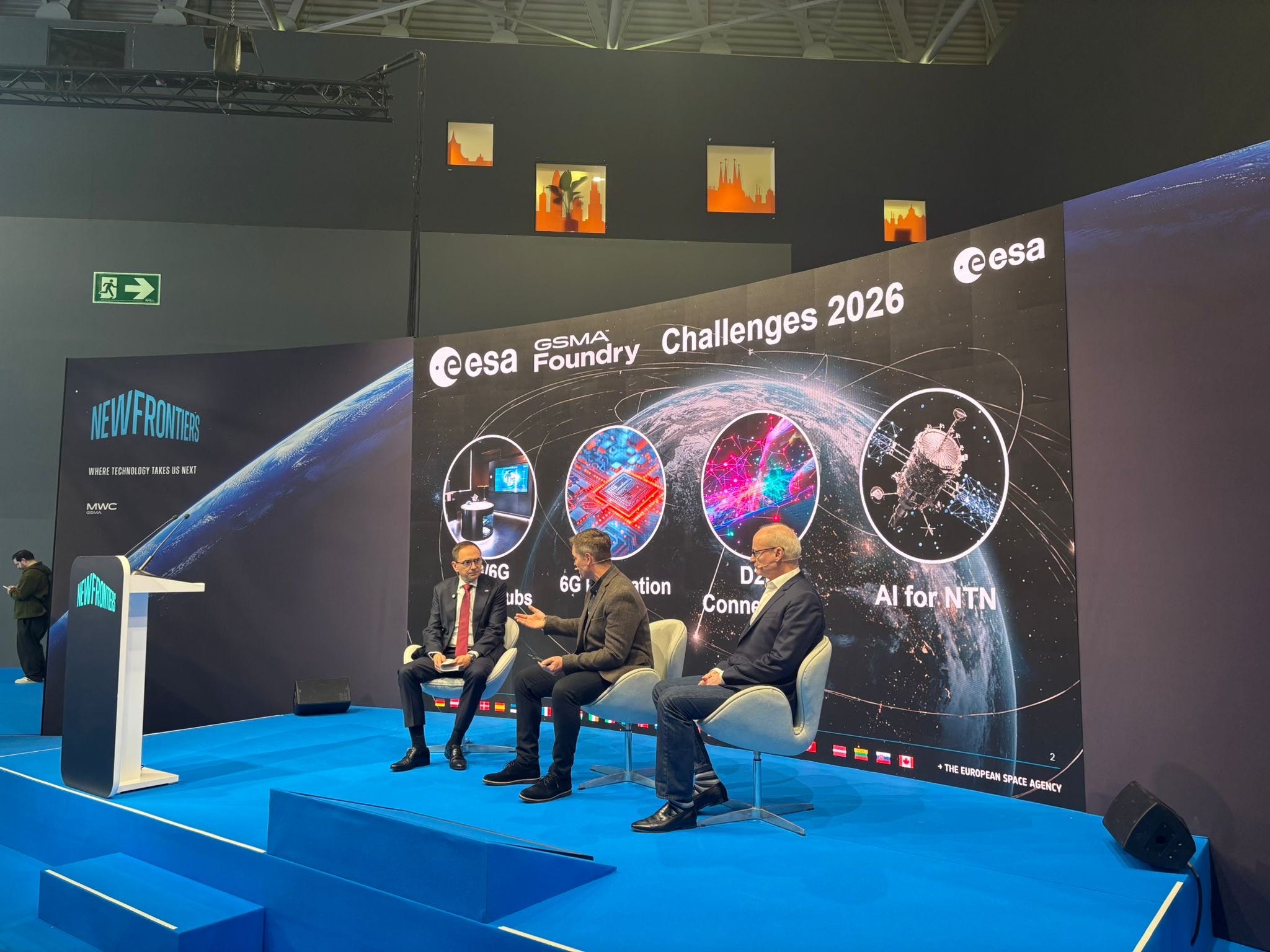
GSMA Foundry and the European Space Agency announced new funding worth up to €100 million for projects accelerating the convergence of space and mobile industries. The initiative targets four pillars: AI for non-terrestrial networks (NTN), direct-to-device (D2D) connectivity, 5G/6G collaborative testbed hubs and early-stage 6G innovation.
Laurent Jaffart, Director of Resilience, Navigation and Connectivity at ESA, said the funding was made possible by “Member States’ unwavering support” at the ESA Council at Ministerial Level (CM25). GSMA CTO Alex Sinclair added that the partnership demonstrates “hybrid networks are no longer a concept – they are a commercial reality.”
What’s new: The funding builds on the GSMA Foundry and ESA partnership established in 2024, which has already awarded projects to NextWorks, OQ Technology, Keysight and Sateliot, among others. Fifteen live NTN demonstrations were showcased at MWC in the New Frontiers zone. The programme specifically targets areas where satellite-terrestrial convergence will be critical for 6G.
Why this matters: Satellite-terrestrial integration is one of the most consistently cited requirements across 3GPP 6G Workshop submissions. ESA’s own submission called for a “single and unified 6G radio access technology” with no GNSS dependency, and a 30-company joint NTN submission led by Thales argued that non-terrestrial components must be integrated from day one of 6G design. This funding provides the practical R&D pipeline to test those concepts.
Implications for 6G standards: The funded projects across AI-driven NTN orchestration, D2D standards-based connectivity and 6G hub testbeds will generate data and prototypes that can feed directly into 3GPP Release 20 and 21 study items on NTN. The emphasis on standards-based D2D connectivity is particularly relevant as direct-to-device services move from proprietary implementations toward 3GPP-compliant architectures.
View source material to read more
SNS JU invests €116M in 20 new 6G projects
The European Smart Networks and Services Joint Undertaking (SNS JU) announced €116 million in funding for 20 new projects, expanding its portfolio to 100 projects and bringing total EU public funding allocated since 2021 to €630 million from Horizon Europe. An additional €270 million is planned for 2026 and 2027. Colin Willcock, Chairman of the SNS JU Governing Board, said the investment aims to set “global 6G standards that will not only strengthen European industrial leadership but also advance Europe’s technological sovereignty.”
What’s new: The 20 projects span vertical trials in healthcare (6G-CARE), logistics (GENIUS), media (6G-Holonet) and manufacturing (OPTIMUS-6G, PRIME-6G), alongside foundational 6G research in AI-native networks (Agentic6G, 6G-CATS), advanced radio technologies (SHARC, MULTIPLY-6G), quantum-AI integration (QUEST-6G) and security (PAISES-6G, SHIELD-6G). The SOVEREIGN-6G project will establish Europe’s first hybrid 6G Telco Cloud.
Why this matters: The scale of European investment in 6G R&D is now substantial. The two-pillar approach, combining near-term 5G deployment trials with long-term 6G research, ensures continuity across the standards timeline. The AI-native and security research streams align directly with 3GPP’s most active study areas. The over 1,000 standardisation contributions demonstrate that research output is being translated into standards influence.
Implications for 6G standards: Europe’s strategic goal is to shape global 6G standards through coordinated investment and research. With Nokia and Ericsson as anchor industrial players, plus a deep academic research community, the SNS JU programme provides a structured pipeline from research to 3GPP contributions.
View source material to read more
Huawei pushes U6GHz, service intelligence and agentic core networks
Huawei used MWC 2026 to advance three interconnected 6G themes. First, it launched a full U6GHz product suite covering macro, micro and microwave equipment, with its 256 TRX AAU delivering 100 Gbps downlink and 10 Gbps uplink using 400 MHz bandwidth. Second, it proposed a “Service Intelligence” concept for mobile broadband, aiming to evolve operator services from enhanced connectivity to intelligent, user-centric models. Third, Wireless CTO Dr Wen Tong introduced Agentic Core Networks, an AI-native 6G core architecture that uses agentic AI to detect user needs, predict intent and autonomously generate personalised services.
What’s new: The U6GHz product suite is commercially available and spans outdoor AAUs with ELAA design and digital-analog hybrid beamforming, indoor small cells supporting 400 MHz bandwidth, and full-duplex microwave for high-bandwidth transport. The Agentic Core Networks concept builds on Huawei’s January 2026 research paper on the “A-Core” architecture centred on NetGPT. At MWC, Dr Tong extended this into a strategic vision where applications can be “dynamically onboarded and iterated like plug-ins, cutting service rollout time from weeks down to minutes.”
Why this matters: Huawei’s three announcements form a coherent narrative: U6GHz provides the spectrum foundation, service intelligence defines the operator business model, and Agentic Core Networks provides the architectural platform. The U6GHz suite is significant because it demonstrates commercially available equipment for a band that is still undergoing regulatory allocation in most markets. The agentic core concept positions Huawei at the forefront of a broader industry shift toward AI-driven network autonomy.
Implications for 6G standards: The U6GHz products validate spectrum that is central to the global 6G allocation debate ahead of WRC-27. The Agentic Core Networks concept will likely inform Huawei’s 3GPP SA contributions, particularly as the standards body considers how AI-native capabilities should be embedded in 6G system architecture. Huawei’s position as one of the largest 3GPP contributors means these architectural proposals carry significant weight.
View source material to read more – U6GHz
View source material to read more – Service Intelligence
View source material to read more – Agentic Core Networks
Rohde & Schwarz and Qualcomm demonstrate FR1–FR3 carrier aggregation
Rohde & Schwarz and Qualcomm Technologies demonstrated carrier aggregation across FR1 (around 2.5 GHz) and FR3 (around 7 GHz) frequency ranges at MWC Barcelona 2026, using 4x4 MIMO on both bands with higher-order modulation. The demonstration used the Rohde & Schwarz CMX500 signalling tester extended with a new RFU18 board providing coverage up to 18 GHz. Tingfang Ji, VP of Engineering and Head of 6G Research at Qualcomm Technologies, said the collaboration “highlights the importance of aggregating existing spectrum bands with new 6G spectrum in FR3 to establish 6G as the high efficiency digital infrastructure for the 2030s.”
What’s new: The RFU18 is a modular hardware upgrade for the existing CMX500 platform, offering customers a path to extend frequency coverage to 18 GHz without replacing entire test systems. This is the first public demonstration of FR1–FR3 carrier aggregation with signalling-level validation, combining existing mid-band with the upper mid-band spectrum that is central to 6G planning.
Why this matters: Carrier aggregation across FR1 and FR3 will be fundamental to how 6G networks deliver both wide-area coverage and high capacity. The FR3 range (7.125 to 24.25 GHz) is widely regarded as the capacity “sweet spot” for 6G. The ability to test this at signalling level, rather than just at the RF layer, is a step toward validating device behaviour under realistic protocol conditions.
Implications for 6G standards: The FR3 frequency range featured prominently in 3GPP 6G Workshop submissions, with multiple vendors advocating for carrier bandwidths up to 400 MHz. This demonstration provides early validation of cross-band aggregation that will underpin 3GPP Release 20 study items on the 6G radio interface. Qualcomm’s involvement reinforces its commitment to FR3 as central to 6G device design.
View source material to read more
DOCOMO and VIAVI demonstrate AI-driven RAN control
NTT DOCOMO and VIAVI Solutions completed a joint study demonstrating AI-driven radio access network control for 6G, achieving up to 20% throughput improvement by reducing control overhead through digital twin and AI-based beam prediction. The demonstration was conducted in a simulated environment modelling multiple base stations around Tokyo Station. Hiroyuki Oto, SVP and GM of 6G-Tech at NTT DOCOMO, said:
“AI for network will contribute to the full spectrum of 6G values.”
What’s new: DOCOMO’s Self-awareness Network concept uses AI and digital twin technologies to predict optimal beams for each user equipment, reducing the need for conventional network quality measurements and reporting. The VIAVI TeraVM AI-RAN Scenario Generator provided AI-enabled predictions, with the digital twin generating measurements. Results confirmed that reducing measurement overhead freed wireless resources for data transmission.
Why this matters: Control signalling overhead is a persistent drag on wireless network efficiency. If AI-based prediction can reliably replace a portion of conventional measurement-and-report cycles, the capacity gains compound across the entire network. The 20% throughput improvement, while demonstrated in simulation, addresses a real bottleneck.
Implications for 6G standards: AI-driven beam management and overhead reduction are active areas of study within 3GPP. Simulation-based evidence of this kind helps build the case for standardising AI-native RAN control mechanisms in Release 20 and beyond.
View source material to read more
KT unveils 6G blueprint at MWC
South Korean operator KT presented its 6G vision at MWC 2026, built around six core technologies: ultra-connectivity, ultra-low latency, quantum-safe security, AI-native architecture, autonomous networks and semantic communication. Lee Jong-sik, EVP and Head of KT’s Network Research Institute, said:
“Beyond speed competition, we are preparing to deliver tangible customer experience innovation, cost structure transformation and the creation of new markets.”
What’s new: KT outlined a dual-track strategy of “AI-for-Network” and “Network-for-AI”, combining network optimisation through AI with infrastructure designed to support AI services. The operator plans coverage spanning land, sea and air, integrating non-terrestrial networks with terrestrial infrastructure through affiliate KT SAT. Semantic communication, transmitting only core meaning rather than entire datasets, is positioned as a new 6G paradigm for services including autonomous driving and remote robotic control. KT also introduced “supercell” technology for rapid disaster communications deployment.
Why this matters: KT’s 3GPP 6G Workshop submission emphasised customer value through infrastructure evolution, with specific priorities around the upper mid-band (7.125–8.4 GHz) and quantum-safe security. The MWC presentation expands on these themes with implementation detail. The semantic communication emphasis is notable; while the concept has appeared in research, KT is among the first major operators to position it as a core 6G network feature.
Implications for 6G standards: KT’s dual-track AI strategy aligns with the emerging consensus around AI-native 6G. The semantic communication push could gain traction as 3GPP considers how to handle the data explosion from AI agents and connected devices. The NTN integration through KT SAT provides a practical testbed for the terrestrial-satellite convergence that 6G demands.
View source material to read more
Intel positions Xeon platform as 6G evolution path
Intel used MWC 2026 to argue that the path from 5G to 6G should be built on inference-first compute foundations rather than architectural resets. Kevork Kechichian, EVP and GM of the Data Center Group, wrote that “progress will come from deploying intelligence responsibly and at scale across existing infrastructure.” Intel highlighted operator deployments including AT&T with Ericsson demonstrating AI-native link adaptation on Xeon 6 SoC with up to 20% throughput improvement, Vodafone committing to Xeon 6 SoC for large-scale Open RAN modernisation across Europe, and SK Telecom deploying Xeon 6 in its mobile core production environment.
What’s new: Intel previewed its next-generation Xeon 6+ processor, built on Intel 18A, designed for increased core density while reducing power consumption. The company explicitly pushed back against a “GPU-first worldview” for network AI, arguing that inference-heavy RAN workloads should match compute to workload type. The new RAN deployments with AT&T, Vodafone, Rakuten Mobile and SK Telecom demonstrate production-scale adoption of Xeon 6 SoC with built-in AI acceleration via AMX and vRAN Boost.
Why this matters: The CPU versus GPU debate for network AI is shaping how operators think about 6G infrastructure investment. Intel’s argument that most RAN inference can run on existing CPU platforms without separate accelerators addresses the cost and complexity concerns that operators consistently raise. The Xeon 6+ preview signals Intel’s roadmap continuity toward 6G-era silicon.
Implications for 6G standards: The compute platform debate sits largely outside 3GPP specifications, but the choice between CPU-based and GPU-based RAN processing influences what AI-native features are practically deployable. Intel’s 3GPP Workshop submission advocated for a unified AI/ML framework across use cases. Demonstrations of production AI-RAN on current silicon help calibrate the ambition of 6G AI-native specifications against what is economically deployable.
View source material to read more
Soitec and NTU Singapore achieve GaN milestones for 6G
Soitec and Nanyang Technological University, Singapore (NTU Singapore) announced results from a four-year joint research programme demonstrating high performance of Gallium Nitride (GaN) devices on Soitec’s advanced epitaxial wafers. Christophe Maleville, CTO at Soitec, said the research “clearly demonstrates the cornerstone role advanced engineered substrates will play in enabling 6G technologies.”
What’s new: Three technical papers demonstrate that GaN-on-Silicon can deliver record-level Power Added Efficiency (PAE) levels exceeding 50% at FR3 frequencies, confirming suitability for energy-efficient RF solutions. The results position GaN-on-Si as a complement to established Gallium Arsenide (GaAs) technologies for next-generation RF front-end modules, offering higher output power, improved thermal management and reduced system complexity.
Why this matters: Efficient power amplifiers at FR3 frequencies are a prerequisite for 6G deployment. The semiconductor supply chain for 6G radio components is an area of active concern, as covered in September 2025 when Ericsson and SweGaN announced a separate GaN-on-SiC collaboration for the 7–15 GHz range. The Soitec/NTU work takes a different approach, GaN-on-Silicon rather than GaN-on-SiC, which trades some peak performance for better cost, scalability and integration with existing silicon manufacturing.
Implications for 6G standards: While semiconductor materials sit outside 3GPP’s scope, the availability and performance of RF components at FR3 frequencies directly influences what 6G radio specifications can realistically deliver. Multiple approaches to GaN, whether on SiC or Si substrates, competing for 6G design wins is healthy for the ecosystem.
View source material to read more
White papers and reports published this week
BCG and Qualcomm map the 6G economic case
Boston Consulting Group, in collaboration with Qualcomm, published a report arguing that 6G networks will form the foundation for next-generation AI systems and estimating that 5G-enabled applications will approach $18 trillion in cumulative value creation by 2035. The report positions 6G as essential infrastructure for industrial automation, immersive experiences, smart cities, e-health and public safety.
Why this matters: The report provides a structured economic framework for 6G investment decisions, linking technical capabilities to measurable value creation. Its identification of four policy levers, namely timely spectrum access, open merit-based standards, sustained R&D investment and deep technical talent pipelines, aligns with the advocacy positions of operators and vendors in the 3GPP process. The $18 trillion 5G figure provides a baseline against which 6G economic projections will be measured.
View source material to read more
ETSI publishes two ISAC reports on architecture and security
ETSI’s Industry Specification Group on Integrated Sensing and Communications published two reports. ETSI GR ISC 003 defines architectural foundations for integrating sensing into 6G systems, examining 17 key challenges across system architecture, RAN architecture and lower-layer RAN, and proposing a reference model supporting monostatic, bistatic and multi-static sensing configurations. ETSI GR ISC 004 addresses security, privacy, trustworthiness and sustainability, identifying 19 key issues including protection against unauthorised sensing, safeguards against signal manipulation, secure handling of sensing data and consent mechanisms for sensing humans.
Why this matters: These two reports arrive at a critical moment, as 3GPP begins exploring 6G ISAC system and RAN architecture. The architectural report (GR ISC 003) provides the reference model and identifies the new RAN functionalities, such as sensing task coordination, measurement configuration and interference mitigation, that will need to be standardised. The security report (GR ISC 004) tackles the difficult questions that ISAC raises around privacy, including the sensing of non-connected humans and the risks of unauthorised surveillance.
View source material to read more – Architecture
View source material to read more – Security
Next G Alliance examines sustainable AI for 6G
The Next G Alliance published a white paper examining the dual impact of AI on sustainability in telecommunications: “AI for Sustainability” and “Sustainable AI.” The paper explores strategies to reduce embodied emissions in AI infrastructure, transition to renewable energy and minimise energy consumption of machine learning processes. It also examines how AI can enhance energy efficiency across RAN, core networks, user equipment and data centres.
Why this matters: As AI becomes foundational to 6G architecture, the energy cost of AI systems themselves becomes a critical concern. The paper addresses this tension directly, examining how AI-driven optimisation can improve network energy efficiency while acknowledging the significant computational demands of model training and deployment. The integration of AI with quantum computing, NTN and intent-based automation points to forward-looking areas where sustainability and performance intersect.