


6G news and analysis for the week ending Friday 6th March, 2026.
This is the second of three special editions covering 6G developments from MWC 2026 in Barcelona, focusing on the collaboration agreements. I’ll bring you a final report tomorrow.
If yesterday’s edition story was about mega-coalitions and political positioning, then today’s focus is more to do with execution. Qualcomm and Ericsson moved from concept to hardware by validating foundational 6G physical layer capabilities in joint lab prototypes, including a 400 MHz component carrier operating in the 6–8 GHz centimetre-wave range. This is the kind of work that translates vision into specifications: two of the industry’s most influential standards contributors demonstrating technical alignment on the radio building blocks that will underpin 3GPP Release 20 study items.
T-Mobile was quite an active collaborator this week. Through a new transatlantic 6G Innovation Hub with parent Deutsche Telekom, an expanded strategic partnership with Qualcomm, and appearances in both the NVIDIA and NokiaAI-RAN initiatives covered in our last edition, the US operator is staking a claim as a central player in shaping 6G’s direction. The “Physical AI” framing adopted by the innovation hub, where networks become the connective tissue for systems that interact with and control the physical world, represents an evolution beyond the familiar “faster broadband” narrative. Deutsche Telekom is all on board with this too.
Meanwhile, Nokia provided tangible evidence that AI-RAN is moving from concept to production. Functional tests of GPU-accelerated RAN workloads with T-Mobile, Indosat and SoftBank, each demonstrating different aspects of the technology, mark a clear step up in maturity. And in a quieter but significant development, Ericsson signed dual 6G research MoUs with both Türk Telekom and Turkcell, giving it a broad research footprint in a market that is actively building its 6G credentials.
A quick plug for TelecomTV... I’ve been busy all week producing and presenting The Slice news programme, and recommend you try and watch them if you want a more comprehensive look at the developments from MWC, as well as insights from some of the industry’s senior leaders.
Finally, this week’s research papers reinforce the AI-native theme, with notable work on compact language models for edge deployment and LLM-driven intent orchestration for Open RAN.
T-Mobile expands 6G ambitions across two continents
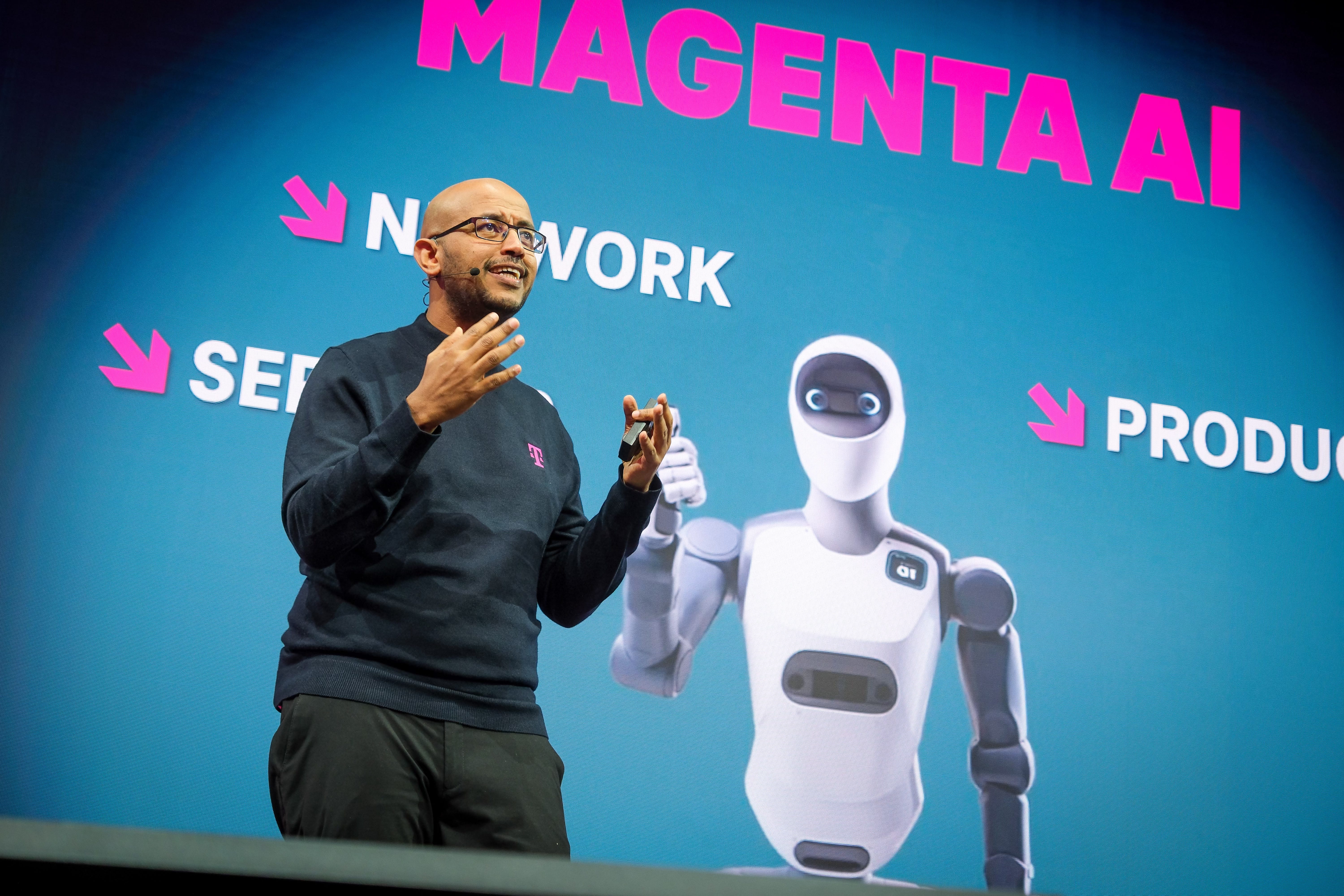
T-Mobile and Deutsche Telekom launched a joint 6G Innovation Hub spanning T-Mobile’s Innovation Lab in Bellevue, Washington and T-Labs in Berlin. The transatlantic initiative focuses on three pillars: AI-native and autonomous networks, secure wide-area sensing and positioning, and convergence of connectivity and high-performance compute. John Saw, President of Technology and CTO at T-Mobile, said:
“Physical AI is different. Data must carry intent, context and timing to trigger real-world action, what we describe as operational ‘kinetic tokens,’ requiring deterministic performance, ultra-low latency and precise synchronisation.”
Separately, Qualcomm and T-Mobile announced an expanded strategic collaboration to accelerate the transition from 5G Advanced to 6G, with commercial deployments targeted from 2029. The partnership covers all three of what Qualcomm calls the pillars of 6G: advanced connectivity, integrated sensing, and energy-efficient high-performance compute.
What’s new: The T-Mobile/Deutsche Telekom hub introduces the concept of “Physical AI” as its organising principle, where 6G networks serve as the connective tissue enabling systems that interact with and control the physical world in real time. The “kinetic tokens” framing distinguishes between informational data (today’s AI) and operational data that triggers real-world action. The Qualcomm partnership deepens an existing relationship, with both companies committing to pre-commercial trials spanning connectivity, sensing and compute. T-Mobile explicitly positions itself as helping to shape 6G foundational technologies, leveraging its nationwide 5G Standalone credentials.
Why this matters: T-Mobile is emerging as one of the most active US operators in 6G positioning. Within a single week at MWC, it appeared in the NVIDIA AI-native platform coalition, the Nokia/NVIDIA AI-RAN functional tests, this Qualcomm collaboration, and its own innovation hub with parent Deutsche Telekom. The transatlantic structure is notable, linking the largest US and European mobile markets under coordinated 6G R&D. The “Physical AI” concept aligns with the broader industry shift toward treating 6G as infrastructure for autonomous systems, robotics and industrial automation rather than simply faster mobile broadband. Deutsche Telekom board member Abdu Mudesir described this as a “fundamentally changing” role for networks.
Implications for 6G standards: The hub’s focus on sensing, positioning and compute convergence maps directly onto IMT-2030 usage scenarios and active 3GPP study items. T-Mobile’s commitment to working with Qualcommon pre-commercial trials provides a path from lab prototypes to standards-informed deployment. The emphasis on a “unified global 6G standard” in the hub’s description signals alignment with the single-standard approach that operators have consistently advocated through 3GPP.
View source material to read more
Also: Qualcomm and T-Mobile collaboration
Qualcomm and Ericsson validate 6G physical layer
Qualcomm and Ericsson announced at MWC 2026 that they have achieved technical alignment on fundamental 6G radio innovations, validating key physical layer capabilities through joint lab prototypes. The partners demonstrated a 400 MHz component carrier with 30 kHz subcarrier spacing, aligned with proposed 3GPP Release 20 study items. They are also exploring performance in the cmWave range around 6–8 GHz. Erik Ekudden, CTO of Ericsson, said:
“Partnering with Qualcomm, we are transforming 6G from a concept into reality by validating its foundational capabilities through real-world prototypes.”
What’s new: This moves the Qualcomm-Ericsson relationship from coalition-building into actual hardware validation. The prototype work includes foundational 6G physical layer concepts tested in lab environments, with live MWC demonstrations. The cmWave exploration at 6–8 GHz specifically examines device capabilities with four transmit-receive antennas, providing early data on how new spectrum will perform at the device edge. The partners are also prototyping AI and AR experiences with new device form factors and resilient infrastructure.
Why this matters: Lab prototype validation is a critical step between concept papers and pre-commercial systems. With Qualcomm committed to pre-commercial 6G devices by 2028 (as reiterated through its mega-coalition announced yesterday), demonstrating that fundamental radio concepts work in hardware becomes essential. The 6–8 GHz focus is significant because this spectrum sits at the heart of the emerging global consensus for 6G upper mid-band allocation. The emphasis on uplink performance and wide-area reliability reflects the consistent operator demand documented across 3GPP 6G Workshop submissions. The joint work with leading operators on AI-native, context-aware networking extends the collaboration beyond radio into the device-network compute paradigm that both companies see as central to 6G.
Implications for 6G standards: The 400 MHz component carrier at 30 kHz subcarrier spacing is explicitly positioned as input to 3GPP Release 20 study items. The cmWave exploration provides practical data for spectrum performance decisions ahead of WRC-27. Both companies are significant 3GPP contributors, and joint alignment on physical layer fundamentals between the leading chipset maker and a leading infrastructure vendor carries weight in the standards process.
View source material to read more
Nokia advances AI-RAN with NVIDIA operator trials
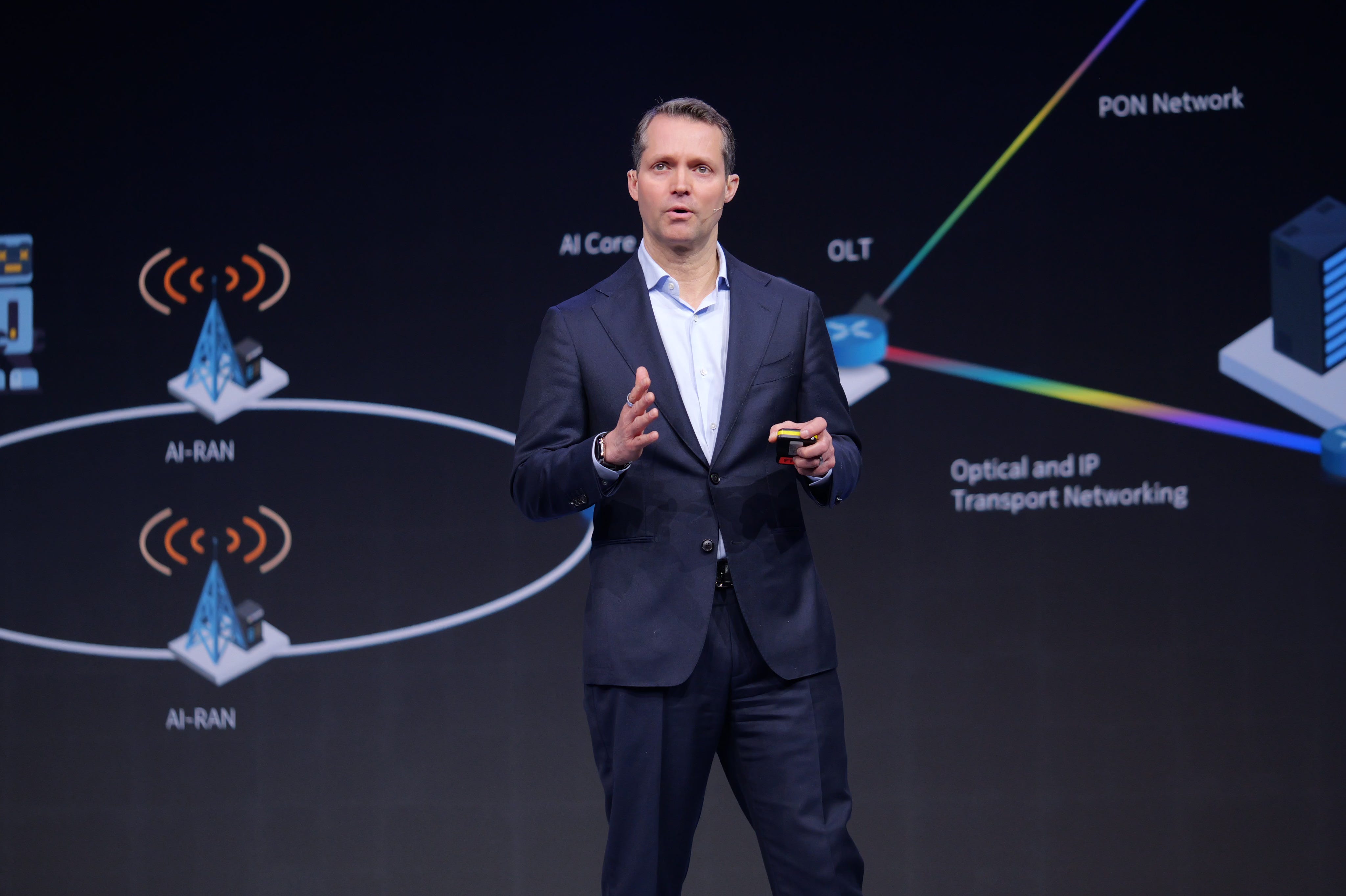
Nokia announced significant progress in its AI-RAN partnership with NVIDIA, including new customer integrations and successful functional tests of GPU-accelerated AI-RAN workloads. The collaboration now spans operators including BT, Elisa, NTT DOCOMO, Vodafone Group, T-Mobile US, Indosat and SoftBank. Justin Hotard, President and CEO of Nokia, said:
“AI-RAN transforms RAN into a software-driven platform optimized for AI, and with NVIDIA and a growing ecosystem of partners we are progressing from validation to commercial deployment.”
What’s new: Nokia has completed functional tests with three operators. At T-Mobile’s AI-RAN Innovation Centre in Seattle, Nokia’s AirScale Massive MIMO radio ran concurrent AI and RAN processing on a single NVIDIA Grace Hopper 200 server. Indosat achieved Southeast Asia’s first AI-RAN-powered Layer 3 5G call at MWC, proving AI and RAN workloads can run simultaneously on shared GPU infrastructure. SoftBank demonstrated how spare AI-RAN compute capacity can run third-party AI tasks, a significant step toward RAN monetisation beyond connectivity. The ecosystem has expanded to include Dell Technologies, Quanta, SuperMicro and Red Hat.
Why this matters: AI-RAN is transitioning from concept towards operational validation. The three operator trials each demonstrate a different dimension: T-Mobile validates concurrent workloads on commercial hardware, Indosat proves it works in a live operator environment, and SoftBank shows the monetisation pathway. The expanded server vendor ecosystem (Dell, Quanta, SuperMicro) means operators will have COTS-based infrastructure choices, a critical requirement for commercial-scale deployment. The collaboration with Red Hat on OpenShift provides the cloud-native orchestration layer needed to manage AI and RAN workloads across hybrid environments.
Implications for 6G standards: AI-RAN is increasingly positioned as the bridge between 5G Advanced and AI-native 6G. While GPU-based RAN processing remains an implementation choice rather than a standards requirement, the growing operator adoption creates de facto industry direction. The AI-RAN Alliance’s architectural guidance, referenced in the SoftBank demonstration, could influence how 3GPP members define the interface between AI workloads and RAN functions in Release 20 and beyond.
View source material to read more
Ericsson signs dual 6G research deals in Türkiye
Ericsson signed separate MoUs at MWC 2026 with both Türk Telekom and Turkcell to advance 6G research and development in Türkiye. The Türk Telekom agreement, signed with senior Turkish government officials present, focuses on shaping emerging 6G standards through joint R&D projects and scientific publications. It builds on a previous collaboration announced last year. The Turkcell partnership establishes a dedicated 6G R&D programme.
What’s new: The two deals give Ericsson a broad footprint across Türkiye’s two largest operators. The Turkcell scope is notably specific, targeting four technology domains that map directly onto key 6G building blocks: autonomous networks, agentic AI, integrated sensing and communication (ISAC) and digital twins. The Türk Telekom agreement extends beyond bilateral R&D to include joint contributions to global 6G standards definition. Turkcell CEO Ali Taha Koç positioned the deal as building on the operator’s 5G foundation, stating the company has achieved “a frequency portfolio that is unparalleled in Türkiye.”
Why this matters: Türkiye’s 6G positioning is accelerating. Following last week’s coverage of the InterDigital/Türk Telekom collaborative cellular-Wi-Fi sensing demonstration, these Ericsson partnerships signal that Turkish operators are actively building 6G research capabilities rather than waiting for standards to be finalised. However, it is worth noting that Türkiye is still in the early stages of 5G deployment. Ericsson’s Mehmet Oğul acknowledged this directly: “In Türkiye, the era of 5G is beginning to unfold.” The dual-MoU strategy gives Ericsson research partnerships with both major Turkish operators, strengthening its position in a market that could become a significant 6G testbed.
Implications for 6G standards: The explicit focus on contributing to 6G international standardisation, particularly in the Türk Telekom deal, suggests that Turkish operators are seeking a more active role in 3GPP processes.
View source material to read more
Also: Turkcell and Ericsson partnership
MediaTek and SUTD launch S$34m 6G lab in Singapore
MediaTek and the Singapore University of Technology and Design (SUTD) launched a joint 6G research laboratory with a total committed investment of over S$34 million (approximately US$25 million). The lab will study non-terrestrial networks (NTN), AI-native radio systems and energy efficiency in telecoms infrastructure. It builds on an existing partnership between the two organisations that began in 2024.
What’s new: The lab represents the next phase of Singapore’s Future Communications Research and Development Programme, a national initiative launched in 2021 by the Infocomm Media Development Authority and the National Research Foundation Singapore. SUTD already hosts labs aligned with the O-RAN Alliance and the AI-RAN Alliance, and this collaboration brings MediaTek’s modem and AI chipset expertise into earlier phases of system design. The S$34 million investment is substantial for a bilateral academic-industry 6G lab in Southeast Asia.
Why this matters: MediaTek is one of the world’s largest fabless semiconductor companies and an active stakeholder in 3GPP standardisation. The lab gives Singapore, and MediaTek, a platform to generate credible research that can feed into standards development. The focus on NTN, AI-native radio and energy efficiency addresses three of the most active areas in the pre-6G research agenda. As MediaTek’s 3GPP Workshop submission emphasised, the company sees a “6G Nucleus” approach that maximises device economies of scale, and lab-generated data on chipset-level performance will directly inform that strategy.
Implications for 6G standards: Countries that contribute credible 6G research are better positioned to influence 3GPP specifications. Singapore’s investment through this national programme reflects a deliberate strategy to participate in standards-shaping. The combination of MediaTek’s commercial chipset perspective with academic research could produce practically grounded contributions, particularly around NTN integration and AI-native radio design, both of which are active 3GPP Release 20 study areas.
View source material to read more
Selected research papers published this week
Multi-band sensing tackles 6G’s FR3 challenge
Researchers from New York University Abu Dhabi have proposed a novel approach to multi-band sensing in the FR3 frequency range (7–24 GHz), addressing one of the practical challenges of ISAC in 6G. The paper introduces a channel analysis framework that accounts for dense multipath components (clutter, diffraction and diffuse scattering) that vary across non-contiguous sub-bands. A proposed multi-band estimator achieves reductions of 37% and 17% in delay estimation error compared to single-band approaches at 8.75 GHz and 21.7 GHz respectively.
Why this matters: ISAC is one of the six primary usage scenarios defined for IMT-2030. As 6G pushes into FR3 with its non-contiguous sub-bands, understanding how sensing performance varies across these frequencies is essential. The paper provides practical guidance on the trade-offs between different sub-bands and demonstrates that combining data across bands significantly improves accuracy, directly informing how multi-band ISAC could be implemented in future 3GPP specifications.
View source material to read more
Tiny language models could power 6G edge reasoning
A research team led by Mohamed Amine Ferrag has published a systematic study of compact language models for network-level semantic reasoning in AI-native 6G systems. Using a new benchmark called 6G-Bench (30 decision-making tasks across five capability domains), the study evaluates models ranging from 135 million to 7 billion parameters. The key finding is that mid-scale models in the 1.5–3 billion parameter range achieve the best balance between reasoning accuracy and computational efficiency for edge deployment.
Why this matters: The study addresses a fundamental tension in AI-native 6G: frontier-scale language models are too large for latency-sensitive edge deployment, but very small models lack reasoning stability. The finding that a “sweet spot” exists around 1.5–3B parameters, where accuracy rises sharply while computational demands remain manageable, provides practical guidance for how AI reasoning could be embedded in 6G network infrastructure without requiring data-centre-scale compute at every node.
View source material to read more
AI agents proposed for unified RAN-core intelligence
Researchers including Tarik Taleb have proposed an AI agent-based framework that converges intelligence across the radio access network (RAN) and core network (CN), using a large language model integrated with the Reasoning and Acting (ReAct) paradigm. Unlike conventional task-specific AI models that require frequent retraining, the framework enables an AI agent to dynamically reason over cross-domain network state information and generate adaptive control policies through a closed-loop process.
Why this matters: Current AI approaches in networks deploy separate, task-specific models in the RAN and core, creating fragmented decision-making and high maintenance overhead. This paper proposes a unified intelligence layer that spans both domains without model retraining, addressing a key scalability concern for AI-native 6G. The experimental results showing strong generalisation to previously unseen network scenarios are relevant to 3GPP’s ongoing discussions about how AI/ML should be integrated into the network architecture.
View source material to read more
LLM-driven intent orchestration for Open RAN
Researchers from Brazil have proposed ORION, an O-RAN-compliant intent orchestration framework that uses large language models via the Model Context Protocol (MCP) to translate natural language intents into enforceable network policies. The framework uses a hierarchical agent architecture spanning the Service Management and Orchestration (SMO) layer, Non-Real-Time RIC and Near-Real-Time RIC. Evaluations using GPT-5, Gemini 3 Pro and Claude Opus achieved 100% policy generation success for high-capacity models.
Why this matters: Intent-based networking is widely discussed as essential for autonomous 6G operations, but the gap between high-level business intents and low-level network configurations remains largely unresolved. ORION demonstrates that LLMs can bridge this translation gap within the existing O-RAN architecture, from natural language through to E2-level enforcement. The trade-offs in reasoning efficiency across different models highlight practical considerations for deploying such systems at scale.