


6G news and analysis for the week ending Friday, 3rd April, 2026.
South Korea dominated this week’s news, with the government approving a three-year national roadmap that anchors its digital future on 6G commercialisation by 2030 and a drive to become a top-three global AI power by 2028. The plan, which covers infrastructure upgrades, talent pipelines and cross-sector AI adoption, sits alongside a new LG Uplus and LG Electronics partnership targeting semantic communication and post-quantum cryptography for 6G. Together, these moves reinforce the systematic Korean approach to 6G positioning that we have tracked through the AI Native Alliance (AINA), the Samsung 6G investment fund and the Finland bilateral talks covered in our post-MWC edition.
In addition, SK Telecom and NTT DOCOMO published their latest joint white paper, this time focused on the enabling features for vRAN evolution and the path to AI-RAN. The paper, the fourth output from their cooperation since 2022, makes the operator case for strict hardware-software separation, resource pooling and xPU-based AI computing capabilities in future base stations. Meanwhile, NVIDIA expanded its AI infrastructure ecosystem through a $2 billion investment in Marvell Technology, with explicit collaboration on AI-RAN for 5G/6G alongside silicon photonics.
This week’s research papers are particularly strong, with a techno-economic analysis of AI-RAN deployments claiming up to 8x return on investment for GPU-based RAN architectures, and three papers advancing key 6G physical layer technologies: ISAC sensing within 3GPP NR, reconfigurable intelligent surfaces, and a mobility-adaptive waveform framework that builds on the OFDM baseline confirmed by 3GPP for 6G.
Korea unveils three-year AI and 6G roadmap
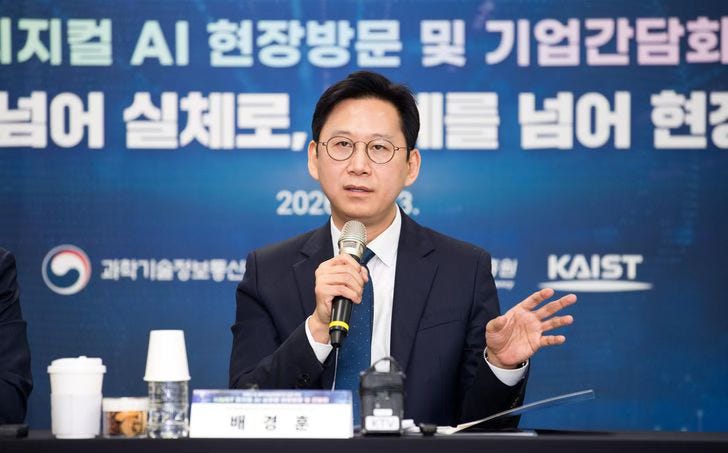
The Ministry of Science and ICT approved a comprehensive three-year national roadmap to position South Korea as a top-three global AI power by 2028, with 6G commercialisation targeted for 2030. The plan was finalised at an Information Communications Strategy Committee meeting on 27 March. Science and ICT Minister Bae Kyung-hoon has been leading the initiative. The strategy was reported by several news outlets including the Korea Times and the official government website Korea.net.
The roadmap is structured around four pillars: expanding digital infrastructure, strengthening digital capabilities, advancing national intelligent information and creating an inclusive digital environment. On infrastructure, the government will upgrade nationwide 5G networks to standalone mode and accelerate 6G technology development. The plan also covers cybersecurity reinforcement, a national integrated data platform and support for AI, semiconductors, quantum computing and blockchain.
What’s new: This is the formal government-level codification of the 6G and AI ambitions that South Korea has been signalling through industry initiatives. The plan goes beyond telecoms to encompass AI adoption across manufacturing, healthcare, agriculture and public services, with talent development programmes from high school through graduate level. A “data safety option” will ensure users retain basic communication services even after exhausting data plans.
Why this matters: South Korea’s 6G strategy is now operating at multiple levels simultaneously, as we reported in March. This three-year roadmap adds the government policy framework, including concrete commitments on 5G SA upgrades as a 6G foundation. Korea’s track record in accelerating mobile technology adoption and its active 3GPP participation through TTA give these ambitions substance, though the “top-three AI power” target should be treated as aspirational policy rhetoric.
Implications for 6G standards: The 2030 commercialisation target is consistent with the 3GPP timeline for Release 21 completion and initial deployments. The emphasis on 5G SA as a prerequisite for 6G migration aligns with the broad industry consensus. The cross-sector AI integration ambitions could generate use case requirements that feed into Korean contributions to 3GPP SA1 service requirements.
View source material to read more
SKT and DOCOMO chart the vRAN-to-AI-RAN path
SK Telecom and NTT DOCOMO published a joint white paper on the key enabling features for vRAN evolution and the path to AI-RAN. This is the latest output from a technical cooperation that began in November 2022 and has already produced papers on green mobile networks (February 2023), 6G requirements (February 2023) and vRAN deployment considerations (February 2024).
The white paper identifies three critical technical requirements. First, strict separation of hardware and software to allow RAN software to be deployed independently from underlying infrastructure. Second, resource pooling technologies to enable capacity improvements and power consumption reductions without compromising service quality. Third, realisation of AI computing capabilities by leveraging xPU-based architectures, enabling base stations to deliver both connectivity and AI services simultaneously.
Yu Takki, Head of Network Technology Office at SK Telecom, said the white paper presents, from a mobile operator’s perspective, “the key features essential for maximising the benefits of vRAN adoption and for the future evolution toward AI-native networks.” Masafumi Masuda, General Manager of Radio Access Design Department at NTT DOCOMO, expressed hope that the paper would “further strengthen cooperation between the two major mobile operators in East Asia.”
What’s new: While the previous 2024 paper focused on deployment and operational considerations for vRAN (specifically L1 accelerator selection), this paper shifts to the architectural requirements for evolving vRAN into an AI-RAN platform. The emphasis on xPU-based architecture enabling dual-purpose base stations, serving both mobile communication and AI workloads, reflects the AI-RAN concept that NVIDIA, Nokia and others have been advancing through commercial partnerships.
Why this matters: This paper represents the operator perspective on a conversation that has been largely driven by vendors and silicon companies. SKT published its comprehensive ATHENA architecture white paper in February, and its recent MoU with Ericsson (covered in our 20th March edition) extends AI-RAN collaboration to 2031. DOCOMO is a key partner in the Nokia/NVIDIA AI-RAN trials and has been a significant voice in 3GPP 6G architecture discussions. When the two largest operators in Korea and Japan jointly specify what they need from vRAN evolution, vendors pay attention. The three requirements map closely onto the architectural direction that the broader industry is heading: disaggregated, software-defined, compute-flexible RAN infrastructure.
Implications for 6G standards: The strict hardware-software separation requirement reinforces the cloud-native, disaggregated architecture principles that operators have consistently advocated in 3GPP. The resource pooling requirement connects to energy efficiency and TCO reduction goals that feature prominently in 3GPP 6G requirements studies. The AI computing capability requirement aligns with the emerging consensus that 6G RAN infrastructure must support workloads beyond pure connectivity.
View source material to read more
NVIDIA and Marvell partner on AI infrastructure and AI-RAN
NVIDIA and Marvell Technology announced a strategic partnership connecting Marvell to NVIDIA’s AI factory and AI-RAN ecosystem through NVLink Fusion. NVIDIA has invested $2 billion in Marvell. The collaboration will see Marvell provide custom XPUs and NVLink Fusion-compatible scale-up networking, while NVIDIA supplies Vera CPU, ConnectX NICs, BlueField DPUs, NVLink interconnect and Spectrum-X switches.
Jensen Huang said the partnership enables customers to “leverage NVIDIA’s AI infrastructure ecosystem and scale to build specialized AI compute.” Matt Murphy, chairman and CEO of Marvell, highlighted the importance of “high-speed connectivity, optical interconnect and accelerated infrastructure in scaling AI.”
The companies will also collaborate on transforming telecommunications networks into AI infrastructure with NVIDIA Aerial AI-RAN for 5G/6G, and advance optical interconnect solutions including silicon photonics technology.
What’s new: This is NVIDIA’s second multi-billion-dollar strategic investment in the telecoms-adjacent infrastructure space, following its $1 billion stake in Nokia in October 2025. The NVLink Fusion platform enables heterogeneous AI infrastructure where Marvell’s custom silicon integrates seamlessly with NVIDIA GPU, networking and storage platforms. The explicit reference to AI-RAN for 5G/6G extends the partnership beyond pure data centre infrastructure into the telecoms domain. The silicon photonics collaboration addresses the optical interconnect bottleneck that becomes critical as AI infrastructure scales.
Why this matters: NVIDIA is systematically building a vertically integrated AI infrastructure ecosystem that now encompasses GPU compute (NVIDIA), RAN software and hardware (Nokia), custom silicon and optical networking (Marvell), and server platforms (Dell Technologies). For telecoms operators, the Marvell partnership is significant because it addresses the custom silicon and high-speed interconnect layers that AI-RAN architectures will require at scale. Marvell already supplies networking ASICs and optical DSPs to major hyperscalers, and bringing this capability into the NVIDIA AI-RAN ecosystem strengthens the supply chain for GPU-accelerated base stations. The $2 billion investment is also the largest in NVIDIA’s recent telecoms-adjacent investment spree.
Implications for 6G standards: While this is primarily an ecosystem and supply chain announcement rather than a standards play, the growing NVIDIA infrastructure ecosystem creates de facto architectural direction for AI-RAN deployments. The custom XPU capability through NVLink Fusion could influence how vendors implement the accelerated computing platforms that 6G RAN specifications are likely to accommodate. The silicon photonics work is relevant to the fronthaul and midhaul connectivity requirements that 3GPP will need to address for disaggregated 6G architectures.
View source material to read more
LG Uplus and LG Electronics target 6G AI communications
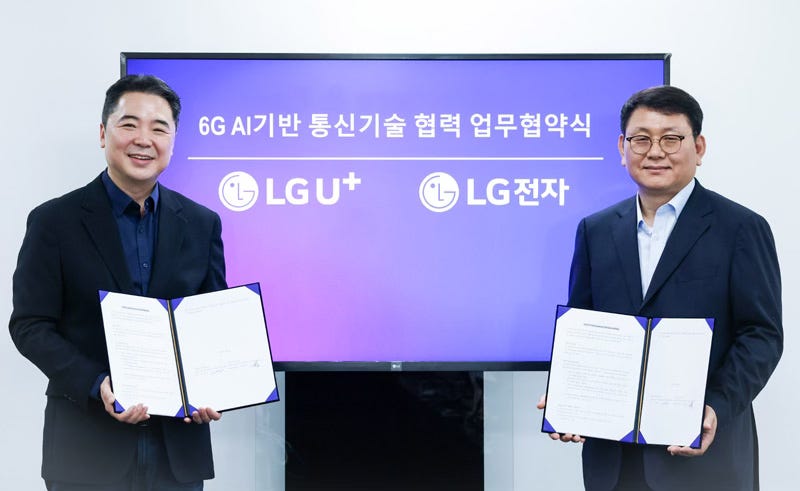
LG Uplus and LG Electronics signed a memorandum of understanding to jointly develop AI-driven communication technologies and collaborate on international standardisation for the 6G era. The agreement, announced on 2 April, focuses on semantic communication and post-quantum cryptography (PQC). The signing ceremony was held at LG Science Park in Seoul, with Lee Sang-yup, CTO of LG Uplus, and Je Young-ho, head of LG Electronics’ C&M Standard Research Institute.
Under the partnership, LG Uplus will evaluate real-world applications of semantic communication in network environments and identify security requirements. LG Electronics will research the architecture and algorithms behind semantic communication and develop core technologies for devices and platforms. On PQC, both companies will jointly analyse technology trends and contribute to standard specifications. The collaboration reportedly reflects LG Group’s broader effort to extend its technological leadership across both telecommunications and devices into 6G.
Lee Sang-yup said that the convergence of AI and communications “will be a defining factor in technological competitiveness in the 6G era.”
What’s new: This is the first formal joint 6G R&D agreement between the two LG affiliates, creating a structured operator-device manufacturer pipeline for 6G technology development. The focus areas are notable: semantic communication, which uses AI to transmit meaning rather than raw data, is an emerging research area that could fundamentally change how networks handle traffic. PQC is gaining urgency as quantum computing threatens conventional encryption. The combination of network-side evaluation (LG Uplus) and device-side technology development (LG Electronics) creates an end-to-end research chain.
Why this matters: Both companies are active 3GPP contributors. LG Uplus submitted a detailed vision to the 2025 3GPP 6G Workshop emphasising sustainability, intelligence and enhanced user experience. LG Electronics also demonstrated full duplex radio at its Future 2030 Summit last October and joined the Qualcomm-led Global 6G Alliance at MWC. The partnership signals that the LG group is coordinating its 6G efforts across the operator and device sides of the business. Semantic communication is still largely a research topic, but KT specifically called for it in its 3GPP Workshop submission, suggesting Korean operators see it as a potential 6G differentiator.
Implications for 6G standards: Semantic communication is not yet a 3GPP work item, but it is attracting growing research attention and could emerge as a study item in Release 21 or beyond. PQC, by contrast, is already on the 3GPP radar — SA3 identified it as one of three highest-impact security areas for 6G at its August 2025 meeting in Gothenburg. The joint operator-device manufacturer approach gives LG a coordinated voice in both RAN and device-side standardisation discussions.
View source material to read more
Selected research papers published this week
AI-RAN economics: up to 8x return on investment
Researchers from Northeastern University presented a techno-economic analysis of AI-RAN deployments, combining publicly available 5G L1 processing benchmarks with realistic traffic models and AI service demand profiles. The study evaluates the surplus compute capacity available in GPU-based RAN deployments and models the returns from leasing idle capacity to AI inference tenants. The results claim that GPU-heavy deployments can achieve up to 8x return on investment when AI-on-RAN revenue offsets the additional capital and operational costs.
Why this matters: The economic case for AI-RAN has been asserted by vendors but rarely substantiated with independent analysis. This paper provides the first detailed techno-economic framework combining real L1 benchmarks across heterogeneous platforms (from x86 servers with accelerators to modern GPUs) with token depreciation models and AI demand dynamics. The finding that AI-RAN economics can work across diverse GPU serving densities strengthens the long-term investment case that NVIDIA, Nokia, SK Telecom and others are building. However, as the authors note, the 5G era has not delivered expected returns, making independent economic validation of 6G architectures essential before operators commit capital.
View source material to read more
ISAC sensing limits under 3GPP NR constraints
Researchers from the University of Malaga analysed the fundamental limits of integrated sensing and communications within the 3GPP New Radio framework. The paper examines range and velocity estimation through Cramér-Rao lower bounds for a monostatic UAV sensing use case under active 3GPP consideration. Key findings include that multi-slot signal exploitation is necessary to meet 3GPP-defined sensing performance targets, and that the existing 5G NR positioning reference signal becomes suitable for velocity estimation when multi-slot processing is employed. The authors also propose a two-step estimator that outperforms conventional maximum-likelihood approaches over a wider distance range.
Why this matters: ISAC is one of six primary IMT-2030 usage scenarios and a prominent feature of virtually every 3GPP 6G Workshop submission. This paper provides quantitative evidence on whether existing NR signal structures can meet the sensing accuracy requirements that 3GPP is currently defining, and identifies the processing techniques needed to bridge the gap. The finding that purpose-designed sensing reference signals outperform repurposed communication signals has direct implications for the sensing-communication resource allocation trade-offs that 3GPP RAN1 must resolve.
View source material to read more
Energy-efficient RIS-assisted indoor 6G networks
Researchers from Chalmers University of Technology and Lund University proposed an optimisation framework for maximising energy efficiency in reconfigurable intelligent surface (RIS) assisted distributed MIMO systems for indoor 6G deployments. The framework jointly optimises access point power allocation and RIS phase configurations under realistic power consumption models. Results demonstrate clear energy efficiency gains over baseline approaches, with design insights for practical RIS deployment including evaluation of centralised versus per-RIS controller architectures.
Why this matters: RIS is a candidate enabling technology for 6G that promises to improve coverage and energy efficiency by controlling the radio propagation environment. This paper moves beyond theoretical bounds to provide practical design guidance for indoor deployments, where distributed MIMO combined with RIS could address the coverage challenges that operators face with higher-frequency 6G spectrum. The evaluation of different controller architectures has direct relevance to network deployment cost and complexity.
View source material to read more
Intelligent Reflection as a Service for 6G
Researchers from China proposed IRaaS (Intelligent Reflection as a Service), a system architecture and deployment strategy for integrating RIS into mobile networks. The concept leverages resource pooling, service-based architecture, cloud infrastructure and model-free signal processing to deliver on-demand intelligent reflection services without requiring radical changes to existing communication protocols. The paper also proposes a commercial deployment model that balances the interests of telecom operators, RIS service vendors and property owners.
Why this matters: While most RIS research focuses on physical layer optimisation, this paper addresses the practical deployment and commercial model questions that will determine whether RIS achieves meaningful adoption. The service-based approach, which aligns RIS with the cloud-native architecture direction of 6G, offers a pragmatic path to deployment that avoids wholesale network overhaul. The three-way commercial model between operators, vendors and property owners is a realistic framing of the deployment challenges.
View source material to read more
Mobility-adaptive waveform framework for 6G
Researchers from institutions including Chalmers University of Technology presented GS-OFDM (gear-switching OFDM), a unified framework in which base stations adaptively select among three processing modes — from legacy OFDM to delay-Doppler domain processing — based on channel mobility conditions. The work builds on the GEARBOX-PHY vision and addresses the performance degradation of standard OFDM in the high-mobility scenarios envisioned for 6G, such as high-speed transport and vehicle-to-everything communications.
Why this matters: 3GPP has confirmed OFDM as the baseline waveform for 6G, but high-mobility scenarios expose its well-known limitations. This paper proposes a practical approach that preserves backward compatibility with legacy OFDM while enabling advanced processing when mobility conditions demand it. The adaptive gear-switching concept is architecturally efficient because it avoids mandating a single new waveform, instead allowing the network to select the optimal processing mode per user. This approach aligns with the 3GPP principle of evolutionary design and minimal unnecessary complexity.