


6G news and analysis for the week ending Friday, 10th April, 2026.
Welcome to all our new readers (thank you Dean); you’ve picked a quiet week to join! Quite a lot of noise but not a lot of substance.
Yesterday I watched a 3GPP/ATIS webinar on study items. Great overview by the chairs of the SA and RAN TSG, but not a lot of new information that we haven’t already covered. I was surprised the capex/opex research item on architecture and migration wasn’t verbally highlighted as I think this could turn out to be a contentious point - we will have to wait until June to find out. Also of note, I get the feeling that ISAC is not going to feature as prominently as many thought (or still think)... and it’s inclusion in Release-21 should not be taken for granted: there are still many questions about its commercial viability. I also learned that “cell-free” architectures should now be called “Gothia Cell”. Who knew?
Having said it was a quieter week in absolute volume, there were a couple of stories that illuminate the architectural and policy decisions that will define 6G. The standout is probably a new whitepaper from the HAPS Alliance that maps high altitude platform stations into the emerging three-layer 6G network architecture: surface, stratosphere and space. It is an accessible and detailed treatment of how High Altitude Platform Stations (HAPS) can serve as programmable network nodes with regenerative payloads and beam-forming, bridging the coverage and latency gaps between terrestrial and satellite systems. For an industry that often treats non-terrestrial networks (NTN) as a satellite-only conversation, this is a useful reminder.
In the Gulf, despite the geopolitical turmoil, the UAE marked a significant spectrum milestone at the SAMENA Leaders’ Summit 2026 with the commercial launch of an Upper 6GHz (U6GHz) ecosystem, bringing together regulators, operators, chipmakers and device manufacturers. Separately, Oman’s Telecommunications Regulatory Authority commissioned its first formal 6G readiness study, joining fellow GCC nations Saudi Arabia, the UAE and Bahrain in a regulatory convergence on next-generation planning.
Meanwhile, AWS joined the TM Forum AI & Data Mission Board with an opinion piece that positions the path to AI-native 6G around three barriers: data fragmentation, the “everywhere problem” of spatial, user and service variance, and sustainable scaling. The piece introduces the concept of experiential validation and connects it to AWS’s Hypercomposed Networks vision.
Spain also opened a notable new 6G test facility in Catalonia. Plus, we round out the week with five hand-picked research papers spanning agentic AI for RAN automation, secure intent-based networking, FR3 channel modelling, telecom world models and energy-efficient agentic AI inference.
Oh, and this week saw a news item that explains why it is so important to have a regular, informed update of 6G-related developments. The headline reads:
“6G is coming: 100x faster than 5G with mind-blowing AI powers”
Sounds great, I want it now!!
HAPS Alliance maps stratospheric role in 6G
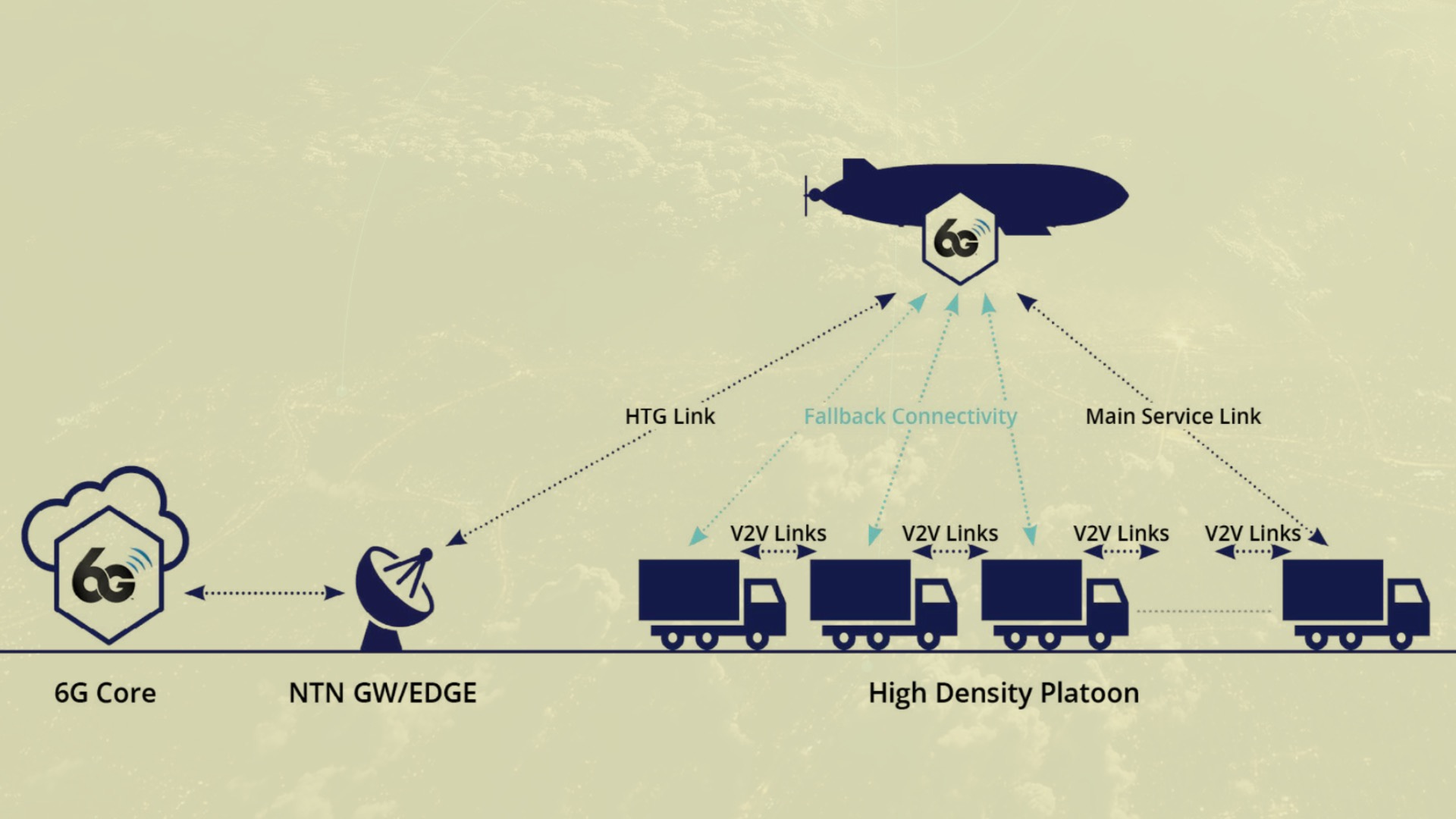
The HAPS Alliance has published a whitepaper, “6G from the Stratosphere: The Role of HAPS in Key Use Cases,” outlining how high altitude platform stations fit into a three-layer 6G network architecture comprising surface, stratospheric and space assets. The paper positions HAPS at approximately 20 km altitude, each covering 50–100 km, as programmable network nodes with regenerative payloads, beamformed radio and onboard computing. The whitepaper, which is dated March but only hit the news wires this week, is free to download.
What’s new: The paper maps HAPS capabilities against priority 6G use cases including direct-to-unmodified-smartphone (D2US) connectivity, rapid disaster recovery, vehicular connectivity including C-V2X, public safety monitoring through integrated sensing and communication, and shared neutral-host network models. HAPS platforms are presented as enabling local breakout, dynamic capacity allocation and improved access network resilience through coordination with terrestrial and satellite layers.
Why this matters: Non-terrestrial networks are firmly established as a pillar of 6G architecture, but industry discussion has been heavily weighted toward satellite constellations. The stratospheric layer occupies a distinct niche: closer to Earth than LEO satellites, offering lower end-to-end latency for certain applications while maintaining wide-area coverage that terrestrial infrastructure cannot provide in underserved regions. Multiple 3GPP 6G Workshop submissions last March from Airbus, ESA, Thales and SoftBank identified HAPS as enabling ubiquitous coverage and disaster-resilient networks. This whitepaper provides a structured use-case framework that had been missing from the broader NTN discussion.
Implications for 6G standards: The emphasis on programmability and neutral-host capabilities raises standards questions about how HAPS nodes are integrated into the RAN architecture and whether existing NTN specifications can accommodate stratospheric platforms or require dedicated treatment in Release 21.
View source material to read more
Gulf states advance 6G spectrum and readiness
Two developments from the Gulf region this week illustrate the accelerating pace of 6G preparation across the GCC.
UAE launches commercial U6GHz ecosystem:
The SAMENA Council Leaders’ Summit 2026 hosted the launch of a commercial Upper 6GHz (U6GHz) ecosystem in the UAE, bringing together the Telecommunications and Digital Government Regulatory Authority (TDRA), SAMENA Council, Huawei, du, e&, GSMA, Nokia, HONOR and Tozed in a joint commercialisation commitment. U6GHz refers to the 6,425–7,125 MHz range, identified by 3GPP as Band n104, offering 700 MHz of continuous bandwidth.
Bocar Ba, CEO of the SAMENA Council, said the UAE has “moved ahead of many markets in transitioning from trials to commercial rollouts.” The GSMA confirmed that the U6GHz ecosystem is now sufficiently ready to support commercial deployment, noting the band will serve as initial spectrum for future 6G networks. The ceremony follows field tests by e& UAE and Huawei in 2025 that achieved 10 Gbps, and Huawei’s launch of a full range of U6GHz products at MWC 2026.
Oman launches 6G readiness study:
Oman’s Telecommunications Regulatory Authority has commissioned a preliminary study assessing the sultanate’s readiness for 6G deployment, covering core infrastructure requirements, radio frequency spectrum identification and sector applications across smart cities, healthcare, transportation and industry. No vendor partnerships, investment figures or target deployment dates were disclosed. The study is broadly consistent with the preparatory timelines of other proactive regulators in the region.
What’s new: The UAE event marks a transition from trials to a multi-stakeholder commercial commitment around U6GHz, with chipmakers and device manufacturers alongside operators and vendors. Estimations from SAMENA Council technology provider members indicate U6GHz is expected to enable peak speeds of up to 10 Gbps downlink and 1 Gbps uplink under 5G-Advanced. By 2028, U6GHz is expected to cover a substantial portion of the UAE’s population. Oman’s study is the country’s first formal step toward 6G policy planning.
Why this matters: The upper 6 GHz band is one of the most contested spectrum allocation debates globally, with mobile and Wi-Fi interests competing ahead of WRC-27. The UAE’s commercial commitment adds to the growing evidence base (alongside trials from Telefónica/Nokia in Spain and SoftBank in Japan) that the band can deliver meaningful capacity and coverage for mobile services. The framing of U6GHz as a bridge from 5G-Advanced to 6G is significant, as it positions early deployment as an evolutionary stepping stone rather than a standalone initiative. Oman joining the 6G readiness conversation alongside Saudi Arabia, the UAE and Bahrain suggests GCC-wide regulatory convergence on next-generation spectrum planning.
Implications for 6G standards: The commercial deployment of band n104 provides real-world operational data that will inform 3GPP’s FR3 standardisation work and the broader upper mid-band framework for 6G. The multi-operator, multi-vendor ecosystem in the UAE could serve as a reference market for how spectrum, regulation and industrial collaboration accelerate next-generation connectivity. Oman’s spectrum band recommendations, once published, will feed into the growing body of national positions ahead of WRC-27.
View source material to read more — UAE
View source material to read more — Oman
Spain opens 6G test facility in Catalonia

Universitat Politècnica de Catalunya (UPC) has launched 6GLabNet, described as Spain’s first centre for real-world testing of 5G-Advanced and 6G technologies. The €4 million facility spans two campuses – Diagonal Nord in Barcelona and Baix Llobregat in Castelldefels – connected by 32 km of fibre optic cable provided by the Catalan government. Spain’s Minister for Digital Transformation and Civil Service, Óscar López, attended the launch and said Spain ranks among world leaders in digital infrastructure. Note that we do not yet have a more technical announcement from UPC itself; we are reliant upon third-party reporting.
What’s new: Each campus is equipped with advanced antennas and stations for data transmission at millimetre-wave frequencies, enabling complex communication scenarios outside the laboratory. The launch event demonstrated real-time drone operation between the two campuses, an autonomous robotic vehicle and AI-powered transport. The platform is open to businesses, government agencies and research groups, with projects in mobility, AI and industrial automation already underway. Seven scientific groups, along with business and government representatives, are involved.
Why this matters: 6GLabNet joins a growing European network of 6G test facilities, including IMDEA Networks in Madrid (which we covered in January), the Dutch National 6G Testbed and Germany’s research infrastructure. Spain now has two distinct 6G test environments: IMDEA’s laboratory-and-outdoor testbed and UPC’s dual-campus, fibre-connected real-world facility. The 32 km fibre link between campuses enables distributed testing scenarios that most single-site facilities cannot replicate.
Implications for 6G standards: The facility’s focus on mmWave frequencies and autonomous transport aligns with active 3GPP study areas. EU-funded testbeds provide validation infrastructure for candidate 6G technologies before they enter the standards process, contributing to the evidence base that informs 3GPP working group decisions.
View source material to read more
AWS joins TM Forum AI & Data Mission Board
AWS has joined the TM Forum AI & Data Mission Board, with Kaniz Mahdi, Director Technology at AWS Industries, publishing an opinion piece outlining the company’s perspective on building trusted, scalable AI-native 6G networks. The article identifies three barriers to AI-native networks: data fragmentation across proprietary vendor formats, the “everywhere problem” of serving humans, AI agents and physical AI systems across diverse environments, and sustainable scaling across devices, edge sites, clouds and space systems. The piece was published on TM Forum Inform.
What’s new: AWS commits to three objectives through its Mission Board membership: defining secure, trusted shared data and AI foundations with scalable data and AI products; advancing experiential validation as a first-order design principle for networks, connecting training, simulation and deployment in a continuous loop; and ensuring the path to AI-native 6G is practical and incremental. The article introduces AWS’s Hypercomposed Networks concept, which envisions intelligence embedded throughout the network fabric, and connects it to the need for physics-compliant digital twins and synthetic data generation.
Why this matters: TM Forum published its monetisation-first 6G white paper in February, positioning itself as a bridge between technical capabilities and commercial frameworks. AWS’s membership adds hyperscaler weight to this effort. The framing of data fragmentation as the foundational constraint, “first barrier to unlock”, reflects a growing industry consensus that AI-native networks cannot function without unified, sovereignty-aware data foundations. The experiential validation concept, where networks are tested against real-world conditions rather than theoretical benchmarks, extends the digital twin model into operational validation.
Implications for 6G standards: The emphasis on sovereignty-aware data governance addresses a dimension that standards bodies have not yet fully specified but which operators and regulators increasingly demand.
View source material to read more
Selected research papers published this week
Agentic AI framework proposed for 6G RAN automation
The paper propose an agentic AI framework for wireless network automation, centred on a Hierarchical Online Decision Transformer (H-ODT) that orchestrates three categories of agents: inter-slice and intra-slice resource allocation, network application orchestration, and self-healing. The framework uses natural language inputs from human operators and integrates an Agentic RAG module for knowledge retrieval across heterogeneous sources.
Why this matters: The paper addresses a practical challenge for 6G network management: coordinating multiple AI agents across different operational domains while maintaining human oversight. The bi-level intent validation methodology, which flags performance-degrading operator intents with 88.5% accuracy, and the self-healing capability that recovers 90% of previous performance without human intervention, provide concrete benchmarks for agentic AI in telecoms.
View source material to read more
EU MARE project enhances secure intent-based networking with agentic AI
Iulisloi Zacarias and colleagues present an enhanced intent-based networking (IBN) framework with a security focus, developed within the EU MARE project. The paper proposes a hierarchical multi-agent, multi-vendor architecture that uses LLMs to translate high-level operator intents into low-level actions, with connections to external security knowledge bases including MITRE ATT&CK, MITRE FiGHT and NIST.
Why this matters: Intent-based networking is expected to be a core operational model for 6G, but security implications of LLM-driven network control remain underexplored. The integration of established security frameworks (MITRE ATT&CK, FiGHT) into the agentic AI pipeline provides a practical approach to threat-aware autonomous networking. The multi-domain, multi-vendor architecture has direct applicability to 6G’s disaggregated, multi-operator environments.
View source material to read more
FR3 outperforms mmWave for cell-edge users in comparative study
The paper presents a comparative study of Frequency Range 3 (FR3, 7.125–24.25 GHz) against FR1 (sub-6 GHz) and FR2 (mmWave) across suburban, urban and high-rise urban environments using ray-tracing channel modelling. The results show that under equal aperture sizes, FR3 achieves higher data rates than FR2 for cell-edge users in both interference-free and full-interference scenarios.
Why this matters: FR3, also known as the upper mid-band, is one of the most important spectrum candidates for 6G, offering a balance between bandwidth capacity and propagation characteristics. The finding that FR3 outperforms mmWave at cell edges is significant for network planning, as it suggests the additional array gain at mmWave frequencies is insufficient to compensate for severe path loss. This supports the growing consensus that FR3 will be a workhorse band for 6G coverage and capacity, and provides evidence for regulators weighing upper mid-band allocation decisions ahead of WRC-27.
View source material to read more
Telecom World Model unifies digital twins and foundation models for 6G
Hang Zou, Mérouane Debbah and colleagues introduce the Telecom World Model (TWM), an architecture for learned, action-conditioned, uncertainty-aware modelling of telecom system dynamics. The framework decomposes the problem into a controllable system world and an external world, with a three-layer architecture comprising field world models, control/dynamics world models and a telecom foundation model layer. A proof-of-concept on network slicing validates the approach.
Why this matters: This paper bridges two prevailing AI paradigms in telecoms: LLM-based automation and physics-based digital twins. It turns these into a unified framework that addresses their individual limitations. The uncertainty-aware, action-conditioned approach is particularly relevant for 6G, where network control decisions will cascade across multiple layers. The involvement of Mérouane Debbah, a prominent figure in the AI-for-telecoms research community, adds visibility to the concept.
View source material to read more
Survey maps energy challenges of agentic AI in 6G networks
This paper surveys the energy efficiency challenges created by agentic AI systems in next-generation networks. The paper proposes an energy accounting framework that identifies computational and communication costs across the Perception-Reasoning-Action cycle, and establishes a taxonomy spanning model simplification, computation control, input and attention optimisation, and hardware-aware inference.
Why this matters: As agentic AI moves from research into operational network management, its energy footprint becomes a critical design constraint. Unlike traditional AI where computational FLOPs are the primary bottleneck, agentic systems face compounding costs from iterative inference and persistent data exchange. The survey’s identification of 6G-native agentic AI and self-sustaining systems as open challenges provides a research roadmap that connects AI efficiency to the sustainability priorities embedded in IMT-2030.