


6G news and analysis for the week ending Friday 28th August, 2026.
Welcome back to another week of 6G announcements. Although this is one of the quietest weeks of the year for news, it has certainly produced an unusually argumentative one for analysis. Three of this week’s stories are disputes rather than advancements.
We start with Plum Consulting who has published a study that challenges one of the industry’s most repeated claims (one that surfaces every decade with the arrival of a new G). Operators, it argues, do not need 200 MHz of dedicated spectrum each for 6G, and there is no case for identifying more than 600 MHz for IMT across the upper 6 GHz and 7 GHz bands. The GSMA has argued the opposite for over a year. With WRC-27 decisions on the 7125 to 7250 MHz band approaching, this is a well-timed and knowledgeable intervention from the sceptical side of the argument.
The second dispute is about silicon. Light Reading has secured on-the-record responses from Ericsson and Samsung to Nokia’s position that 6G will ultimately require a GPU. Unsurprisingly, both reject it. The disagreement is not about whether AI belongs in the RAN, but about how large the models can be inside a half-millisecond transmission window. That is a physics discussion, not a marketing one.
Meanwhile, the Chinese government has named 6G as a designated pillar industry for the 15th Five-Year Plan period, with MIIT describing it as a top priority through 2030. We also cover India’s C-DOT Foundation Day, a Chinese proposal for BRICS 6G cooperation, and we have our usual four research papers – this week on two-sided AI, networked sensing, RIS and MIMO-OFDM. And apparently I have to now disclose that the em dash in the previous sentence was added by me, and not my friendly AI companion. What a world.
Plum questions the 6G spectrum demand case
Plum Consulting has published a study by analysts Tim Miller and Richard Rudd examining the technical and economic consequences of different upper 6 GHz band configurations. The work is framed around the European Union’s pending decisions on splitting the band between licence-exempt use and IMT, ahead of WRC-27 decisions on the 7125 to 7250 MHz band. It models what happens if IMT identification is capped at 600 MHz rather than expanded to 700 MHz. The central finding is that restricting IMT to 600 MHz produces no meaningful loss to consumers. On the GSMA’s position that operators need 200 MHz of dedicated spectrum for 6G, the study carefully states that this demand is “as yet unproven”.
What’s new: The economic modelling is the substance here. Plum concludes that in European markets with more than three operators, giving larger operators 200 MHz and smaller operators 100 MHz each produces only marginal differences in service quality. It also finds that asymmetric allocation would likely have no effect on the prices paid for spectrum.
Why this matters: This runs directly against the position European operators have been advancing for two years. Ofcom allocated 540 MHz of mobile priority spectrum in the upper 6 GHz band in July, broadly matching the RSPG opinion we covered last November, and the GSMA called even that insufficient. Plum’s argument is that smaller operators can combine or share holdings if wider bandwidths are ever needed, and that the latency penalty of a 100 MHz deployment is a small component of total network latency. It also proposes a practical settlement: identify 7125 to 7250 MHz for IMT, leave the lower part of the upper 6 GHz band to Wi-Fi, and use the resulting 60 MHz gap as a guard band. This is a modelling exercise built on assumptions about future traffic, not measured evidence, and operators will doubtless contest those assumptions.
Implications for 6G standards: Channel bandwidth assumptions feed directly into 3GPP evaluation work for Release 21. If Europe settles at 600 MHz while Asia-Pacific converges on the much wider 6425 to 8400 MHz tuning range proposed at APG27-3 that we covered in August, 3GPP faces the prospect of specifying 6G radio across materially divergent regional band plans.
View source material to read more
Vendors divide over GPUs in the 6G RAN

Ericsson and Samsung have both publicly rejected Nokia’s position that 6G will require GPU-based compute in the radio access network, in a detailed report by Iain Morris for Light Reading. Nokia chief technology officer Pallavi Mahajan argued that GPUs unlock machine learning techniques that were previously unusable in the RAN because the compute was not available. She cited reproducing kernel Hilbert space methods as one example (yes, that was new to me too). Ericsson was direct in response, telling the publication that “GPUs are one option for 6G and AI RAN, not the only one”. Samsung likewise said it does not regard GPUs as a prerequisite for 6G, and rejected both CPU-only and GPU-only approaches.
What’s new: This is the first time to our knowledge that both rivals have responded on the record to the GPU-essential proposition. The technical argument (and it is a very technical one) turns on the transmission time interval. Michael Begley, Ericsson’s head of RAN compute, has put the budget at 500 microseconds, which constrains RAN models to tens of thousands of parameters rather than millions. Ericsson has also begun introducing an ASIC it calls a neural network accelerator into its massive MIMO radios.
Why this matters: This could well be the architectural fault line underneath a year of AI-RAN announcements. We covered Nvidia’s $1 billion investment in Nokia in October 2025, the commercial AI-RAN platform launch in July with its claim of doubled spectral efficiency by 2028, and the reported GPU radio unit chip in June. Samsung notes that throughput gains from a GPU may have to be sacrificed to meet TTI requirements. Nokia counters that its plug-in card delivers 1.5 times the capacity and twice the spectral efficiency within the same 190 watt power envelope. As we noted last month, all of these figures remain vendor-measured and vendor-published. The commercial subtext is vendor lock-in. Critics argue Nokia has exchanged dependence on Marvell for dependence on Nvidia and CUDA, while Ericsson and Samsung retain some portability across x86 and Arm. That independence rests heavily on Intel, which reported a $15 billion net loss for the first half of 2026.
Implications for 6G standards: Nothing in the emerging 6G specifications mandates a particular compute architecture and this is likely to remain an implementation choice. The standards-relevant question is whether the TTI constraint limits what Release 20 study items on AI and machine learning for the air interface can realistically assume about model size.
View source material to read more
Beijing names 6G a pillar industry to 2030
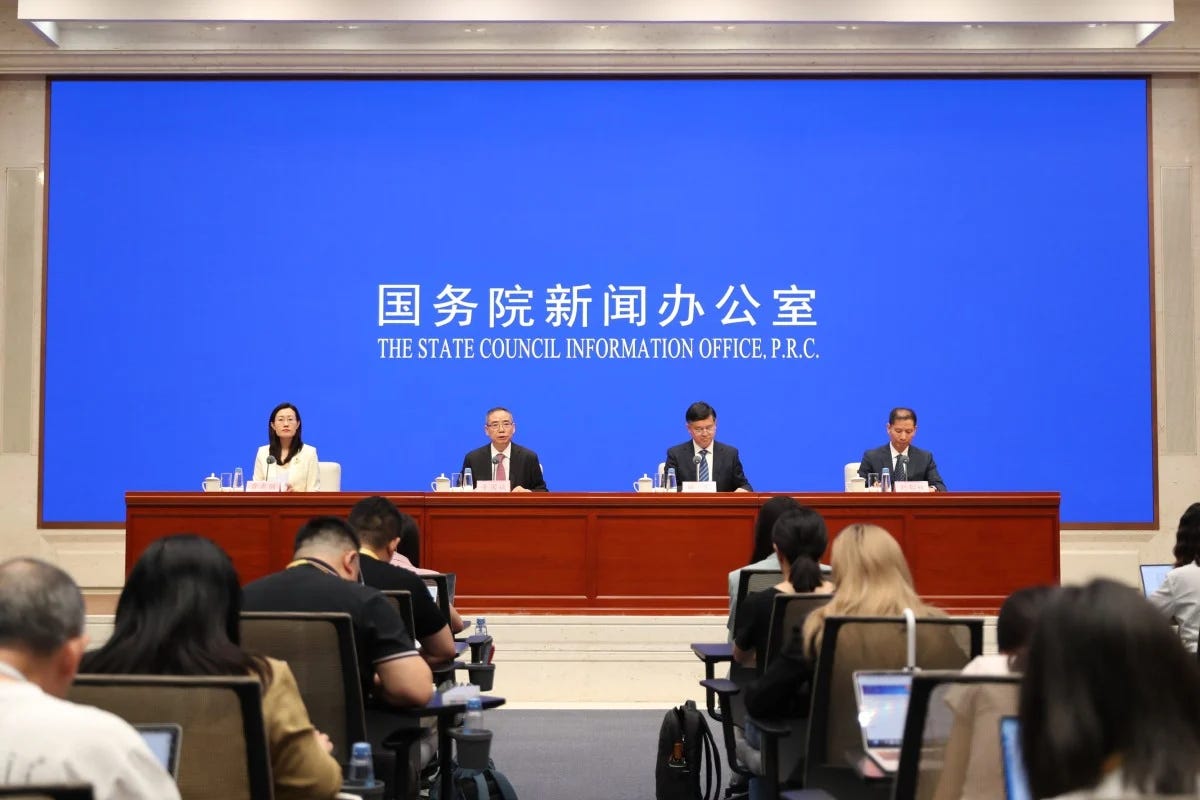
China has designated 6G as one of a group of emerging industries intended to become new drivers of economic growth by the end of the decade. Vice-minister of Industry and Information Technology Xin Guobin set out the plan at a State Council Information Office press conference on 26 August, reported by the South China Morning Post and by Xinhua via the government’s English-language site. The list spans 6G, quantum technology, brain-computer interfaces, nuclear fusion and robotics. Liu Yulin, head of MIIT’s information and communications development department, described next-generation 6G communications as a “top priority”. The ministry said it would accelerate core technology research, continue technology trials and develop industry standards during the 15th Five-Year Plan period, which runs from 2026 to 2030. Xin separately said China has formulated nearly 200 key standards for artificial intelligence.
What’s new: The framing is the new element rather than the programme itself. 6G has previously been presented in terms of technological self-reliance and standards positioning. Here it is presented as an economic growth pillar, alongside fusion and robotics, in a plan explicitly designed to offset weakness elsewhere in the economy.
Why this matters: The underlying substance largely restates work already under way. We covered the ministry-provincial collaborative pilot and its 2029 target for independently developed 6G solutions in June, the Phase Two trials in back in January, and the 6 GHz trial frequency permit in May. What has changed is the economic context. The same press conference addressed sluggish consumer spending, the property slump and industrial overcapacity, with vice-minister Xin conceding that irrational competition remains a problem in the EV sector. Economists at ANZ Research were quoted noting that the growth of China’s new economy is not sufficient to offset property weakness. Naming 6G as a growth pillar sets an expectation that a pre-standard technology may struggle to meet before 2030.
Implications for 6G standards: Standards development is named explicitly as a policy instrument rather than a by-product of research. Trial results generated under the national programme feed into contributions from Huawei, ZTE and China Mobile to Release 20 study items and Release 21 normative work.
View source material to read more — SCMP
View source material to read more — gov.cn
C-DOT told to take India’s 6G ambition global

India’s Union Communications Minister Jyotiraditya M. Scindia used the 43rd Foundation Day of the Centre for Development of Telematics (C-DOT) to press the state research organisation to convert its work into exportable products. Speaking on 25 August, he argued that India had lagged in 4G, kept pace in 5G and was now positioned to lead in 6G. He called for technologies that are “affordable, dependable, scalable, and globally competitive”, framing the goal as moving from products made in India to products made in India for the world. Minister of State Chandra Sekhar Pemmasani, speaking at the same event, said India now has an opportunity to write 6G standards rather than only read them. C-DOT unveiled close to 14 quantum products at the event. Pemmasani also urged the organisation to “reduce the distance between invention and implementation”, noting a product cycle of 12 to 18 months.
What’s new: The commercialisation pressure is new and both ministers focused less on research ambition and more on the gap between laboratory output and marketable product. Pemmasani disclosed that C-DOT revenue has grown from ₹80 crore to ₹600 crore in recent years, and said the indigenous 4G stack deployed for BSNL now serves 22 million subscribers across roughly 100,000 sites. That deployment was delivered by a Tata Consultancy Services-led consortium with C-DOT as core partner and Tejas Networks as RAN vendor.
Why this matters: Regular 6G Futures readers will recognise most of the rhetoric here. We covered Scindia’s “with 6G, the ambition is to lead” remarks in January, the revamped TDIP scheme and spectrum roadmap in April, and the C-DOT centre of excellence at IIT Hyderabad in June. The more substantive evidence came in July, when the Bharat 6G Alliance disclosed a fifteenfold rise in Indian technical contributions to 3GPP since 2020. Against that, the persistent constraints remain: uneven 5G rollout, R&D spending below that of leading 6G nations, and weak recent spectrum auctions. The GSMA has separately noted that nearly 47 per cent of India’s population is still offline. A minister publicly criticising his own research organisation’s product cycle is a reasonable indicator that the gap between announcement and delivery is understood in Delhi.
Implications for 6G standards: India’s TSDSI is a 3GPP Organisational Partner, giving the country a formal route into the process. Pemmasani said India had contributed to the ITU under the IMT-2030 framework for the inclusion of ubiquitous connectivity as a usage scenario, and of coverage, interoperability and sustainability as capabilities.
View source material to read more — ANI
View source material to read more — ETV Bharat
View source material to read more — ET Telecom
China floats BRICS 6G and subsea cooperation
Chinese Vice Minister of Industry and Information Technology Ke Jixin proposed BRICS cooperation on 6G, satellite internet and a shared submarine cable network at the 12th BRICS Communications Ministers’ Meeting in Pune on 21 August. The proposal also covered artificial intelligence, next-generation communications, training and digital policy coordination. No infrastructure programme was approved. The only concrete outcome reported from the meeting was a bilateral India-Brazil ICT cooperation memorandum. The proposal was reported by Rare Earth Exchanges, a critical-minerals publication, which framed it as a route for China to convert materials and manufacturing strength into influence over downstream telecom equipment and technical standards.
What’s new: This appears to be the first time China has advanced 6G cooperation through the BRICS channel specifically. Previous multilateral positioning has run through the ITU, 3GPP and bilateral partnerships.
Why this matters: BRICS now spans 11 countries with divergent strategic interests and India in particular is pursuing its own standards agenda alongside a 6G research partnership with the European Union. A Chinese proposal at a ministerial meeting carries no binding weight. It is worth reading alongside the US-led coalition efforts we covered in July, where the same analytical point applied: declarations do not determine standards outcomes. The publication itself notes that the underlying report came from China’s MIIT, and cautions that Chinese proposals should be independently verified and not treated as approved BRICS projects.
Implications for 6G standards: WRC-27 spectrum decisions are taken by governments, which is where multilateral blocs have genuine leverage. If regional groupings harden into competing spectrum positions before late 2027, the risk to 3GPP is fragmentation across divergent band plans rather than any exclusion of participants.
View source material to read more
Selected research papers published this week
Rethinking two-sided AI models for 6G
Yongjeong Oh and colleagues revisit three assumptions that underpin most work on two-sided AI models, where AI sits at both transmitter and receiver for channel feedback and data communication. They integrate two-sided model processing into the 5G New Radio protocol stack and validate it alongside conventional NR on a testbed. They also propose a compact model table selected by channel condition, and a gradient-free fine-tuning method that exchanges only scalar feedback.
Why this matters: Two-sided models are one of the harder problems in the 3GPP AI/ML air interface work, because they require model alignment between network and device vendors. The gradient-free approach directly addresses that, since exchanging scalar feedback rather than gradient vectors avoids disclosing proprietary model information between vendors. Legacy coexistence on a real testbed is also more than most papers in this area attempt.
View source material to read more
Multi-UE sensing for perceptive mobile networks
J. Andrew Zhang and colleagues propose networked sensing that exploits the correlated observations arising when multiple user devices interact with the same target. The paper sets out uplink, downlink and hybrid architectures, together with a multi-view processing framework covering synchronisation, correlation-aware parameter estimation and sensing fusion.
Why this matters: Most integrated sensing and communication work assumes the base station does the sensing. Treating distributed handsets as a cooperative sensing array is a different proposition, and it changes what the network must standardise. The open challenges the authors identify, particularly target association and sensing information compression, are exactly the issues 3GPP will have to resolve if multi-node sensing is to reach Release 21.
View source material to read more
Survey maps RIS for cognitive radio networks
Diluka Galappaththige and colleagues provide a systematic review of reconfigurable intelligent surface assisted cognitive radio networks. The survey covers dynamic spectrum access models, spectrum sensing, RIS architectures and deployment strategies, then organises the literature into six research directions including active RIS, secure operation and machine learning approaches.
Why this matters: RIS and cognitive radio are both long-standing research areas that have struggled to reach standardisation, and combining them raises the bar further. The value of this survey is its treatment of the practical obstacles, including scalability, channel estimation and standardisation itself. Given how crowded RIS research has become, a consolidated reference that is candid about deployment difficulty is useful.
View source material to read more
Random multiplexing lifts MIMO-OFDM efficiency
Jie Yang and colleagues present a low-complexity precoded MIMO-OFDM scheme that improves spectral efficiency by deliberately compressing information symbols across subcarriers. It uses random multiplexing for precoding and a linear-complexity detector, while preserving compatibility with existing 5G architectures. The authors provide theoretical analysis and report gains in achievable rate and bit error rate over conventional MIMO-OFDM.
Why this matters: 3GPP has confirmed OFDM as the baseline waveform for 6G, so proposals that improve efficiency without replacing it have a clearer path to adoption. The explicit preservation of 5G architectural compatibility matters for the migration debate, where operators have consistently asked for hardware reuse rather than replacement.