


6G news and analysis for the week ending Friday 4th September, 2026.
A new TelecomTV report leads our coverage for this week, and I should declare an interest as it was written by my colleague Ray Le Maistre (TelecomTV is my day job!). The report, which I thoroughly recommend, puts questions to BT, SK Telecom, SoftBank and Verizon, and the answers do not entirely align. BT says no application has yet been identified that specifically requires 6G infrastructure. Verizon argues that 6G is needed anyway, because AI devices break the downlink-heavy assumption on which 5G was built. That is actually a very useful and refreshing disagreement. As I say, please visit the site and download.
Spectrum once again supplies the week’s practical news and it connects rather nicely with Ray’s report. MasOrange and Ericsson ran technical validation in the 6 GHz band in Spain, moving from 64-transceiver active antennas to 256TR configurations. Meanwhile Verizon told the report that roughly 400 MHz per operator of mid-band spectrum is the non-negotiable floor for workable sensing. That is double the 200 MHz minimum the GSMA has been citing to regulators.
Ericsson also spent the week setting out its AI-native positioning across Asia, with an innovation event in Seoul and a new academic initiative in Tokyo. The Korean session leaned heavily on ISAC and AI-RAN, though much of it repackaged material first shown at MWC Barcelona earlier in the year.
We also cover an ecosystem MoU from Japan’s XGMF, a Saudi mmWave partnership that needs careful reading, and our usual selection of four research papers. One asks whether there will ever be a 7G... and despite the initial reaction to scream out loud, it is a very interesting read (and also backs up what I’ve been hearing from off the record conversations).
One final message before we get to the fun details: This coming week I’ll be in Düsseldorf for TelecomTV’s AI-Native Telco Forum, as well as the launch of a major new Index report that I have been compiling over the past 8 months. I know there are a few presentations that cover 6G readiness, so I’ll report on those for next week’s newsletter. And then it will be time for the next set of 3GPP Plenaries. The countdown is at 2 years... tick, tock.
Operators split on whether 6G is needed
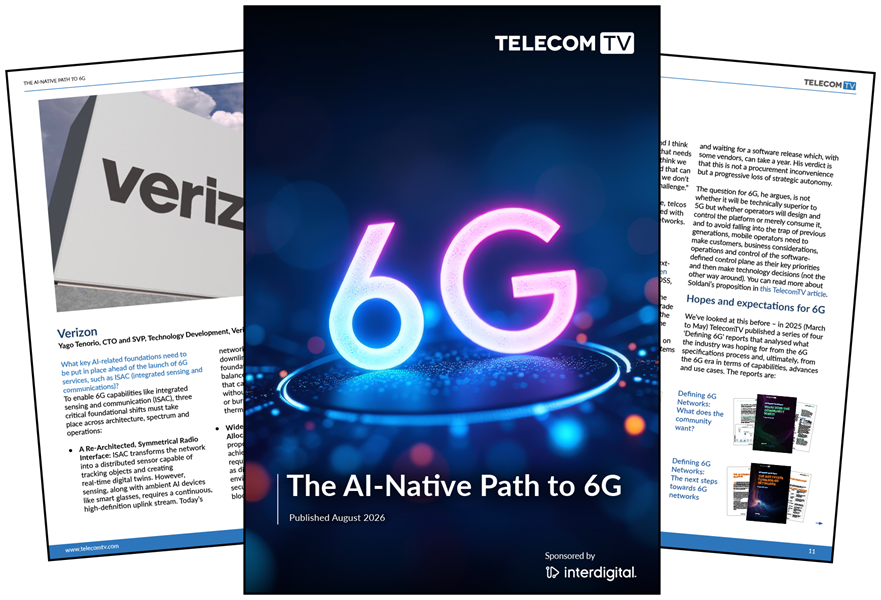
TelecomTV has published The AI-Native Path to 6G, a report examining how AI is reshaping operator planning for the next generation. It puts four questions to BT, SK Telecom, SoftBank Corp. and Verizon, covering the AI foundations required before launch, the services 6G might enable, whether 6G infrastructure is actually necessary, and whether operators hold the skills. The responses expose an interesting split. Verizon argues that mobile AI forces a network rebuild, while BT is unconvinced there is anything 6G must carry that 5G Standalone cannot. Reza Rahnama, Managing Director of Mobile Networks at BT, said he does not believe any applications have been identified that “specifically would require 6G infrastructure.”
What’s new: Verizon CTO Yago Tenorio gives the most detailed technical information in the document. He argues that ISAC and always-on AI wearables require a continuous, high-definition uplink stream, and that today’s asymmetrical downlink bias must give way to a rebalanced radio protocol. He also sets a hard spectrum figure, describing policy pipelines for around 400 MHz per operator in mid-band as a non-negotiable foundation for real-world sensing.
Why this matters: The 400 MHz figure deserves attention, because it is double the 200 MHz per operator minimum the GSMA has used in its regulatory advocacy, and it comes while Europe is still arguing over whether 665 or 700 MHz will be designated across the whole upper 6 GHz band. If sensing accuracy really does scale with contiguous bandwidth, the spectrum arithmetic for ISAC does not currently work in most markets. The uplink point is equally awkward. Every operator submission to the 3GPP workshop last year stressed reuse of existing site grids, but a symmetrical radio protocol is not a software upgrade. BT’s position is the necessary counterweight and it echoes the pattern from 5G, where capability arrived years ahead of demand. SKT makes a similar argument from the other direction, saying deployment timing should follow service demand and market development rather than technological advancement, and that large-scale need will stay limited while the device landscape remains smartphone-centric. SoftBank is even more direct, noting that not all of its distributed AI and physical AI work needs to wait for 6G, since some is achievable on 5G.
Implications for 6G standards: The SKT, Docomo and Nokia contribution on reference-signal-free transmission is the item here with direct specification consequences, since removing DM-RS overhead changes radio resource efficiency at the physical layer. The uplink symmetry argument, if operators support it collectively, would reach into the Release 21 radio design rather than remaining in the study phase.
View source material to read more
Sentiment shifts as the 6G window narrows
Excuse the indulgence because we are going to stay with the TelecomTV report, as it sets the operator responses against a compressed timetable and a changed industry mood. It states that the likely timeframe to initial pre-standards deployments has fallen to roughly 24 months, with first commercial 6G launches expected in 2030 and in selected markets only. Dell’Oro Group estimates that cumulative total wireless network capital expenditure, not RAN alone, will exceed $500bn across the six years from 2029 to 2034.
What’s new: Asked at the start of this year whether the telecom sector is doing enough to prepare for 6G, 40 per cent of TelecomTV’s DSP Leaders Council said current R&D and planning levels are adequate. Thirty per cent said the industry is already lagging, up from 19 per cent a year earlier. The proportion arguing the sector should not waste time or resources on 6G fell to 24 per cent from 35 per cent.
Why this matters: Outright dismissal of 6G is receding while anxiety about being behind is growing, especially among those who lived through the disappointments of 5G. The report is candid that the pressure is not evenly distributed, since spectrum and licence processes vary enormously and some markets have only recently launched 5G. It also documents the political pressure driving part of the acceleration, including the US administration pressing Qualcomm for pre-standards 6G silicon in time for the Los Angeles Olympics in July 2028, well ahead of any completed specification. In late July the NTIA said more than 20 governments had affirmed a collective Call to Action on 6G leadership and security.
Implications for 6G standards: A 24-month pre-standards window and a March 2029 specification freeze are difficult to reconcile, and pre-standards hardware built to political deadlines is precisely what the NGMN warned against in June. The risk is fragmentation before the specification stabilises, which is the failure mode operators have spent two years imploring 3GPP to avoid.
View source material to read more
MasOrange and Ericsson test 6 GHz band
Spanish operator MasOrange has reportedly completed a technical validation of the 6 GHz band with Ericsson, positioning the spectrum as the band that will do for 6G what 3.5 GHz did for 5G. The trial tested advanced active antenna architectures, moving from the 64 transmitter and receiver configurations used commercially today to 256TR systems. That step offers the potential to quadruple the number of radiating elements. The companies also tested beamforming techniques for dynamically steering transmission towards individual users. Víctor Manuel Plaza, project manager at MasOrange, described the band as “a fundamental technological enabler for any operator aspiring to lead” in the coming decade.
Note that we are relying on translated agency copy published by Spain’s Democrata, as we have not seen a primary release from either MasOrange or Ericsson, and no test bandwidth, throughput or coverage figures have been disclosed.
What’s new: The antenna work is the highlight here rather than the spectrum choice. Most upper mid-band trials we have covered have focused on demonstrating coverage parity against existing 3.5 GHz grids. This one is about the radio hardware required to make the band economic and specifically about scaling array density to compensate for higher path loss.
Why this matters: This is the fifth substantial upper mid-band dataset we have tracked since November. It follows Telefónica and Nokia at Valencia, SoftBank and Nokia in Tokyo’s Ginza district, Samsung and KT at 7 GHz, and Optus and Nokia in Australia last month. Spain now has two of its three major operator groups running 6 GHz work. The band has not yet been allocated in Spain, which makes this preparatory rather than pre-deployment activity. MasOrange points to a 2030 commercial horizon for 6G in Spain, consistent with the operator consensus we have reported throughout the year. The 256TR figure is worth watching, because array size drives cost, weight, power draw and site engineering, and those are the constraints that will decide whether upper mid-band deployment is affordable.
Implications for 6G standards: Antenna array assumptions feed directly into the FR3 work running through Release 21, including the channel bandwidth and beam management design that vendors build against. European trial data also strengthens the regional position ahead of WRC-27, where the upper 6 GHz allocation remains contested between mobile and Wi-Fi interests. Read this alongside Verizon’s claim in the TelecomTV report above that operators need around 400 MHz each of mid-band spectrum for workable sensing. Europe’s likely allocation across the whole upper 6 GHz band will not stretch that far across three or four operators per market.
View source material to read more
Ericsson pushes AI-native 6G across Asia
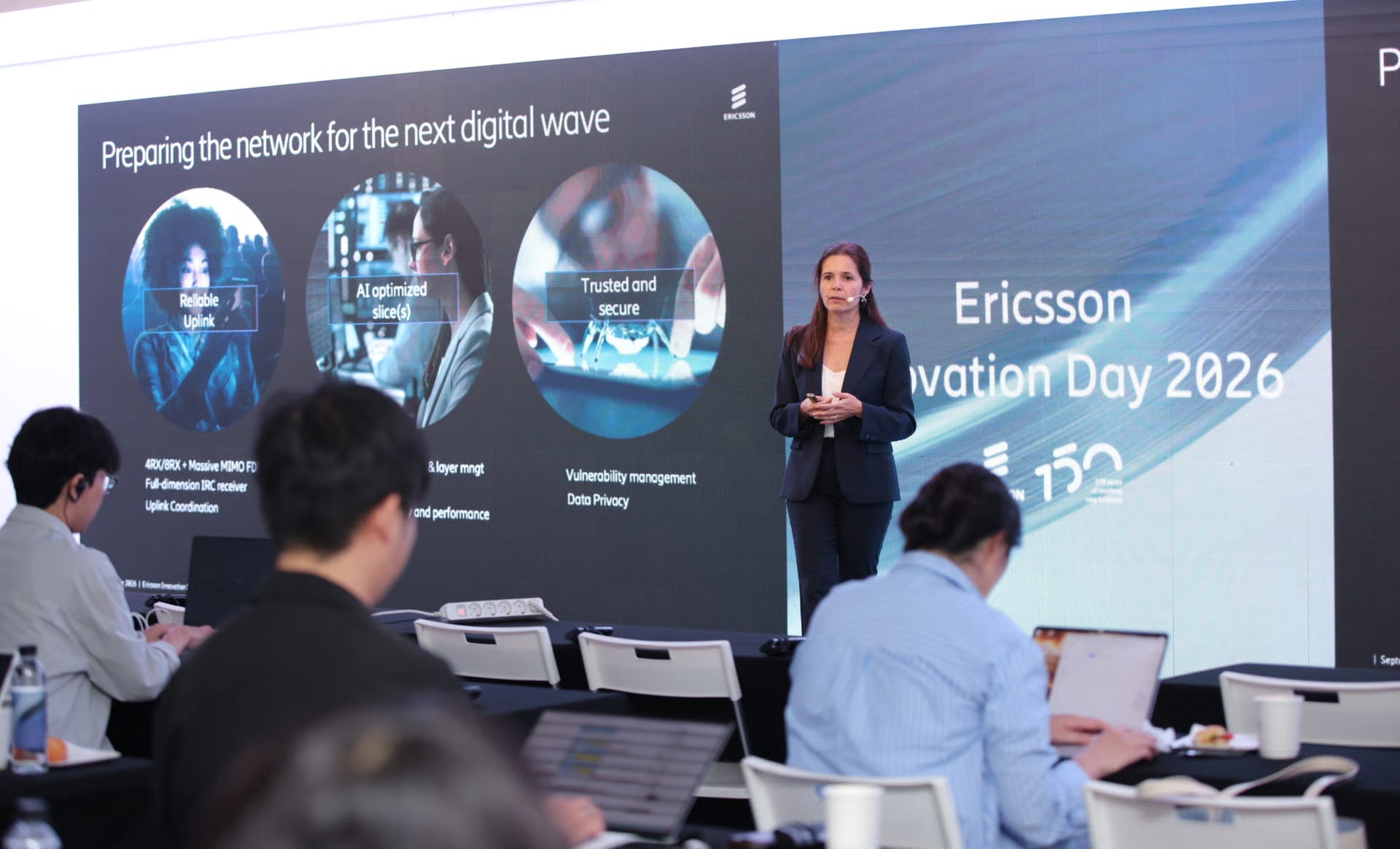
Ericsson used two separate Asian events this week to set out its position on the evolution towards 6G. At Ericsson Innovation Day 2026 Korea in Seoul, the company framed the next phase around two ideas: networks for AI, and AI for networks. It presented AI-RAN not as a product or an accelerator but as an architecture applying AI across the whole RAN layer. Integrated sensing and communication (ISAC) was the event’s main technical highlight, with Ericsson claiming a clear roadmap and commercial application cases in critical infrastructure, transport and low-altitude airspace. Sibel Tombaz, CEO of Ericsson Korea, said: “Competitiveness in the AI era begins with the network.”
Separately, Ericsson Japan launched “Enter New Horizons” with the University of Tokyo, marking the company’s 150th anniversary. A two-day workshop in July brought employees together with students to build scenarios for Japanese society around 2035, across manufacturing, infrastructure and energy, mobility and regional sustainability. Outcomes will be presented at the end of September. Jawad Manssour of Ericsson Japan said reliable connectivity is becoming essential for AI and autonomous systems “to operate safely and at scale.”
What’s new: Very little, is the honest verdict. The Seoul event explicitly restaged technologies Ericsson showed at MWC 2026. The Tokyo initiative is a brand and academic engagement exercise with no technical deliverable attached. The one point of interest is the ISAC framing, where Ericsson is now presenting sensing as a current capability with commercial cases rather than a 6G-era promise.
Why this matters: Ericsson has spent the year building a consistent argument that 6G is an evolution from 5G Standalone and 5G-Advanced rather than a break, and that current investment converts naturally into AI-native 6G. That is a commercially convenient position for an incumbent vendor with a large installed base, but it also matches what NGMN put on record in June. Ericsson made the same 5G Standalone argument in Seoul twelve months ago and Korean operators have since made clear that profitability, not ambition, governs their pace. The low-altitude economy reference is interesting, since it aligns Ericsson with the drone-sensing work it has already demonstrated with AT&T.
Implications for 6G standards: ISAC architecture variants are active in the SA2 study and vendor claims of commercial readiness will be tested against that work. Positioning statements of this kind do not advance Release 21 directly, but they signal which capabilities Ericsson intends to push into normative specification.
View source material to read more - Korea
View source material to read more - Japan
XGMF links 6G to human augmentation
Japan’s XG Mobile Promotion Forum (XGMF) has signed a Memorandum of Understanding with the Human Augmentation Consortium to cooperate on building a global 6G ecosystem. The consortium works on technologies that extend human sensory perception and physical capability through networks and operates under the Cabinet Office’s Cross-ministerial Strategic Innovation Promotion Program. The two bodies say they will pursue the extension of sensory perception and movement via networks and the creation of new 6G use cases. The consortium’s stated activities include connectivity verification for augmentation applications, devices and platforms, international standardisation work and white paper publication. The announcement was made on 19 August, but we’ve only just seen it and it is worth reporting.
What’s new: XGMF has been building outward links steadily, including the trilateral workshop with the Next G Alliance and Korea’s 6G Forum in July. This is the first time we have seen it formally attach itself to a human augmentation programme.
Why this matters: Japan’s 6G strategy has been consistently use-case led, framed around demographic decline, workforce shrinkage and the maintenance of social infrastructure. Human augmentation fits that framing and connecting it to network capability is a reasonable way to generate requirements that are not simply faster downloads. The caution is that this MoU contains no work programme, no timeline and no technical scope. It is a statement of intent between two Japanese bodies and its value will depend entirely on what follows.
Implications for 6G standards: Japan’s ARIB and TTC are 3GPP Organisational Partners, so nationally aligned use-case work has a route into the process. Whether sensory extension produces requirements distinct from existing low-latency and uplink-capacity targets is an open question.
View source material to read more
Saudi partnership targets mmWave localisation
ACES, the Saudi digital infrastructure and neutral host company, has signed a Memorandum of Understanding with US semiconductor firm Movandi to work on next-generation wireless infrastructure in Saudi Arabia and the wider region. The agreement covers mmWave and RF front-end technologies, O-RAN architectures, indoor and outdoor small cells, joint R&D and proof-of-concept deployments. ACES has already developed an O-RAN compliant shareable 5G small cell locally, and the partnership is framed around technology localisation under Vision 2030. Maryam Rofougaran, CEO and co-founder of Movandi, said that moving from innovation to large-scale deployment “requires strong local execution.”
What’s new: ACES is attempting to build domestic product development capability rather than act purely as a deployment partner, and Movandi gains a regional platform for its beamforming and RFIC portfolio.
Why this matters: Gulf states have been among the more active 6G participants and we have tracked spectrum and research activity from Saudi Arabia’s CST, the UAE, du, e& and Bahrain’s regulator over the past year. This partnership adds a supply-side dimension to what has mostly been spectrum policy and research funding. That said, the announcement is overwhelmingly about 5G mmWave, small cells and Open RAN. The 6G content remains aspirational. Treat this as regional industrial policy rather than as next-generation technical development.
Implications for 6G standards: Minimal implication in the near term, as neither company is a significant 3GPP contributor on 6G work items. Regional mmWave deployment experience could eventually inform FR2 evolution discussions, but nothing in this announcement connects to Release 21.
View source material to read more
Selected research papers published this week
Will there be a 7G?
Adnan Aijaz of Toshiba Europe’s Bristol Research and Innovation Laboratory asks whether a seventh generation is justified at all. The paper argues that 7G should not be treated as an inevitable numbering exercise or a list of more ambitious radio targets. Instead it proposes a readiness framework covering demand-led need, system-level discontinuity, coordination value, sustainability, trust and geopolitical viability, then applies it to candidate discontinuities including agentic network operation, RF-native computing and policy-aware spectrum governance.
Why this Matters: The question is deliberately provocative, but the framework is the useful part. It sets a test that any future generation must pass, namely whether it solves coordination problems that 6G, Wi-Fi, NTN, private cellular and edge platforms cannot. That is a discipline the industry conspicuously failed to apply to 5G. The paper’s three candidate outcomes – a distinct generation, an extension of 6G, or a broader post-6G fabric – all map neatly onto the “generation-free” evolution arguments that AT&T and others put to the 3GPP 6G Workshop.
View source material to read more
Agentic control for cooperative 6G terminals
Chao-Kai Wen and colleagues extend end-user collaborative MIMO, where nearby devices form a virtual multi-antenna terminal to overcome the antenna limits of a single handset. The paper adds a control layer of device, hub and network agents that interpret user intent, choose cooperation modes and replan as conditions change. Two scenario studies cover live streaming and wearable-assisted blind-spot sensing.
Why this Matters: Uplink capability at the device remains one of the harder constraints in 6G, and terminal form factors limit how many antennas can be added. Device cooperation is a plausible route around that, but it requires coordination that no current specification provides. The authors address standardisation, interoperability and trust directly, which is more than most agentic AI papers manage.
View source material to read more
Structured reasoning for telecom fault diagnosis
Hao Zhou and colleagues review the evolution of root cause analysis in mobile networks and propose a structured reasoning framework for large language models. The approach organises heterogeneous telemetry into canonical contexts, enforces decision-path reasoning during diagnosis and produces evidence-grounded explanations. It was tested against two 5G datasets, TeleLogs and TelecomTS.
Why this Matters: Applying general-purpose LLMs directly to network diagnosis produces hallucination and unstable reasoning, which is exactly the failure mode operators cannot tolerate in fault management. Grounding the reasoning in structured network evidence is a more honest engineering response than scaling the model. It complements the agentic control work we covered in May, where the constraint was latency rather than trustworthiness.
View source material to read more
Quantum-resilient security for O-RAN
Dzung Quoc Ngo and colleagues examine how quantum-resilient mechanisms could strengthen confidentiality, authentication and trust across Open RAN. The paper covers post-quantum cryptography, quantum authentication and quantum-enhanced threat detection within a zero-trust architecture, and analyses integration with the Near-Real-Time RIC, the O-Cloud and open interfaces.
Why this Matters: The disaggregated O-RAN architecture widens the attack surface at precisely the moment quantum-capable adversaries become a planning assumption. Post-quantum cryptography is already one of the three priorities that 3GPP SA3 identified for 6G. This paper’s contribution is the deployment framing, including technology maturity and adoption timelines, which is what operators actually need.
The subtitle does the heavy lifting: an uplink problem, and no application that yet demands it. Those two are linked. Every generation gets sold on downlink headline speed, but the experiences people actually reach for now, live video up, cloud backup, real-time sensing and control, are uplink-bound. And uplink is where the physics is least forgiving: smaller power budget on the device side, worse link budget at cell edge, and in TDD the uplink slots are the scarce ones by design. If 6G wants a use case that demands it, uplink coverage and capacity is the honest place to look, not another downlink record. Did the discussion land on uplink as the real gap, or is that still the part everyone skips?