


6G news and analysis for the week ending Friday, 24th April, 2026.
As the hype and wild claims build around 6G (haven’t you heard? It’s a race apparently) it’s good to know that rational and pragmatic progress is being made in the places that count. At the 2026 Global 6G Technology and Industry Ecosystem Conference in Nanjing, Purple Mountain Laboratories and the Future Mobile Communications Forum announced what China describes as its first Pre-6G experimental network. The state-media framing emphasised “ten times 5G” capabilities, but the more interesting message came from the keynote stage: academician Wu Hequan told the conference that 6G offers only limited bandwidth gains over 5G, with the real improvements concentrated in latency, reliability, energy efficiency and security. That’s a remarkably candid assessment from one of China’s most senior communications voices, and closely aligned with the operator views expressed back at the 3GPP 6G Workshop in March 2025.
Meanwhile, India stepped up its own 6G positioning with a coordinated week of announcements. Communications Minister Jyotiraditya Scindia unveiled a revised 203 crore Technology Development and Investment Promotion (TDIP) scheme for 2026–31 to fund Indian participation in the ITU, 3GPP and oneM2M, while TRAI Chairman Anil Kumar Lahoti used the COAI DigiCom Summit to confirm that the 600 MHz band’s validity has been extended and that new spectrum recommendations are in place to support a faster 6G rollout. India is clearly trying to convert market scale into standards influence, which, as we know, is easier said than done.
Elsewhere, SoftBank demonstrated dynamic nullforming (no, me neither) from a fast-moving aerial base station, an important piece of the HAPS spectrum-sharing puzzle. And in the US, a little-known entity called Landover Saturn 5 has petitioned the FCC to repurpose nine UHF TV channels for 5G and future 6G use. And don’t forget our pick of five research papers to round out this week’s edition.
Nanjing 6G conference activates Pre-6G test network
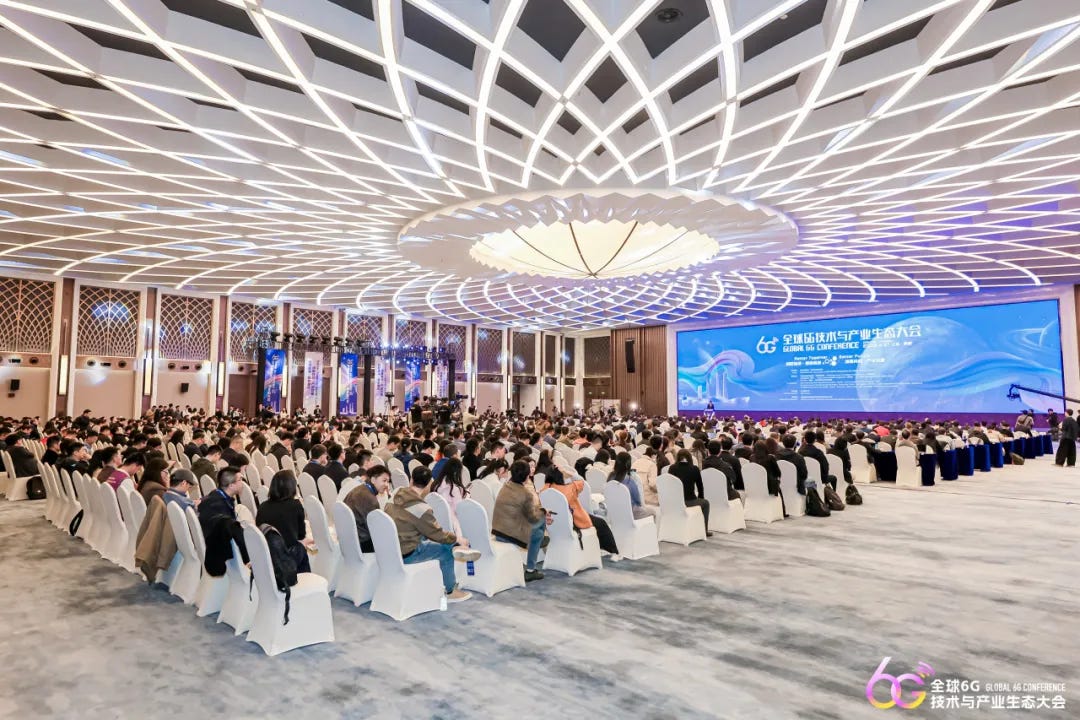
The 2026 Global 6G Technology and Industry Ecosystem Conference, hosted by Purple Mountain Laboratories (also known as Zijin Mountain Laboratory) and the Future Mobile Communications Forum, opened in Nanjing on Tuesday. The centrepiece was the formal announcement of what organisers describe as China’s first “pre-6G” experimental network, integrating 6G innovations into an existing 5G framework. Systematic verification is under way in use cases such as low-altitude inspection, industrial manufacturing, embodied intelligence and holographic communications.
Beyond the network itself, the conference signalled a broader ecosystem push. Southeast University (Purple Mountain Labs’ academic parent) launched a dedicated Purple Mountain College to train mobile communications specialists, and new collaborations were announced with the Chinese Academy of Sciences’ Institute of Industrial AI, China Petroleum Pipeline Bureau and Sichuan Jiuzhou Electric Group. The Nanjing 6G Future Industry Fund Cluster was launched with a fund of 3.312 billion yuan, targeting core technology development, enterprise cultivation, scenario integration and talent acquisition. The Chinese conference attracted international participation, with keynotes from Rahim Tafazolli (Director of the 5/6GIC at the University of Surrey) and Gerhard Fettweis (Technical University of Dresden), alongside Purple Mountain’s director You Xiaohu. Representatives from 3GPP, CCSA and CAICT joined roundtables on standards evolution and industry cooperation.
The most technically substantive remarks came from academician Wu Hequan of the Chinese Academy of Engineering, who told the conference that 6G standardisation “has shifted from idealistic indicators to practical implementation, with the core being to achieve commercial viability and sustainable development.” He added that compared to 5G, 6G “offers limited improvements in bandwidth, but significantly enhances latency, reliability, energy efficiency (improving by approximately 90%), and security.” You Xiaohu’s keynote proposed a converged network architecture driven by endogenous data, using wireless data knowledge graphs and embedded time-sensitive networking (TSN) mechanisms; he claimed scenario verification on the pre-6G test network showed orders-of-magnitude improvements in low-latency determinism and intelligent scheduling.
In parallel, at a Ministry of Industry and Information Technology press conference on the same day, bureau head Xie Cun confirmed China’s 5G base station count has reached 4.958 million, with 5G-Advanced now covering 330 cities. MIIT said it would step up a coordinated push into 6G and next-generation internet alongside expanded 5G-Advanced, pilot 10G optical networks and space computing infrastructure.
What’s new: Wu Hequan’s framing is the genuinely new element here. Senior Chinese technical voices have rarely spoken so plainly about 6G’s limited bandwidth gains. This aligns with a growing industry consensus (see Vodafone, Telstra and NTT DOCOMO’s 3GPP 6G Workshop submissions) that 6G’s value proposition is determinism, efficiency and AI-native architecture rather than peak speeds. You Xiaohu’s knowledge-graph-driven architecture and embedded TSN approach is also a specific technical proposition, not a marketing claim.
Why this matters: The “ten times 5G” figure that dominated the state-media coverage sits awkwardly against Wu Hequan’s technically grounded remarks on the same stage. We should also treat “Pre-6G” as a marketing label: a 5G network with selected 6G-candidate features, not a standards-compliant system. The more important story is institutional: Purple Mountain Laboratories authored one of the most detailed 3GPP 6G Workshop submissions, advocating cell-free RAN (which I believe we should now be calling “Gothia cell”), cloudified CUs and distributed DUs, and is now building an end-to-end innovation chain that runs from university talent pipelines through a 3.3 billion yuan fund to operational testbed validation. The international academic presence (Profs Tafazolli and Fettweis are both heavyweight 6G researchers) suggests this is not a purely domestic event. Worth remembering that the EU has separately been tightening research collaboration controls with Chinese institutions, so these bridges are not as open as they once were.
Implications for 6G standards: System-level trial results from the Nanjing pre-6G network will feed directly into Chinese vendor contributions to 3GPP Release 20 study items and Release 21 normative work. The Purple Mountain Laboratories workshop submission is already on record advocating user-centric, cell-free architectures with distributed DUs. The test network is the validation platform that gives those proposals field evidence. China’s phased 6G programme is unusually well coordinated with its standards strategy.
View source material to read more – Purple Mountain Laboratories (in Chinese)
View source material to read more – Global Times
View source material to read more – CGTN
View source material to read more – Yicai Global
View source material to read more – Zhitong Finance
India unveils TDIP revamp and fresh spectrum roadmap
There was a coordinated series of announcements this week to support India’s pitch to become a 6G standards influencer (remember its attempts to create its own 5G standard ten years ago?). At the COAI DigiCom Summit 2026 in New Delhi, Communications Minister Jyotiraditya Scindia released revised guidelines for the revamped Technology Development and Investment Promotion (TDIP) scheme, backed by an outlay of 203 crore for the 2026–31 period. The scheme funds Indian participation in international telecom standardisation bodies including the ITU, 3GPP and oneM2M, covering attendance at global meetings, submission of technical contributions, leadership roles in study groups and the hosting of international standardisation events in India. Beneficiaries now extend beyond established industry players to include startups, MSMEs, academia, research institutions and telecom operators, implemented through TSDSI, the Telecom Centres of Excellence and TCIL.
On the same day, Minister of State Dr Pemmasani Chandra Sekhar urged operators and manufacturers to move towards design-led manufacturing, build export-grade testing and certification facilities, and form joint ventures with global technology leaders. “As AI, 6G, and Quantum Communications evolve, the next phase must focus on design-led manufacturing and deeper R&D participation, so that India helps write global standards,” he said.
Separately, TRAI Chairman Anil Kumar Lahoti said India is actively preparing for 6G rollout and has extended the validity of the 600 MHz band, considered crucial for next-generation coverage. TRAI has recommended additional spectrum for auction, inter-band spectrum sharing, leasing of excess spectrum, active infrastructure sharing and a hybrid fibre-plus-FWA approach to meet rising AI-driven data demand. Lahoti also noted that captive non-public 5G networks have yet to emerge as a major success in India. Julian Gorman, Head of APAC at the GSMA, struck a cautionary note at the summit:
“For 6G leadership to be credible, 5G must evolve beyond consumer speeds into an engine of industry transformation. With nearly 47% still offline, closing the usage gap and building trust will be critical.”
What’s new: The TDIP revamp is the most concrete financial mechanism India has deployed to fund standards participation directly, rather than relying solely on the Bharat 6G Mission and the Telecom Technology Development Fund. The widened beneficiary pool, including startups and academia, and the explicit support for pilot projects and proof-of-concept demonstrations, address a persistent criticism that Indian 6G funding has flowed mostly to established players.
Why this matters: India has been vocal about 6G leadership ambitions for some time, and regular readers may recall Scindia’s earlier “with 6G, the ambition is to lead” statement (covered in January) and the New Delhi Declaration from October 2025. The gap between rhetoric and delivery has always been execution. Sustained engagement in 3GPP working groups requires technical depth, persistence and coalition-building that funding alone cannot buy. The TDIP scheme provides the institutional framework, but the GSMA’s reminder about India’s 47 per cent offline population and the disappointing 2024 spectrum auctions are a useful reality check. TRAI’s 600 MHz validity extension is pragmatic as the band had no takers in 2022 and keeping it in play through the 6G planning horizon preserves optionality.
Implications for 6G standards: TSDSI is a 3GPP Organisational Partner with 54 member companies, so better-funded Indian participation could translate into more technical submissions to 3GPP working groups on Release 21 items. The active infrastructure sharing recommendations also align with the network-sharing themes raised by multiple 3GPP 6G Workshop contributors, including China Broadnet and the GSMA.
View source material to read more – DD News (TDIP scheme)
View source material to read more – ET Edge Insights (Scindia)
View source material to read more – VARINDIA (COAI Summit)
View source material to read more – NDTV Profit (TRAI)
View source material to read more – IANS (600 MHz band)
SoftBank demonstrates dynamic HAPS nullforming
SoftBank announced that it has successfully conducted a field trial of dynamic nullforming technology from a fast-moving aerial base station, demonstrating that spectrum sharing between High Altitude Platform Station (HAPS) and terrestrial networks is achievable even when the aircraft is in continuous motion. The trial took place in December 2025 on Hachijo Island, Tokyo, with a base station mounted on a light aircraft simulating a HAPS vehicle flying in a circular path at an altitude of approximately 3,000 metres and a maximum ground speed of more than 200 km/h.
What is nullforming? I’m glad you asked. Nullforming is the inverse of beamforming: instead of steering radio signal energy towards a receiver, an antenna array uses controlled phase and amplitude adjustments to create a “null” – a direction in which emissions are actively suppressed. In the SoftBank trial, this lets an aerial base station transmit normally to users below while simultaneously pointing a null at a terrestrial base station using the same frequency, preventing the two networks from interfering with each other.
Using SoftBank’s proprietary 5G cylindrical antenna and high-capacity payload, the aerial base station transmitted in the 1.7 GHz band while directing a null towards a terrestrial base station operating in the same frequency. SoftBank reported that applying dynamic nullforming improved the average throughput of the terrestrial device by approximately 80 per cent, with the technology continuously tracking changes in aircraft position and attitude. The work was partially funded through the National Institute of Information and Communications Technology (NICT) Beyond 5G/6G R&D programme.
What’s new: This extends SoftBank’s 2024 nullforming demonstration from a tethered aerostat (which hovered at a fixed point) to a heavier-than-air platform in active circling flight. The dynamic tracking of null direction against a moving airframe is the engineering step that distinguishes laboratory concepts from deployable technology, and 80 per cent throughput recovery under interference is a useful benchmark.
Why this matters: Spectrum sharing between terrestrial and non-terrestrial networks is one of the hardest unresolved problems in cellular architecture. HAPS has a particularly challenging profile: unlike geostationary satellites, a HAPS platform moves relative to ground, and unlike LEO constellations, it usually serves densely populated areas directly below. Following our HAPS special edition on 12 April, where we concluded that HAPS faces a narrow path into Release 21 without a compelling spectrum-sharing story, this demonstration is precisely the kind of evidence base HAPS advocates need to build. SoftBank is one of four operator members of the HAPS Alliance and has been the most persistent telecoms investor in stratospheric platforms since its 2017 HAPSMobile joint venture. Note, though, that a light aircraft at 3,000 metres is not a stratospheric HAPS at 20 km. The trial demonstrates the signal processing approach, not the operational environment.
Implications for 6G standards: The WRC-23 HIBS decisions identified 700–900 MHz, 1.7 GHz and 2.6 GHz for HAPS operating as IMT base stations, but practical deployment depends on interference management. Evidence that dynamic nullforming can maintain terrestrial network quality strengthens the case for including HAPS-specific interference management requirements in 3GPP NTN specifications, even if HAPS itself remains subsumed within the broader NTN framework.
View source material to read more
US petition seeks UHF TV spectrum for 6G
A relatively unknown entity, Landover Saturn 5 LLC, has petitioned the US FCC to open a rule-making that would repurpose UHF Channels 28–36 (554–608 MHz) for flexible 5G and future 6G wireless use. The petition, filed on 15 April, would clear approximately 50 MHz of low-band spectrum and, according to the company, could force more than 40 per cent of US TV stations to relocate to lower channels through voluntary ATSC 3.0 channel-sharing arrangements. The filing was timed three days ahead of the National Association of Broadcasters annual convention in Las Vegas, and was reported by Broadband Breakfast.
Landover claims the plan could generate roughly $15 billion for the US Treasury while being privately financed on a 24–36 month timeline, in contrast to the 600 MHz Broadcast Incentive Auction (Auction 1001) which took years and cost over $13 billion in federally funded transition costs. The petition frames the proposal as a public-private partnership in which Landover would act as “Sponsor” responsible for coordinating broadcaster participation, spectrum clearing and monetisation, subject to FCC oversight.
What’s new: This is a genuinely novel financing structure: rather than a government-led incentive auction, a private entity proposes to coordinate the clearing process itself. Landover LLC has a 30-year track record in spectrum development, including 38 GHz broadband networks in the US and 3.5 GHz/2.6 GHz networks in several European markets, so it is not a fringe filing. The 17 billion MHz-POPs figure and the explicit 6G framing are both designed to match the current political climate.
Why this matters: Low-band spectrum below 1 GHz is the critical coverage layer for wide-area 6G and direct-to-device satellite services, and US policy has been consistently focused on identifying more of it since the December 2025 “Winning the 6G Race” memorandum. The broader context is that US broadcasters are under severe pressure from cord-cutting and declining linear advertising, which weakens their traditional opposition to spectrum repurposing. Whether the FCC moves on this specific petition is another question. Private-led spectrum clearing is regulatorily novel and broadcasters will likely resist any proposal that reduces their available channels. The timing, right before the NAB Show, is not accidental.
Implications for 6G standards: Any new 600 MHz allocation would extend coverage-layer spectrum available for 3GPP low-band NR deployments, with implications for FR1 band planning in Release 21. The band sits immediately above the existing 600 MHz Band n71, and a contiguous 50 MHz block would be operationally attractive for carriers seeking sub-gigahertz capacity.
View source material to read more
Selected research papers published this week
Holographic MIMO for non-terrestrial 6G coverage
This paper makes the case for Holographic MIMO (HMIMO) as a candidate antenna technology for non-terrestrial networks in IMT-2030 systems. The authors argue that HMIMO’s theoretically continuous apertures and surface impedance modulation enable beamforming with far fewer RF chains than conventional MIMO, addressing the power-consumption constraints of satellite platforms. A case study examines HMIMO integration in LEO-based multi-user communication.
Why this Matters: Satellite energy budgets are one of the persistent bottlenecks for NTN integration, and conventional MIMO’s one-RF-chain-per-element architecture is difficult to scale in orbit. HMIMO is appearing with increasing frequency in 6G literature as a way to preserve spatial multiplexing gains while reducing power and weight, making it a plausible candidate for the multi-layer NTN architectures that 3GPP is studying for Release 21.
View source material to read more
Fluid antennas meet rate-splitting multiple access
Researchers from a multi-institution team examine the combination of fluid antenna systems (FAS) and rate-splitting multiple access (RSMA) for 6G. The paper argues that FAS, which dynamically reconfigures antenna positions within a compact aperture, and RSMA, which manages interference through common and private message streams, are mutually reinforcing. Case studies quantify gains over fixed-position antenna systems with RSMA and NOMA baselines.
Why this Matters: Interference management under imperfect channel state information is one of the harder problems in dense 6G deployments. RSMA has been gaining attention as a more robust alternative to NOMA, and FAS offers low-cost spatial diversity without the full complexity of conventional MIMO. The combination is a candidate for interference-limited 6G access scenarios, particularly where massive connectivity and high spectral efficiency are required simultaneously.
View source material to read more
IRIS² vs Starlink: a sovereignty simulation study
Researchers at the University of Padova compare two representative LEO/multi-orbit satellite constellation architectures: SpaceX’s Starlink, a commercial dense-LEO Internet constellation, and the European Union’s planned IRIS², a multi-layer LEO/MEO/GEO system designed for secure, sovereign and resilient government communications. The paper runs a simulation campaign comparing per-cell and per-user capacity, satellite mobility and handover impact, and the ability of each architecture to support global connectivity.
Why this Matters: NTN integration is central to 6G, and the design philosophy of the underlying constellation shapes what the network can do. The IRIS²/Starlink comparison is politically as well as technically significant: European sovereignty concerns about dependency on US commercial constellations have been a recurring theme in EU 6G policy, and this paper provides quantitative evidence for the design trade-offs involved. The findings will inform ongoing 3GPP NTN architecture discussions for Release 21.
View source material to read more
UAVs as dynamic nodes in communication networks
This survey examines UAVs in multiple roles – as relays, user equipment, gNB and Reconfigurable Intelligent Surfaces – across deployment scenarios and architectural frameworks for 5G/B5G and 6G networks. The authors also propose a UAV-Network-in-a-Box (NIB) architecture for disaster recovery and temporary coverage.
Why this Matters: Aerial platforms are a recurring theme in 6G architecture discussions, and UAVs occupy a distinct slot between terrestrial and stratospheric HAPS layers. The paper’s coverage of UAV-as-RIS and UAV-as-gNB configurations aligns with active 3GPP Release 20 study items on NTN and sidelink, and the security considerations for UAV communications are increasingly relevant as these platforms move from niche applications to mainstream network components.
View source material to read more
Energy impact of centralised vs decentralised AI in 6G IoT
A team led by researchers at University of Kaiserslautern-Landau compares centralised and decentralised machine learning architectures for 6G IoT networks, using a testbed deployed within the German railway infrastructure for ML-based predictive maintenance. The analysis reports that distributed models maintain competitive predictive accuracy (~90%) while reducing overall electricity consumption by up to 70 per cent, largely by mitigating transmission-related energy costs.
Why this Matters: Energy efficiency is a headline 6G target (the IMT-2030 framework calls for up to 100× better efficiency per bit than 5G) and AI/ML workloads are a significant new source of energy demand. This paper provides concrete evidence from a real-world industrial testbed that distributed ML architectures can deliver substantial energy savings without accuracy loss, supporting the broader industry case for AI-native architectures that push intelligence towards the network edge.