


6G news and analysis for the week ending Friday, 25th September, 2026.
Hello and welcome to this week’s 6G Futures newsletter. In case you missed them, I have published special editions on the 3GPP TSG #113 plenaries for RAN and SA, and CT will follow once the post-meeting report is published.
Spectrum leads again, but this week from a rather unexpected direction. Greece has proposed that EU states pool part of their future 6G auction receipts into a European Spectrum Union, with an initial €12–15 billion put forward as a planning assumption. It is a budget idea first and a telecoms idea second, and therefore operators should pay attention to how this may (or may not) develop.
In Washington, the FutureG Office’s Tom Rondeau has put his finger on the real constraint in the federal pipeline. It is not the total megahertz that’s the issue, but rather finding 400 MHz in one contiguous piece. Meanwhile in Korea, Samsung has won both of the government’s flagship AI-RAN projects with KT and SK Telecom. They are 5G private networks, but they will put Samsung’s CPU-first view of AI-RAN to a real test.
Also this week, a paper on programmable GaN chips gets a late university launch, and LMT begins planning a Latvian NTN hub. Türk Telekom has also formed an academic science board for 6G, ISAC and NTN research. Of our four research papers, you could start with the FR3 measurements from an urban macrocell. Or, if you love living on the cutting edge, then how about a telecoms view of Jev?
Greece proposes pooling 6G auction money in a European Spectrum Union
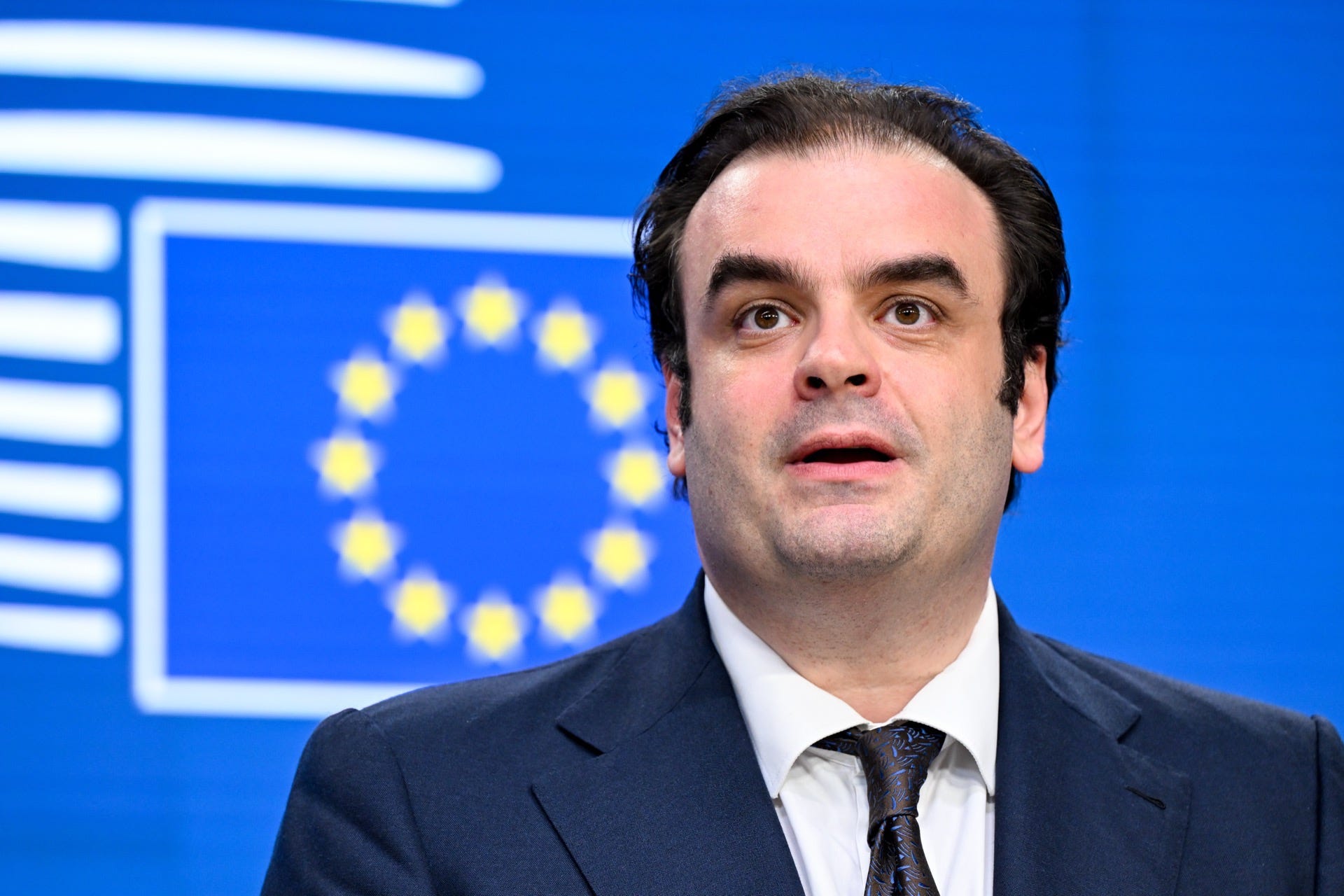
Greece has proposed that EU member states create a European Spectrum Union, channelling part of the proceeds from future national 6G spectrum sales into a common fund for technology investment. Kyriakos Pierrakakis, Greece’s finance minister and President of the Eurogroup, presented the plan to EU ministers on Tuesday, reports Reuters. We should stress that auctions would still remain national. The proposal states: “The potential initial financial scale could be around €12–15 billion... At this stage, this is a planning assumption rather than an official valuation or forecast.”
It joins a long list of candidate revenue sources for the EU’s €2 trillion 2028–2034 budget, all needing unanimous support.
What’s new: Pierrakakis first floated the idea in July. This is the first costed version that has now been put to ministers, treating 6G licences as a partly European revenue source.
Why this matters: Spectrum is now a line in a budget negotiation alongside defence and farming, which changes who has a stake in auction values. In June we noted that the Commission’s draft Digital Networks Act leans towards indefinite licences, a model built to lower the cost of holding spectrum. A fund that depends on proceeds pulls the other way. The €12–15 billion is also an assumption, as the proposal itself admits, for bands whose sizes Europe is still arguing over.
What this means for policymakers: It needs unanimity and reaches into a national competence, so I would certainly not bet on it in this form. But if any version survives, treasuries in Brussels and in national capitals will both want high reserve prices. Operators will read that as a spectrum tax by another name, just as costly 6G investment decisions are being considered.
View source material to read more - Reuters
View source material to read more - Proto Thema
US defence official calls contiguous 6G bandwidth “a really hard problem”
Dr Tom Rondeau, principal director of the US Department of War’s (DoW) FutureG Office, has told Mobile World Live that delivering the wide channels envisaged for 6G is the biggest technical challenge facing regulators and industry. The publication reports that 6G standards work anticipates 400 MHz contiguous downlink channels. Rondeau said:
“How do you get a contiguous 400MHz of bandwidth in any band of spectrum with all the encumbrances it has? It’s a really hard problem...”
He also argued that the military gains from operating across commercial bands. Narrow, predictable military allocations make it easier for adversaries to build jammers.
What’s new: We covered the process change behind this, the OMB memorandum allowing parallel band studies and auction preparation, last week. The new element is a defence official naming contiguity, not total megahertz, as the binding constraint. Rondeau also claims recent conflicts show dense commercial 5G networks resist jamming well.
Why this matters: The congressional mandate counts 800 MHz in total. 6G performance depends on how much of it arrives in single blocks. Of the four federal bands under study, only 7 GHz plausibly offers 400 MHz channels. The figure matches the per-operator floor Verizon’s Yago Tenorio set out earlier this month. Rondeau’s case for military use of commercial bands also implies coexistence, which sits awkwardly with carriers’ push for cleared, exclusive licences.
What this means for 6G standards: Maximum channel bandwidth is not settled. The RAN4 working agreement on bandwidth at around 7 GHz was challenged at RAN #111, with operators wanting to keep studying wider channels. If US mid-band arrives fragmented, aggregation across smaller blocks becomes the practical route, and the US argument for wide carriers loses force.
View source material to read more
Samsung takes both of Korea’s state AI-RAN projects
Samsung Electronics has signed contracts with KT and SK Telecom for their AI-RAN projects under the Ministry of Science and ICT’s “Hyper AI Network” initiative. It is sole global vendor for KT and main vendor for SKT. From October, both projects will deploy 5G Standalone private networks at industrial sites. KT will trial welding and painting robots at HD Hyundai Samho’s Yeongam shipyard. SKT will test a patrol robot streaming video from hazardous areas at SK Incheon Petrochem. Samsung supplies its Network in a Server (NIS) edge platform, running vRAN and core software on an AMD CPU-based server, with GPUs added “as needed”. Jongsik Lee, Executive Vice President at KT, said:
“KT views this project as an important starting point for validating the next-generation communications paradigm where AI and networks converge.”
What’s new: Samsung has worked with each operator separately before, including per-user AI-RAN with KT. This puts both carriers’ state-backed physical AI trials on one vendor’s platform. To be clear, these are 5G private networks. “6G-ready” is Samsung’s description.
Why this matters: The architecture is the interesting part. NIS is CPU-first with optional GPUs, the position Samsung took when it rejected Nokia’s GPU-essential view of 6G in August. Korea’s flagship AI-RAN trials will now test that proposition in live industrial settings, while Nokia builds its GPU customer list. Robotics also gives margin-squeezed Korean operators a use case that might pay.
What this means for the vendor race: Winning both projects gives Samsung a home-market reference and data from real robotics workloads. Contract values are undisclosed and private network trials are a small market. The prize is incumbency when these operators choose 6G RAN suppliers.
View source material to read more
Programmable mmWave chip holds its settings without standby power
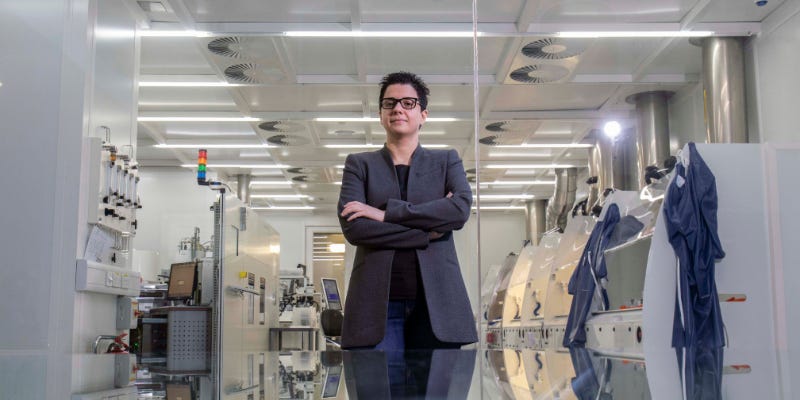
An international team has integrated memristor switches made from multilayer hexagonal boron nitride (hBN), a two-dimensional material, onto gallium nitride (GaN) monolithic microwave integrated circuits (MMICs). The Nature paper demonstrates programmable millimetre-wave attenuators, power dividers and resonators. The switches are non-volatile, so they keep their configuration without drawing power. The authors report operation up to 100 GHz and insertion loss as low as 0.3 dB. Tyndall National Institute at University College Cork announced its contribution this week, alongside KAUST, the National University of Singapore and UTN.BA. Andrés Fontana, Senior Postdoctoral Researcher at Tyndall, said:
“By integrating novel two-dimensional materials with gallium nitride microchips, we have demonstrated a new class of programmable, ultra-low-power devices...”
What’s new: The authors say memristive RF switches had not previously been built into working MMIC circuits. Co-integration on GaN, the dominant material for high-power RF, is the step that matters.
Why this matters: Reconfigurable RF front ends that hold state for free address a real problem as antenna arrays grow for FR3 and sub-THz, and for power-limited satellite payloads. It extends a line of work that includes the MoS₂ memristor switch from UNIST we covered in June. The limits are in the paper: 3,250 switching cycles of endurance and two weeks of state retention. Commercial RF switches must survive vastly more cycles over many years.
What this means for investors: Treat this as a signal of where RF research is heading, not a near-term investment case. The release’s €69.7 billion RF market figure for 2030 is unsourced and describes the whole RF market, not this technology.
View source material to read more - UCC
View source material to read more - Nature
LMT scopes a Latvian hub for satellite and terrestrial 6G
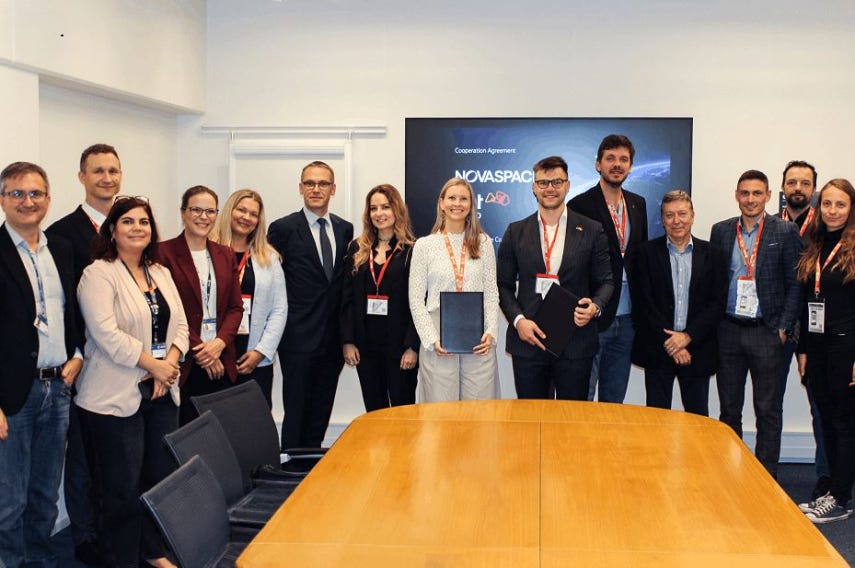
LMT Group and space consultancy Novaspace have agreed to develop the concept for a Latvian 5G/6G terrestrial and non-terrestrial network (TN/NTN) hub, modelled on the European Space Agency’s NTN hub programme. The agreement was signed at ESA’s ESTEC facility in Noordwijk under the EU-funded FIERCE ecosystem-building programme. Novaspace will help LMT define and validate the concept, and identify a regional role that connects to existing European initiatives rather than duplicating them. It builds on LMT’s work with ESA and Sateliot on dual-mode satellite IoT devices. Ingmārs Pūķis, VP and Management Board Member at LMT Group, said:
“As we prepare for the 6G era, integrating satellite communications into our infrastructure and service portfolio is essential.”
What’s new: This is a strategy study, not an actual hub. No funding, site, partner list or timeline has been announced beyond the consultancy engagement.
Why this matters: Small-market operators are using NTN and EU programmes to gain a voice beyond their own subscriber base. LMT joined the SNS JU Advisory Group in August, and it serves defence customers in a region where resilient connectivity has become a security question. 3GPP is treating non-terrestrial access as part of the 6G design rather than an add-on, which gives this kind of positioning some substance.
What this means for operators: For smaller operators, the route into 6G may run through resilience and defence funding and EU programmes rather than consumer revenue. The risk is the one LMT names itself. Europe already has several NTN hubs, and a distinctive role has to be found, not declared.
View source material to read more
Selected research papers published this week
Same-site FR3 coverage more than halves from 6 to 18 GHz
Enrui Liu, Pan Tang, Haiyang Miao, Qi Zhen and Jianhua Zhang measured wideband channels at 13 aligned frequencies between 6 and 18 GHz in an urban macrocell. Path loss rises with frequency, while delay spread falls. Under their baseline configuration, the 80 per cent coverage distance drops from about 129 m at 6 GHz to 58 m at 18 GHz.
Why this matters: This is measured data on the question behind “golden band” claims: how much of the band works from existing sites. The absolute distances depend on the assumed service and link budget, so read the relative decline rather than the metres. With last week’s beam management paper, it suggests the upper half of FR3 will behave more like a small-cell layer.
View source material to read more
Splitting uplink and downlink sites to balance sensing and communication
Gangyong Zhu, Xiang Cheng, Quan Yu and colleagues examine De-Coupled RAN (DC-RAN), where downlink transmitting and uplink receiving sites are deployed separately and coordinated. They propose communication-sensing coverage symmetry as a way to judge whether both services are available in the same places, and use two case studies to show consistent communication and continuous sensing.
Why this matters: Most ISAC trials reuse co-located sites, although the Samsung sensing receiver in Verizon’s Dallas trial was effectively a separate receive node. This is a conceptual article with illustrative case studies, not a deployment result. Decoupling also means more sites and tighter synchronisation, costs operators have so far resisted.
View source material to read more
Inter-agent chatter is cheap, the inference it triggers is not
Carolina Fortuna, Vid Hanžel, Tim Strnad and Blaž Bertalanič extend their Energy Cost of AI Lifecycle (eCAL) metric to multi-agent workflows. Using hundreds of benchmark configurations on NVIDIA A100 and H100 GPUs, 16 open-weight models and eight orchestration topologies, they find inter-agent text transport accounts for about 0.25 per cent of workflow energy across 5G RAN, metro and optical links.
Why this matters: Operators planning agentic network operations need to decide where agents run. This result says the placement question is about the extra inference and context processing that distribution causes, not bytes on the wire. With agent interfaces now on the SA #113 agenda, that is a useful corrective to edge-first assumptions.
View source material to read more
An early test of Jev for 6G edge decisions
Jev, TypeSafe AI’s decision model that only launched on 15 September, returns structured answers rather than text and has been all over AI developer circles. Delong Li and colleagues have already used it to turn service intents into contracts that a numerical scheduler executes, combined with packet-level New Radio simulation. Jev cut median decision latency by 22.4 per cent against DeepSeek and 61.9 per cent against Gemini.
Why this matters: Interpretation eats into the same deadline as transmission, so speed counts. But in the real image service Jev completed 459 of 1,080 requests correctly and on time, against 463 for DeepSeek. The more durable finding is that numerical scheduling beat letting the model choose placement. This evaluation appeared four days after launch, so treat it as very early. Expect similar studies to follow.