


6G news and analysis for the week ending Friday, 13th February, 2026.
The 6G standards machine shifted up a gear this week as 3GPP convened simultaneous working group meetings of all its technical specification groups (TSGs) - RAN, CT and SA. In Gothenburg, over 1,500 RAN experts continued progress on Release 20, with the first two 6G radio study items now well underway. In Goa, around 800 delegates from 240 companies tackled service requirements, system architecture and security for 6G.
India’s role in the 6G narrative was further underscored by the New Delhi Declaration, adopted at the Bharat 6G Symposium 2025. While the declaration is aspirational rather than technical, the range of co-signatories, from Europe’s 6G-IA to Japan’s XGMF and Korea’s 6G Forum, signals genuine international coordination beyond bilateral deals. This builds on the India-EU 6G partnership announced earlier this month.
Elsewhere, Shanghai provided a glimpse of China’s 6G industrial strategy, with the 6G AI-Valley in Songjiang district now housing over 50 companies working across the value chain. And on the research front, this week’s papers tackle some of the foundational technical questions for 6G, including how to model radio channels in the critical 7–24 GHz band, whether alternative waveforms can outperform OFDM for satellite communications, and how to benchmark AI reasoning for network-level decision-making.
Key announcements this week
3GPP advances 6G work on two continents
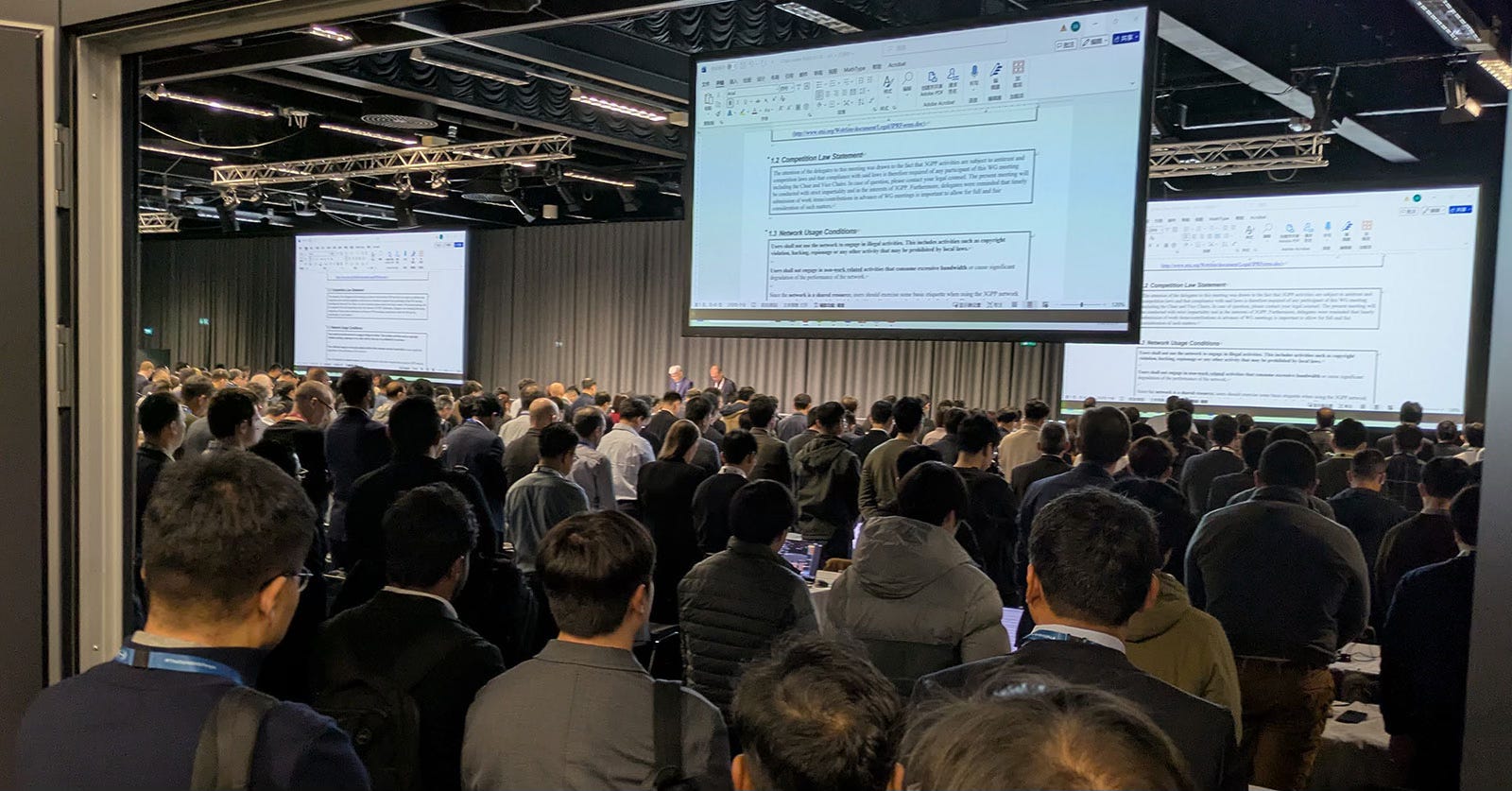
3GPP convened parallel working group meetings this week in Gothenburg, Sweden, and Goa, India. In Gothenburg, over 1,500 RAN experts continued work on Release 20, with the two initial 6G RAN study items progressing steadily. The first, the 6G Scenarios and Requirements study, will produce the plenary-level report TR 38.914, expected by mid-2026. The second, running in Working Group RAN1, explores the potential for a new “6GR” access technology, with completion targeted for early 2027. Release 19 is now complete and subject only to maintenance.
In Goa, India’s TSDSI hosted around 800 delegates from 240 companies across 55 countries for the TSG CT and TSG SA working groups. Discussions focused on 5G-Advanced specification maturity alongside the first 6G studies covering use cases, service requirements and system architecture. Several specialist working groups kicked off their 6G efforts, including security (SA3), media aspects (SA4), management and orchestration (SA5), and application enablement (SA6).
What’s new: The simultaneous activation of 6G studies across RAN, SA and CT working groups marks a significant broadening of the standardisation effort. The 6GR radio study in RAN1 is particularly notable, as it will determine whether 6G requires a fundamentally new access technology or an evolution of 5G NR. The Goa meetings also saw SA3, SA4, SA5 and SA6 begin their 6G study items for the first time.
Why this matters: These parallel meetings demonstrate that 6G standardisation is no longer confined to a handful of study items in the radio domain. The engagement of security, media, management and application enablement groups means that system-level 6G design is now active across 3GPP. The study outputs will form the foundation for normative 6G specifications in Release 21, expected to commence in mid-2026.
Implications for 6G standards: The TR 38.914 report due mid-2026 will establish the definitive set of 6G scenarios and requirements against which all subsequent technical work is measured. The parallel RAN1 study on 6GR will determine the scope of air interface innovation for 6G. The SA and CT studies now underway will shape everything from network architecture to charging models.
View source material to read more
Also: 3GPP Working Groups in Goa
New Delhi Declaration sets 6G principles
The Government of India has reinforced its 6G ambitions through the New Delhi Declaration, adopted at the Bharat 6G Symposium 2025. Signatories include the Bharat 6G Alliance, 6G-IA (Europe), the NextG Alliance, ATIS (North America), Japan’s XGMF, South Korea’s 6G Forum, 6G Brasil, the UK-India Future Networks Initiative, UK TIN, UK Federated Telecoms Hubs and the University of Oulu’s 6G Flagship. The declaration positions 6G as “a global public good.”
Minister of State for Communications, Pemmasani Chandra Sekhar, confirmed the declaration was endorsed by a broad coalition of international 6G organisations. He stated:
“The endorsed principles for 6G networks include being trusted and secure, resilient and reliable, open and interoperable, inclusive and affordable, and sustainable.”
What’s new: This is the first multi-lateral declaration to assemble representatives from virtually every major regional 6G initiative under a single set of principles. The breadth of signatories, spanning Asia, Europe, North and South America, distinguishes it from bilateral agreements.
Why this matters: The declaration aligns perspectives on global standardisation activities, including 3GPP and ITU, and promotes interoperability. India’s TSDSI is a 3GPP Organisational Partner with 54 member companies. However, declarations of principle are not the same as technical contributions. The real test of India’s 6G influence will be measured in standards contributions, patent filings and the upper 6 GHz spectrum allocation decision, which remains pending. As noted in previous editions, India’s ambition is genuine but persistent challenges remain, including uneven 5G rollout and lower R&D expenditure than leading 6G nations.
Implications for 6G standards: The emphasis on “open and interoperable” aligns with the broader industry push for reduced optionality and simplified specifications captured in multiple 3GPP 6G Workshop submissions. The coordination between signatories could help build pre-standards consensus on contentious issues such as spectrum harmonisation and AI governance frameworks.
View source material to read more
Shanghai builds 6G industrial cluster

China’s state media People’s Daily reports that Shanghai’s 6G AI-Valley Future Industry Park in the Songjiang district has assembled over 50 companies working across the 6G value chain. The park, designated as the core zone for building a 6G future industry cluster, houses firms developing satellite controllers, AI glasses with embedded 6G chip modules, and a satellite internet test and verification platform. Jin Jun, chairman of the 6G AI-Valley, said:
“If 5G accelerated information flow by clearing ‘blood vessels’, 6G constructs a ‘nervous system’.” The park’s model enables companies to “develop downstairs, verify upstairs, pilot in the park, and manufacture locally.”
What’s new: The park includes a rooftop satellite internet test and verification platform that maintains live links to satellite signals, enabling end-to-end testing from development through to in-orbit integration. Companies are co-developing AI glasses with brain-computer interface technology (worth stating that such technology is in the very earliest research phase). Shanghai’s plan targets becoming one of China’s first cities with full 6G commercial deployment by 2030 - although “full” is doing a lot of heavy lifting here.
Why this matters: While much 6G coverage focuses on standards bodies and research labs, Shanghai’s approach represents a deliberate industrial policy to create vertically integrated 6G ecosystems. The co-location of satellite testing, device prototyping and chip development in a single complex mirrors the “develop, test, deploy” pipeline that accelerated China’s 5G rollout. China’s 6G patent portfolio already leads globally, and this type of infrastructure converts research advantage into commercial capability. However, the 2030 commercial target should be treated cautiously, given that 3GPP Release 21 (containing the first normative 6G specifications) is unlikely to be complete before late 2029.
Implications for 6G standards: China’s investment in satellite-terrestrial integration infrastructure aligns with 3GPP’s NTN work and the country’s broader push for space-air-ground convergence. Chinese companies including Huawei, ZTE and China Mobile are among the most prolific 3GPP contributors, and facilities like this provide the testing environment to support their standards contributions.
View source material to read more
SynaXG and Tech Mahindra target AI-Native RAN
SynaXG and Tech Mahindra have signed a Memorandum of Understanding to jointly develop and deploy AI-native, software-defined wireless network solutions. The collaboration combines SynaXG’s RAN software stack and AI-RAN intelligence platform with Tech Mahindra’s network services and carrier-grade deployment capabilities. Abhishek Malhotra, Global Business Head of Network Services at Tech Mahindra, said:
“AI-native RAN architectures will become foundational.” Mantosh Malhotra, Chief Business Officer at SynaXG, described AI-RAN as “a fundamental shift in how wireless networks are designed, deployed, and operated.”
What’s new: The partnership targets both operator and enterprise environments, with specific focus on private networks and industry-specific use cases across manufacturing, logistics, smart cities and critical infrastructure. The agreement covers co-innovation, integration and commercialisation of AI-enhanced RAN solutions addressing network performance, spectrum efficiency and power consumption.
Why this matters: AI-RAN partnerships continue to proliferate as the industry builds the commercial ecosystem around AI-native network architectures. Tech Mahindra brings scale through its global delivery capabilities and existing relationships with major operators. The focus on energy efficiency and closed-loop automation reflects the operational priorities that operators have consistently identified, including in their 3GPP 6G Workshop submissions. However, an MoU is an agreement to collaborate rather than a product announcement, and the practical outcomes remain to be demonstrated.
Implications for 6G standards: AI-native RAN is increasingly positioned as foundational infrastructure for 6G rather than an enhancement. The work on AI-driven spectrum efficiency and autonomous network optimisation aligns with active 3GPP Release 20 study items on AI/ML for RAN. However, the translation from vendor-specific implementations to interoperable, standardised specifications remains the central challenge.
View source material to read more
Tampere targets near-flawless 6G reliability
Tampere University in Finland has profiled the work of Assistant Professor Syed Mohsin Abbas, who is developing hardware architectures for ultra-reliable, low-latency communication (URLLC) systems targeting 6G. His research focuses on GRAND (Guessing Random Additive Noise Decoding), a universal decoding technique that identifies and subtracts noise patterns rather than relying on code-specific decoders. Abbas explained:
“We have so many different channel coding techniques, and all of them have their own unique decoding methods. However, there is a different paradigm called Universal Decoding, which can be used to decode any kind of code.”
What’s new: Abbas is also exploring In-Compute Memory architectures that embed computational logic directly within memory storage, eliminating the energy-intensive data shuttling between CPU and memory. He argues this is critical for integrating AI into the communication stack without prohibitive power consumption. The research sits within Tampere’s System-on-Chip Hub, a consortium between academic teams and Finnish companies including Nokia.
Why this matters: Reliability, not speed, is increasingly recognised as the defining technical challenge for 6G. Applications such as remote surgery and autonomous vehicles require error rates orders of magnitude better than current networks can deliver. GRAND’s hardware-friendly approach to universal decoding could simplify receiver design while meeting stringent latency requirements. The In-Compute Memory work addresses the power consumption challenge that AI integration poses for mobile devices and base stations. Abbas’s observation that LDPC codes were proposed in the 1960s but only adopted in 5G standards in 2017 is a useful reminder of how long fundamental research can take to reach commercialisation.
Implications for 6G standards: URLLC has been a 3GPP design philosophy since Release 15 (5G), and multiple 6G Workshop contributors have called for enhanced reliability as a core 6G requirement. Hardware-efficient decoding and power-aware computing architectures will be essential for meeting the more stringent performance targets expected in Release 21.
View source material to read more
Selected research papers published this week
3GPP Rel-19 channel modelling tutorial for 6G FR3
Researchers including Pan Tang and Guangyi Liu have published a comprehensive tutorial on the 3GPP Release 19 channel model for the 7–24 GHz band, designated Frequency Range 3 (FR3). The paper bridges the gap between standardisation specifications and simulation implementation, covering the new Suburban Macro (SMa) scenario, modelling of Extremely Large Aperture Array (ELAA) features including near-field effects and spatial non-stationarity, and recalibrated large-scale parameters.
Why this matters: The 7–24 GHz band is widely expected to be the primary new spectrum for early 6G deployment, frequently referred to as the “golden band.” Accurate channel models are essential for realistic system design and performance evaluation. The legacy 3GPP TR 38.901 model faces validity challenges at these frequencies, particularly when combined with the large antenna arrays that 6G will require. This tutorial provides the practical implementation guidance that researchers and engineers need to work with the updated Rel-19 model.
View source material to read more
AFDM positioned as evolutionary 6G waveform
A research team has presented Affine Frequency Division Multiplexing (AFDM) as a candidate waveform for 6G that maintains high compatibility with the legacy OFDM architecture used in 4G and 5G. The paper demonstrates that AFDM reuses nearly the entire OFDM transceiver pipeline, requiring only lightweight digital pre- and post-processing, while providing intrinsic robustness for high-mobility communications and integrated sensing and communication (ISAC).
Why this matters: Waveform selection is one of the most consequential decisions in 6G radio design. Several 3GPP 6G Workshop contributors, including Cohere Technologies and ESA, have called for new waveforms beyond OFDM, particularly for NTN and high-mobility scenarios. AFDM’s claim of near-complete OFDM reuse while adding Doppler resilience and ISAC capability makes it a low-risk evolutionary path. The paper’s analysis of hardware impairments such as phase noise adds practical value.
View source material to read more
NTN waveform comparison for LEO satellite channels
Researchers have compared the performance of three beyond-OFDM waveforms, OTFS, AFDM and OCDM, in LEO satellite channels using 3GPP TR 38.811 NTN channel models. AFDM and OTFS consistently outperformed OCDM across all tested models, while AFDM showed an advantage over OTFS in specific channel conditions at high signal-to-noise ratios. The simulation framework has been released as open-source code.
Why this matters: Non-terrestrial networks are a central pillar of 6G architecture, and the extreme Doppler shifts in LEO satellite channels push conventional OFDM to its limits. This paper provides the first systematic, standards-aligned comparison of the leading candidate waveforms for NTN, using 3GPP-specified channel models. The open-source release enables independent validation and further development.
View source material to read more
6G-Bench: Benchmarking AI for network reasoning
Mohamed Amine Ferrag, Abderrahmane Lakas and Merouane Debbah have introduced 6G-Bench, an open benchmark for evaluating foundation models on semantic communication and network-level reasoning tasks aligned with 6G standardisation activities. The benchmark defines 30 decision-making tasks extracted from ongoing work in 3GPP, IETF, ETSI, ITU-T and the O-RAN Alliance, with 3,722 validated evaluation questions. Testing across 22 foundation models revealed wide variation in reasoning capability.
Why this matters: As AI-native architectures become central to 6G, the question of whether foundation models can perform reliable network-level reasoning becomes critical. The benchmark’s alignment with real standardisation activities, rather than synthetic tasks, provides a practical measure of AI readiness. The finding that model accuracy spans from 0.22 to 0.82 highlights the gap between AI hype and operational capability.
View source material to read more
Hexa-X-II maps 6G security and resilience controls
The EU’s Hexa-X-II 6G Flagship project has published a summary of the security, privacy and resilience (SPR) controls identified for the 6G end-to-end system, along with their validation frameworks. The project, part of the Smart Networks and Services Joint Undertaking (SNS JU), plays a leading European role in developing 6G technologies.
Why this matters: Security by design is a recurring theme in 6G development, with 3GPP SA3 already beginning its 6G security studies. The Hexa-X-II project provides a structured European perspective on the security controls that 6G systems will need. The validation framework component is particularly valuable, as it moves beyond listing threats toward testing defences.
View source material to read more
6G robotics framework maps IMT-2030 to autonomous systems
Researchers have proposed a systematic mapping of IMT-2030 key performance indicators to robotic functional blocks, covering sensing, perception, cognition, actuation and self-learning. The paper presents a high-level architectural framework integrating robotic, intelligent and network service planes, with a use case demonstrating real-time dynamic safety for human-robot collaboration.
Why this matters: Robotics is one of the use cases most frequently cited in 6G requirements discussions. This paper provides the structured mapping between what 6G networks are designed to deliver (the IMT-2030 KPIs) and what autonomous robotic systems actually need. The human-robot collaboration safety framework addresses a concrete deployment scenario rather than abstract performance targets.